Three Workers a Week Are Dying on the Job in Portugal, and an Unlicensed Sintra Site Just Added Two More
The labour inspectorate's count puts 81 workplace deaths in 2026 so far, after 160 last year: the worst run since 2015. On Wednesday a crane came down on a Belas site that had no licence to occupy the road, killing two painters.
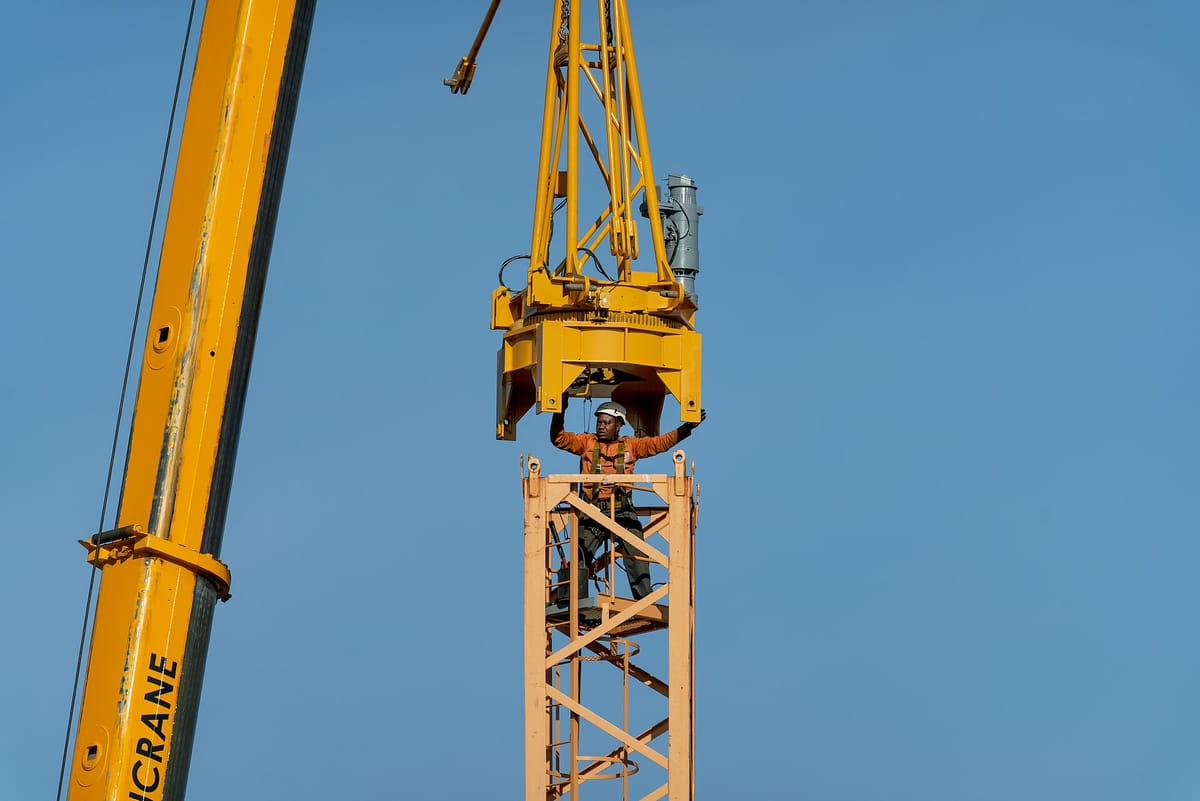
Portugal is burying roughly three people a week who left home to go to work. Jornal de Notícias led its 20 August front page with that figure, drawn from the Autoridade para as Condições do Trabalho (ACT), and the arithmetic behind it is bleak: 81 workers have already died on the job in 2026, after 160 deaths last year against 124 in 2024. On the ACT's own count, that makes 2025 the deadliest year since 2015, when 161 died.
The abstraction acquired a street address on Wednesday morning. Shortly after 8am, a crane collapsed onto Rua Dona Inês de Castro in the parish of Belas, in the municipality of Sintra, killing two Brazilian workers, aged 28 and 40, who were painting a building. They fell the equivalent of about six storeys.
A site that should not have been operating
Sintra's câmara municipal has since confirmed that the works had no licence to occupy the public road, and that the company running them never notified the municipality before starting. A municipal source said the infractions detected would be written up and sent to the Ministério Público to accompany the investigation already under way. Sintra's mayor put it plainly: this kind of work has rules, and the rules must be followed.
That combination, an unlicensed site and a fatal collapse, is the pattern the statistics keep describing. Construction remains the sector with the most fatal accidents in Portugal, and it is also the sector with the highest concentration of subcontracting, short contracts and migrant labour, all of which make oversight harder and make workers less likely to complain about a scaffold that looks wrong.
Two counts, one problem
Readers who follow these numbers will notice they do not match the official statistical series. Portugal's national accident statistics recorded 120 fatal workplace accidents in 2024, an 11.8% fall on the year before, with construction accounting for about a third of them. The ACT's register, which counts the deaths the inspectorate is notified of and investigates, runs slightly higher and is more current. The two series answer different questions; neither is flattering.
What has changed is the direction of travel. The improvement recorded in 2024 has been reversed, and Portugal was already above the EU average for workplace deaths when the ACT launched its two-year safety strategy in July. That strategy leans on inspection campaigns in high-risk sectors and on employer awareness. Its first full test is arriving in the middle of a construction boom.
Why the boom matters
Building activity is running hot. Labour costs rose 5.4% in the second quarter, led by construction pay, which is what happens when contractors compete for scarce crews. More sites, more pressure to finish, more people new to the work: the ingredients of a rising toll are all present.
For anyone commissioning building work in Portugal, from a full self-build to a façade repaint, the Sintra case is a reminder that licensing is not paperwork for its own sake. The municipal permit to occupy the pavement is the step at which someone official looks at how the equipment will be anchored. Two men died because nobody took it.