Portugal Declares a National Public Interest in Assembling Embraer's Super Tucano, and Points at Beja Air Base
The Council of Ministers approved a deliberation on Thursday recognising the national public interest in a final assembly line for the A-29N Super Tucano, naming Air Base No. 11 at Beja as the intended site under conditions. No investment figure or job count has been published.
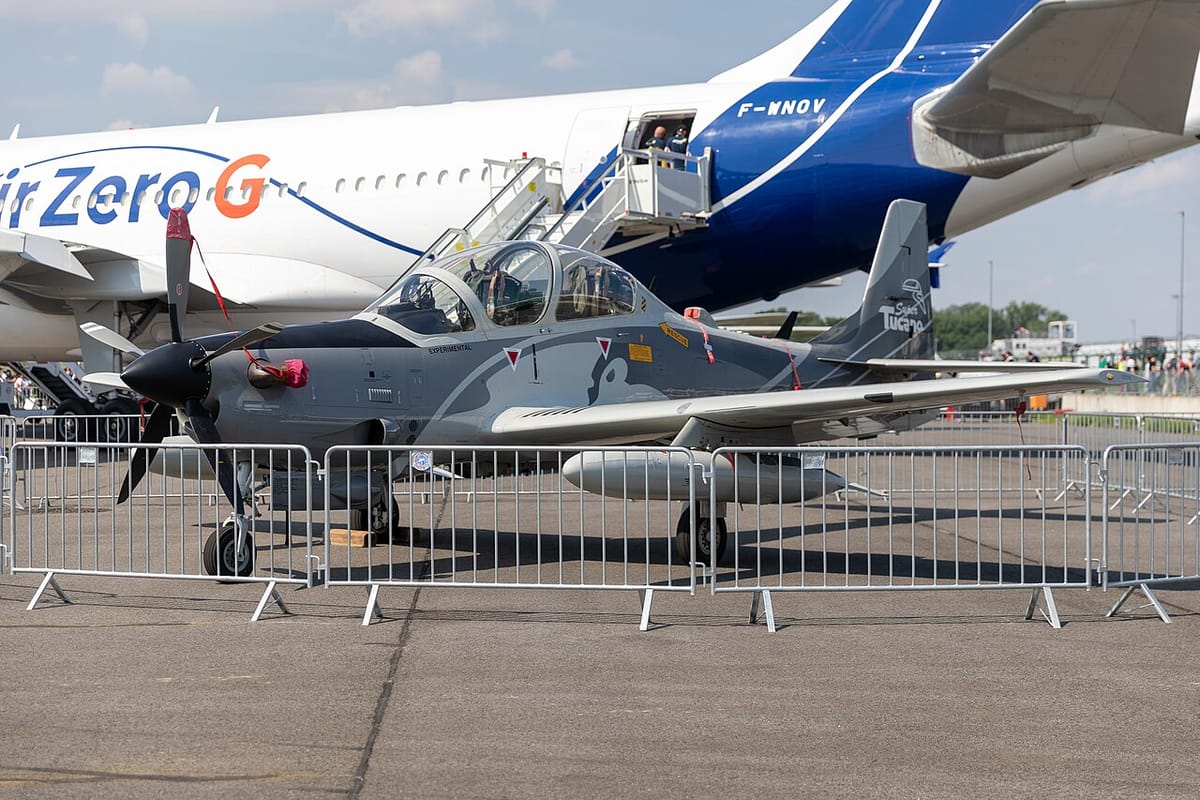
Portugal's Council of Ministers has formally declared that assembling Embraer's A-29N Super Tucano in Portugal is a matter of national public interest, and named the Base Aérea n.º 11 (Air Base No. 11) at Beja as the intended site, subject to conditions. The deliberation, approved on Thursday 20 August at the Prime Minister's official residence, is the clearest legal step yet in a project that has been circling the Alentejo for two years: a final assembly line for a military aircraft, built on Portuguese soil, in a district that has spent a decade looking for an industrial anchor.
What the Cabinet actually approved
The wording of the communiqué is precise and deliberately narrow. Ministers approved "a Deliberation of the Council of Ministers recognising the national public interest in the installation of a final assembly line for A-29N Super Tucano aircraft in Portugal, and in particular and under certain conditions, at the premises of Air Base No. 11, in Beja."
Two things are worth reading closely. The first is the instrument: a deliberação, not a contract and not a spending decision. Recognising national public interest is an administrative unlocking device. In Portuguese practice it eases the path through licensing, land use and the reallocation of state property, and it signals to every downstream authority that the project carries government backing. It does not, on its own, commit a single euro or bind Embraer to build anything.
The second is the hedge. "In particular and under certain conditions" is the Cabinet reserving room: Beja is the intended location, but the declaration covers the assembly line "in Portugal" first and the air base second. Earlier reporting has pointed to land adjacent to the civilian terminal at Beja as an alternative footprint within the same site.
How the project got here
The chain starts with a purchase. On 16 December 2024, at OGMA's plant in Alverca, the Defence Minister Nuno Melo signed a contract with Embraer for twelve A-29N Super Tucano aircraft, an investment of roughly €200 million that also covers a flight simulator and the logistics and sustainment programme behind the fleet. The government said at the time that about €75 million of that would flow back into Portuguese industry, through the firms reconfiguring the aircraft to NATO technical and operational standards.
That reconfiguration is the strategic hinge. The A-29N is the NATO-facing variant of a light attack and advanced-training turboprop already flown by air forces across Latin America, Africa and Europe. Doing the NATO adaptation in Portugal was pitched as a way to make the country a reference point for other alliance and EU buyers, with foreign pilot training to follow. Melo argued that Portugal would end up with "the equipment, developing Portuguese industry, anchoring much of the investment in Portugal, and in training" as well.
Embraer is not a stranger here. The Brazilian manufacturer controls a majority of OGMA (Indústria Aeronáutica de Portugal), the Alverca maintenance and manufacturing house, and it already builds structural parts for the KC-390 military transport in Portugal alongside an engineering centre. In December 2025 the Defence Ministry and Embraer signed a letter of intent for an aircraft factory in the country. In April 2026 Melo said the government was taking "large steps" towards Beja and expected to close the file by the end of the year. Thursday's deliberation is the administrative expression of that timetable.
Why Beja
Beja has runway, airspace and very little else competing for either. The air base sits beside a civil airport that has struggled for scheduled traffic almost since it opened, in a district with the thinnest population density on the mainland and an economy still dominated by agriculture. Successive governments have tried to convert that spare capacity into aeronautical maintenance, cargo or training work with mixed results.
A final assembly line would be a different order of commitment: a fixed industrial installation with a long production tail, in a place where the Cabinet has repeatedly staged its Alentejo announcements. Neither the communiqué nor the government's earlier statements attach a headline investment figure or a job count to the Beja line, and until the conditions attached to the deliberation are published, the scale is unknown.
The wider defence build-out
This lands inside a much larger rearmament cycle. Portugal cleared NATO's 2% of GDP spending bar and has been courting foreign capital for its defence industrial base ever since. In July it ordered three Italian-built frigates for €3.9 billion, its first purchase under the EU's SAFE facility, with the ministry promising a "notable" economic payback in domestic contracts.
Those promises are exactly what the Super Tucano line would have to make real. The frigate deal has drawn sustained scrutiny over price and process, and a transparency watchdog has faulted the oversight around the country's €5.8 billion EU defence loan as largely after the fact. On the government's own numbers, defence-linked industry in Portugal already accounts for around 300 companies, 30,000 people and 2.5% of exports. A Beja assembly line is the test of whether procurement euros convert into that industrial base rather than simply leaving the country.
What this means for foreign residents
- Alentejo jobs, eventually: If the line proceeds, the hiring will be for aeronautical engineering, quality assurance, avionics and skilled assembly work in a district that currently exports its graduates. Nothing is advertised yet, and any recruitment is years rather than months away.
- Property around Beja: Treat any estate-agent pitch built on "the new aircraft factory" with caution. A recognition of public interest is not a signed investment, and no figures for capacity, headcount or start date have been made public.
- Brazil to Portugal ties deepen: Embraer's expanding Portuguese footprint sits alongside a broader Brazilian corporate and migratory presence. Portuguese-Brazilian aeronautics has been a standing item at the top of bilateral summits.
- Watch the fine print: The conditions attached to the deliberation matter more than the headline. They will govern the use of military land, the environmental and licensing route, and what the state expects in return.
The Defence Minister set an end-of-2026 target for closing the project, with the physical adaptation of the site to follow. Between now and then, the questions that matter are the ones Thursday's text does not answer: how much Embraer invests, how many people the line employs, and what happens to the declaration if the company chooses a different site or a different country. For now, Portugal has said yes in principle, and pointed at a runway in the Alentejo. On the Portuguese industrial-investment tape, our report on SRAM breaking ground on a third Coimbra factory, a 57.5 million euro project carrying 527 contracted jobs and 16.9 million euros of state support, due to open in the middle of 2028 sets the latest reference.