Brussels Ranks Portugal Second in the EU for Rising Net Emissions in 2025, and Points to Its Forests and Land Rather Than Its Power Plants
Portugal's net greenhouse gas emissions rose 4.2 percent in 2025 while the EU's fell 1.6 percent, the Commission's climate progress report says, with the land sector the main driver. Portugal also went over its 2025 effort-sharing limit but stays ahead for 2030.
Portugal's net greenhouse gas emissions rose by 4.2 percent in 2025, the second-largest increase in the European Union after Italy's, according to the 2026 EU Climate Action Progress Report that the European Commission published on Monday. Across the EU, net emissions fell by 1.6 percent.
The Commission puts most of Portugal's rise down to the land sector rather than to power stations, cars or homes. In its words, changes in land use, land-use change and forestry (LULUCF, the sector that counts the carbon that forests and soils absorb or release) were "the primary driver behind emission increases in Italy, Portugal, Romania and Hungary".
Where Portugal sits in the EU table
The figures are provisional. They compare the European Environment Agency's 2026 inventory for 2024 with each country's approximated inventory for 2025. On that basis, the report (pages 16 and 17) finds that:
- 19 Member States cut their net emissions in 2025. The largest falls were in Slovenia (13.7 percent), Sweden (11.3 percent), Bulgaria (7.4 percent), Finland (6.3 percent), Denmark (6.0 percent) and France (5.5 percent).
- Eight recorded an increase. The largest rises were in Italy (5.8 percent), Portugal (4.2 percent) and Spain (2.2 percent), followed by smaller increases in Romania, Hungary, Austria, Belgium and the Netherlands.
- The EU as a whole is now 39 percent below its 1990 emissions, while its economy has grown by 74 percent over the same period, the Commission says in its press release.
"Net" means emissions minus what the land absorbs, so a weaker carbon sink in forests pushes the figure up even when nothing changes in factories or on the roads. That is why this figure differs from the estimate of the Commission's Joint Research Centre in September, which counted emissions alone and put Portugal's 2025 rise at 1.6 percent, mostly from gas-fired power and industry. Portugal had cut its emissions for a fourth straight year in 2024, according to the national statistics institute.
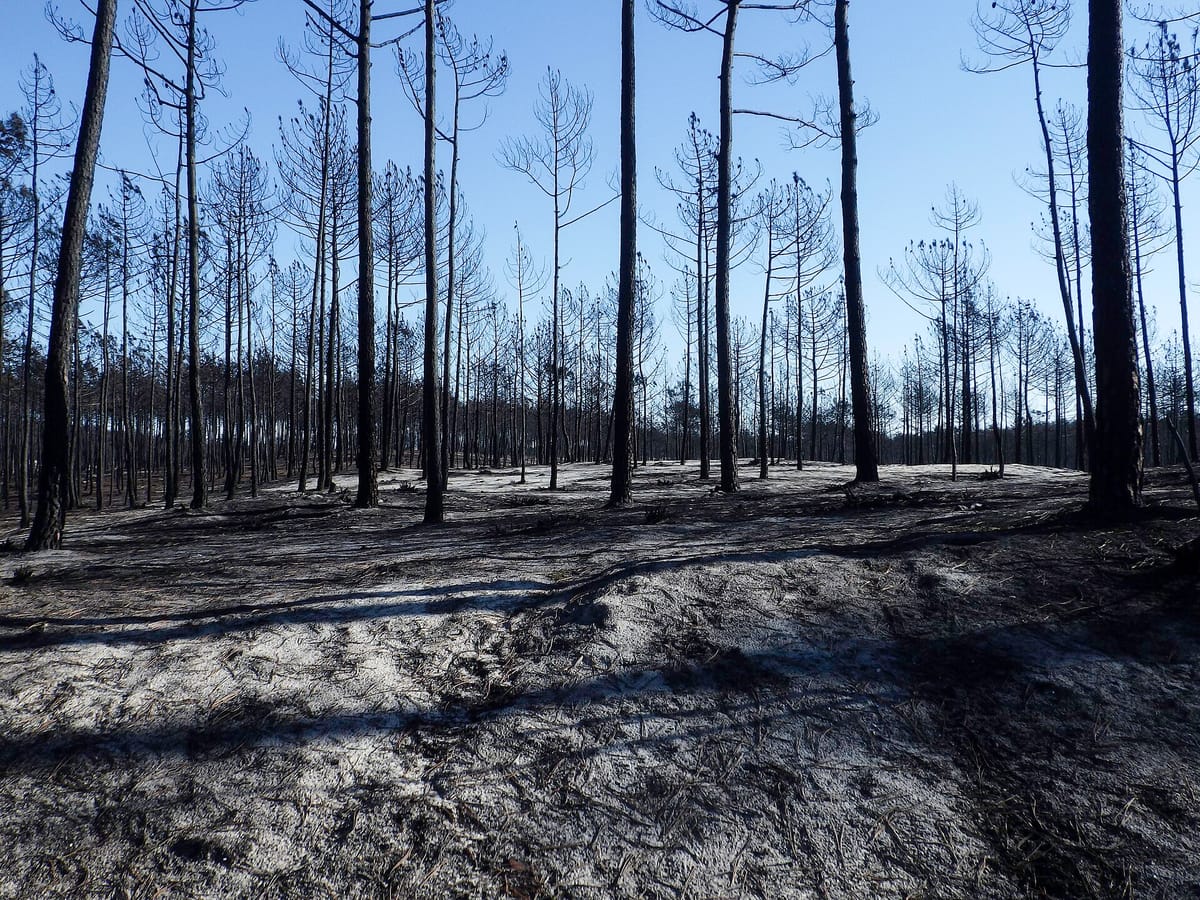
The report does not say what changed in Portugal's land sector. It does say that 2025 was an exceptional fire year: the burnt area in Europe passed one million hectares, "in large part due to fires on the Iberian Peninsula in August", and fire emissions in Europe reached a record high. Copernicus data put Portugal's burnt area at about 284,000 hectares in 2025; this year's was less than a third of that.
A land-sector debit that will need settling
The staff working document that accompanies the report shows the forest and land accounts in more detail. For the first compliance period, each country must not let its land sector become a net source of accounted emissions (the "no-debit" rule). On the preliminary figures for 2021 to 2024, Portugal shows a cumulative debit of 51.2 million tonnes of CO2 equivalent. Only Germany (129.4 million) and Finland (115.0 million) show larger ones; the EU as a whole is in credit by 49.6 million.
The Commission stresses that the figure is not final. Countries keep revising their inventories, some benchmarks such as forest reference levels will have to be updated, and flexibilities exist, including one for natural disturbances such as fires. Those have to be applied before the compliance check for 2021 to 2025. Under the rules, any debit still left after every flexibility is moved onto the country's effort-sharing account.
Over the 2025 limit, but ahead for 2030
The Effort Sharing Regulation sets each country a falling yearly limit for the emissions outside the main carbon market, including domestic transport, buildings, agriculture and waste. Based on the approximated data, 18 Member States went over their 2025 limit, and Portugal is one of them. Its tables show:
- 2024: emissions of 39.6 million tonnes against an allocation of 39.3 million.
- 2025: emissions of 39.1 million tonnes against an allocation of 38.5 million, about 1 percentage point above the path to its target.
- Banked surplus: because Portugal was under its limits in 2021 to 2023, it still had a cumulative balance of 3.6 million tonnes at the end of 2025, so the overshoot is covered for now.
The outlook is better. Portugal must cut these emissions by 29 percent from 2005 levels by 2030. Its own projections put the cut at 30 percent with the measures already in place and 40 percent if the planned measures go ahead. The report names Bulgaria, Greece and Portugal as the countries showing the largest overachievement of their 2030 targets. Portugal is not among the nine (Austria, Croatia, Cyprus, Germany, Italy, Ireland, Lithuania, Malta and Sweden) that the Commission will ask for a corrective action plan.
What Portugal did with its carbon-market money
The Commission also published its Carbon Market Report. Portugal raised 546.0 million euros in 2025 from auctioning allowances under the EU Emissions Trading System (ETS), according to the technical annex. The system raised 43.2 billion euros across the EU in 2025. Portugal's revenue was used like this:
- 50.0 million euros compensated energy-intensive industry for the carbon cost built into electricity prices, double the 25.0 million of the year before.
- 496.0 million euros was left for climate and energy purposes. Portugal reported 92 percent of it as spent and carried the rest over. All of it goes through the Fundo Ambiental (Environment Fund).
- The largest single use was 307.8 million euros for renewable electricity, paid to E-REDES through the compensation mechanism of the national electricity system.
- 52.7 million euros went to the expansion of the Porto metro and 16.8 million to the Lisbon metro, including new trains.
A second carbon market, covering fuel for buildings and road transport, is due to start in 2028. Portugal has already sent Brussels a 1.6 billion euro plan to help low-income homes face it.
"The EU's emissions continue to fall and use of clean technologies is expanding across the economy. But the climate crisis is accelerating too," said Wopke Hoekstra, the Commissioner for Climate, Net Zero and Clean Growth.