Portugal Cut Greenhouse Gas Emissions for a Fourth Straight Year in 2024 While Its Economy Expanded, INE's Accounts Show
Emissions fell 2.8 percent to 52.0 million tonnes in 2024 as GDP grew 2.7 percent, a fourth straight year of decoupling and a first since 1995. A collapse in gas-fired power did the work; air transport and household fuel use went the other way.
Portugal's greenhouse gas emissions fell for the fourth year running in 2024 while the economy kept growing, something that had never happened before in a data series that starts in 1995. The figures come from the air emissions accounts published on 15 October by the Instituto Nacional de Estatística (INE, Statistics Portugal).
Emissions totalled 52.0 million tonnes of carbon dioxide equivalent in 2024, down 2.8 percent on 2023 and the lowest figure in the series. Gross domestic product grew 2.7 percent at market prices over the same year. Put together, the carbon intensity of the economy fell 5.4 percent to 0.21 kilograms of CO2 equivalent per euro of GDP, also a record low. INE puts the fall in intensity since 2017 at 38.9 percent.
Electricity did the heavy lifting
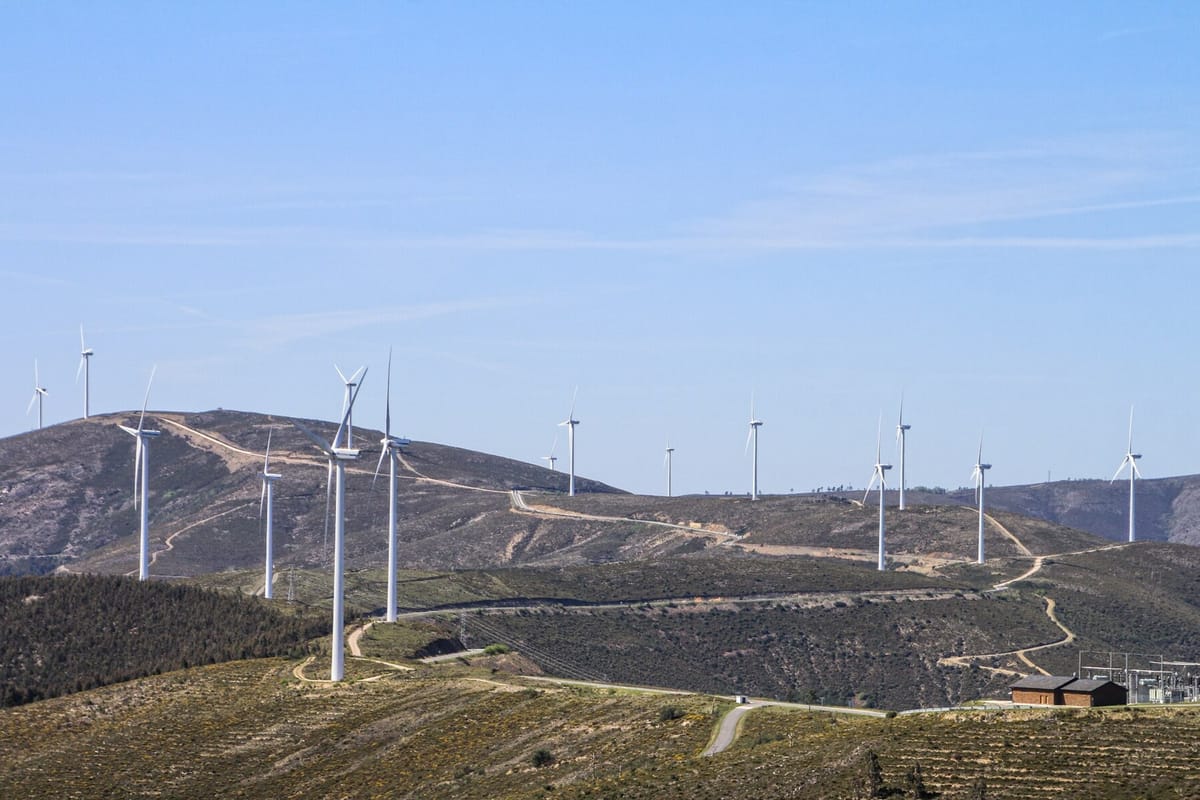
Carbon dioxide, mostly from burning fossil fuels, made up 70.6 percent of the total and fell 3.7 percent. INE links that to power stations burning less fuel: according to its press release, electricity from renewable sources rose 18.5 percent to a record, with hydro up 25.1 percent, solar up 37.4 percent and wind up 9.7 percent, while output from gas-fired power stations fell 45.9 percent. This happened even though, as INE notes, 2024 was classified as a very hot and dry year in mainland Portugal.
The industry tables show how much rests on that one sector. By our arithmetic from INE's data, emissions from electricity, gas and steam supply dropped from 4.23 million tonnes to 2.44 million, a cut of 1.78 million tonnes. That is more than the whole national fall of 1.52 million tonnes, so the rest of the economy, taken together, emitted slightly more.
Air transport went the other way. Emissions attributed to Portuguese air transport rose from 4.79 million tonnes to 5.03 million (our calculation: up 5 percent), more than double their 2020 level and now larger than the power sector's. Agriculture, forestry and fishing slipped 1.1 percent to 8.65 million tonnes. Methane fell 1.3 percent, while nitrous oxide and fluorinated gases rose slightly.
What households emit
Households are counted separately from businesses. Their emissions were almost flat at 6.33 million tonnes. Within that, emissions from private cars and other household transport fell to 3.92 million tonnes (our calculation: down about 5 percent), while the rest of their emissions (everything outside transport) rose. Households were also the largest single source of fine particles (PM2.5) in INE's accounts: about 18,250 tonnes of the 41,300-tonne total in 2024, or roughly 44 percent by our arithmetic. That is consistent with our earlier report that home wood fires produce about 43 percent of fine-particle pollution in mainland Portugal.
How this fits with the 2025 rise we reported
On 8 September we reported that Portugal's emissions rose 1.6 percent in 2025. The two figures cover different years and are measured in different ways. That story used the European Commission's EDGAR model and its early estimate for 2025. INE's accounts stop at 2024, so its four-year run covers 2021 to 2024. If the EDGAR estimate holds, that run ended in 2025, with power generation and industrial fuel burning behind most of the rise.
The method differs too. INE's accounts follow the residence principle that Eurostat sets out: emissions belong to the country where the airline, shipping line or business is based, wherever the fuel is burned. That is why flights by Portuguese carriers abroad count here. National inventories count emissions where they physically happen, and they leave international flights and shipping out of the national total. The totals from the two methods do not match exactly.