Portugal's Greenhouse Gas Emissions Rose 1.6 Percent Last Year While the EU's Fell, and Gas-Fired Power Explains Most of the Gap
The Joint Research Centre's 2026 EDGAR release puts Portugal at 53.11 million tonnes of CO2 equivalent in 2025, up 820,000 tonnes. Power generation and industrial burning account for 72 percent of the rise. The EU total fell 0.2 percent over the same year.
The European Commission's Joint Research Centre published the 2026 edition of EDGAR, its global emissions database, this week. Its estimate for Portugal is that the country's greenhouse gas emissions rose in 2025, from 52.29 million tonnes of carbon dioxide equivalent to 53.11 million. That is 820,000 tonnes more, an increase of 1.6 percent, in a year when the European Union's total fell.
The EU27 went from 3,134.67 million tonnes to 3,127.15 million, a fall of 0.2 percent. Portugal moved the other way, and almost three quarters of the reason sits in two sectors.
Gas-fired power and industrial burning account for 72 percent of the rise
EDGAR splits national totals into eight sectors. Two of them carry the increase:
- Power industry: 3.82 to 4.11 million tonnes, up 7.6 percent, an extra 291,000 tonnes.
- Industrial combustion: 5.18 to 5.48 million tonnes, up 5.8 percent, an extra 299,000 tonnes.
Together those two add 590,000 tonnes, or 71.9 percent of the 820,000-tonne national increase. Everything else is small by comparison. Buildings rose 3.1 percent, to 4.24 million tonnes. Industrial processes rose 1.1 percent. Fuel production rose 1.2 percent. Agriculture and waste both edged down.
Transport did not move at all. It went from 17.564 to 17.571 million tonnes, an increase of 0.04 percent, which is a rounding error. That matters less than it sounds, because transport is not a small sector in Portugal. At 17.57 million tonnes it is a third of the entire national inventory, larger than power generation, industrial combustion and buildings combined.
The thirty-five-year picture is where Portugal looks different
Compare 2025 with 1990, the baseline year that every European climate target is written against, and the gap opens up. EDGAR puts Portugal's 1990 total at 57.75 million tonnes. The 2025 estimate of 53.11 million is 8.0 percent below that. The EU27 over the same period went from 4,859 million tonnes to 3,127 million, a fall of 35.6 percent.
The comparison is unflattering, and it is also slightly unfair, because Portugal was a much smaller emitter in 1990 than the European average and then grew fast. EDGAR's series for Portugal peaks in 2005 at 84.47 million tonnes. Measured from there, the 2025 figure is 37.1 percent lower. Portugal's decarbonisation is real; it just started from a summit that most of Western Europe had already passed.
Inside the national series, two sector lines tell the whole story:
- Power industry, 1990 to 2025: 15.11 million tonnes down to 4.11 million, a fall of 72.8 percent. This is the coal closures and the wind and solar build-out, and it is the single largest emissions reduction the country has achieved.
- Transport, 1990 to 2025: 9.87 million tonnes up to 17.57 million, a rise of 78.1 percent. Transport has been growing for thirty-five years and did not fall in 2025 either.
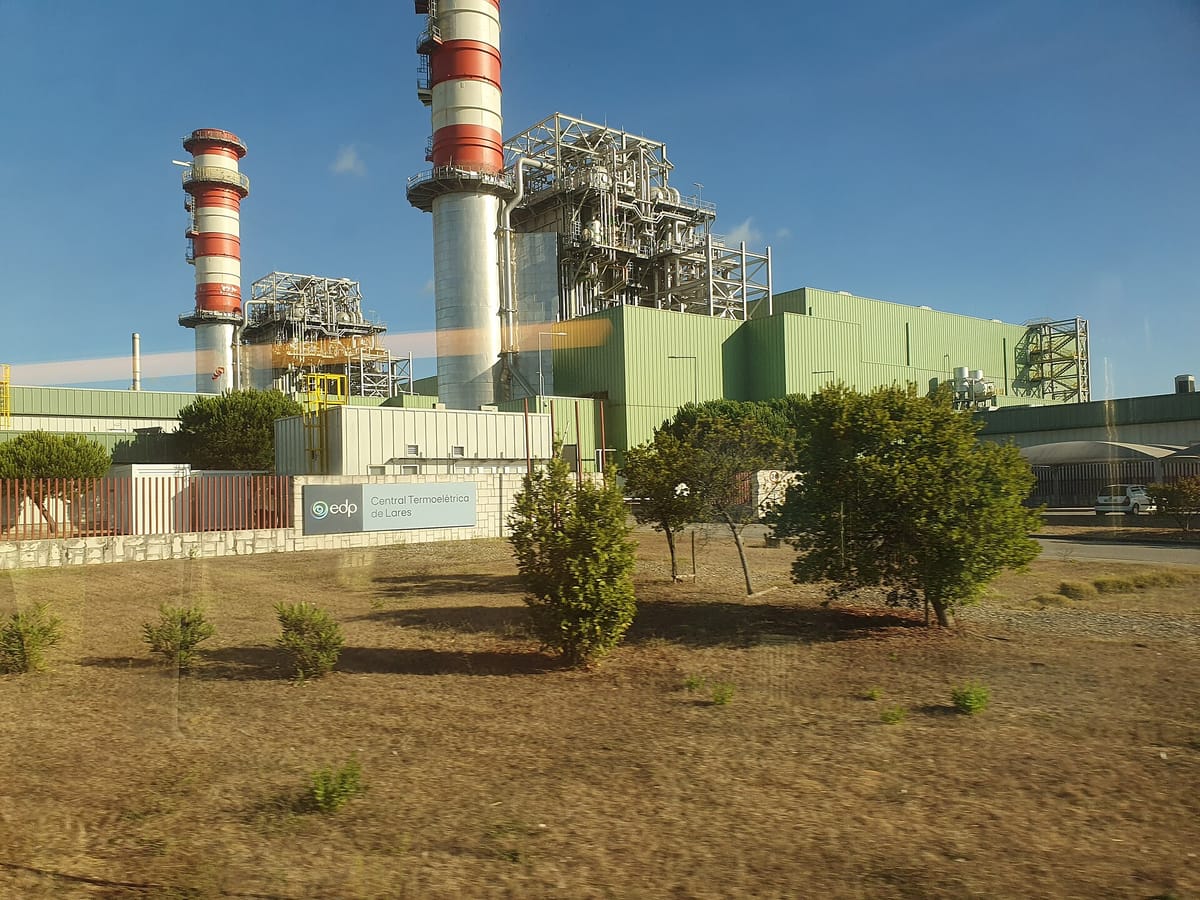
The uncomfortable part of the 2025 estimate is that the increase came from the one sector Portugal has been most successful at cleaning up. A 7.6 percent rise in power-sector emissions in a country that generates most of its electricity from renewables means the gas plants ran more. That is the same tension the Portuguese grid has kept producing since: renewable output keeps setting records, and so does demand, and gas covers the difference. Renewables supplied 71 percent of a record-consumption first half in 2026, and in the quarter before that they carried 80 percent while gas-fired output still jumped by more than half after storm damage to the grid.
Per head, Portugal is still well below the European average
EDGAR's per-capita series puts Portugal at 5.29 tonnes of CO2 equivalent per person in 2025, against an EU27 average of 7.06 tonnes and a German figure of 8.01. Portugal emits about three quarters of what the average European emits.
The direction of travel differs, though. Portugal's per-capita figure rose in 2025, from 5.19 tonnes. The EU average fell, from 7.07. Germany's fell too. Being below the average is not the same as still moving towards the target, and 2025 is a year in which Portugal was not.
How this fits into the global numbers
EDGAR's world total for 2025 is 54,149 million tonnes of CO2 equivalent, up 380 million tonnes or 0.7 percent on 2024. It is another record. Among the large emitters:
- United States: up 131 million tonnes, or 2.2 percent, the largest absolute increase of any country.
- China: up 9.6 million tonnes, or 0.06 percent, effectively flat at just under 16,000 million tonnes.
- India: down 6.8 million tonnes, or 0.15 percent.
- Russia: down 3.3 million tonnes, or 0.13 percent.
- Indonesia: up 16.1 million tonnes, or 1.2 percent.
The EU27 now accounts for 5.8 percent of the world total, and emits about 36 percent less than it did in 1990. Portugal's 53.11 million tonnes is about a tenth of one percent of the global figure, which is worth saying plainly: nothing Portugal does to its own inventory changes the global curve. What it changes is Portugal's own compliance position under EU effort-sharing rules, and the credibility of the 2030 trajectory that has already been flagged as structurally fragile.
Two caveats that matter before anyone quotes the number
This is not the official national inventory. EDGAR is a modelled dataset built by the Joint Research Centre using its own activity data and emission factors, applied consistently across every country so the comparisons work. Portugal's official figures are compiled by the Agência Portuguesa do Ambiente (Portuguese Environment Agency) and submitted to the United Nations Framework Convention on Climate Change. The two use different methods, they do not produce identical totals, and the official 2025 number arrives later. Where a Portuguese climate target is written in law, it is the national inventory that counts.
Land use sits outside all of these figures. The 53.11 million tonnes excludes land use, land-use change and forestry. On EDGAR's separate accounting, Portugal's land is a net carbon sink, and a larger one in 2025 than in 2024: net removals of 19.34 million tonnes against 16.91 million the year before. Almost all of that swing is the wildfire line, which EDGAR estimates fell from 2.83 million tonnes of CO2 in 2024 to 1.31 million in 2025. Fire emissions are volatile from year to year and provisional in an estimate published this early, so the sink figure should be read as an indication rather than a result. The direction of the underlying total, up 1.6 percent while the EU fell, does not depend on it.