Peniche's Jurassic Cliffs and the Monchique Hills Join the IUGS List of the World's Key Geological Heritage Sites
The Lower Jurassic section of Peniche and the Monchique Alkaline Complex are Portugal's two entries in the IUGS 'Third 100' geological heritage sites, announced in Loulé. What the rocks record, and what the listing does and does not do.
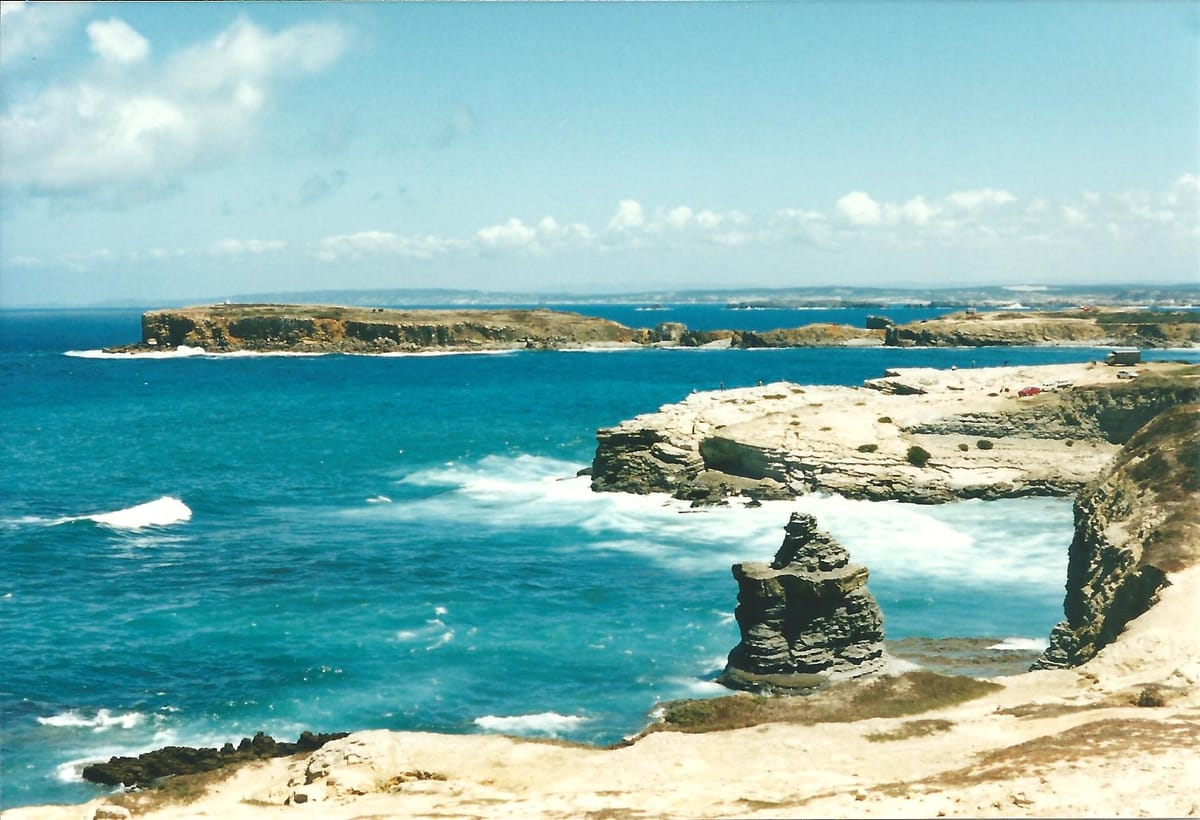
The cliffs on the northern side of the Peniche peninsula and the Monchique hills in the western Algarve are now on the International Union of Geological Sciences' (IUGS) list of the world's key geological heritage sites. They are the two Portuguese entries among the "Third 100" IUGS Geological Heritage Sites, announced on 6 November at a meeting in Loulé that brought together 156 experts from 49 countries.
The IUGS describes the sites as exceptional examples of geological features, processes and discoveries, chosen for their scientific value. The new selection spans 47 countries, with 34 sites in Europe, and sits alongside places such as Mount Fuji, the Norwegian fjords and California's San Andreas fault. It follows a first list of 100, announced in Zumaia, Spain, in 2022, and a second announced in Busan, South Korea, in 2024.
Peniche: 20 million years in one coastline
Site 214 in the IUGS catalogue is the Lower Jurassic reference section of Peniche: a run of limestone and marl layers more than 450 metres thick, laid down on the sea floor from the Sinemurian to the Aalenian stages. That covers almost 20 million years of the Earth's history. At the time, the catalogue explains, Peniche sat between the Western Tethys ocean and the young basin that would become the Atlantic, so its rocks hold fossils from both worlds.
Two features make the section famous among geologists:
- A global reference point. Peniche holds the stratotype that marks the start of the Toarcian stage, about 183 million years ago. Peniche council (Câmara Municipal de Peniche) notes that the new listing joins the "golden spike" at Ponta do Trovão, the marker geologists worldwide use for that boundary.
- A record of an ancient climate crisis. The cliffs carry one of the best records anywhere of the Toarcian Oceanic Anoxic Event, when oxygen fell in the oceans. The IUGS catalogue says the rocks show a mass extinction, a disruption of the carbon cycle and signs of extreme heat.
The nomination was prepared by Luís Vítor Duarte of the University of Coimbra, José Brilha and Paulo Pereira of the University of Minho, and Susana Machado and João Matos of the Laboratório Nacional de Energia e Geologia (LNEG, the National Laboratory for Energy and Geology).
"This distinction is a source of pride for everyone in Peniche," the mayor, Filipe de Matos Sales, said in a statement reported by Lusa via Observador (in Portuguese). "We want this heritage to be ever better known, valued and preserved." The council says on its website (in Portuguese) that it sees the listing as a way to attract quality tourism, international education programmes and investment in protecting the area's geology. The nearby Berlengas are in the news too: the Instituto da Conservação da Natureza e das Florestas (ICNF, the Institute for Nature Conservation and Forests) has 30 days to rework the island pass.
Monchique: rocks named after the town
Site 238 is the Monchique Alkaline Complex, the mass of rock that forms the Monchique hills, including the summit of Fóia. According to the IUGS catalogue, it formed from magma about 72 million years ago, in the Late Cretaceous, and is made up of two concentric bodies of nepheline syenite. Two of its rock types were first described there and carry local names: monchiquite and foyaite.
It is the youngest of three similar rock masses lined up along the Portuguese coast, with Sintra and Sines, which geologists study to understand how the central and northern Atlantic opened. The catalogue also links the rocks to the thermal springs at Caldas de Monchique, where water emerges at 31°C with a pH of 9.5, the most alkaline in the Iberian Peninsula, and supplies both spa treatments and bottled mineral water. The nomination came from researchers at the University of Trás-os-Montes e Alto Douro and the Instituto Dom Luiz at the University of Lisbon.
What the listing does
The IUGS list is a scientific recognition, not a legal designation. The union says many of the new sites are already protected in national parks, geoparks and nature reserves, "but many are not", and hopes that the visibility will encourage their use in teaching and, above all, their preservation.