The Fires Called Vouzela and Valpaços Are Now Officially a Natural Catastrophe, and the 10 Million Euros Follows 32 Parishes Across Nine Councils
A despacho signed on 26 August recognises the 2 to 7 July and 28 July to 2 August fires as a natural catastrophe. It puts €10 million behind farms that lost more than 30 percent of their productive potential, and the window shuts at 17:00 on 27 October.
The Minister of Agriculture and the Sea signed a despacho on Wednesday 26 August that formally recognises two of this summer's rural fires as a natural catastrophe, and the Gabinete do Ministro (Minister's Office) announced it on Thursday. The recognition is not symbolic. It is the legal switch that unlocks money, and it opened a two-month application window that closes at 17:00 on Tuesday 27 October.
Almost every news report has described this as the recognition of "the Vouzela and Valpaços fires". That is how the ministry's own statement frames it too. But the annex to the despacho, which is the part that decides who gets paid, does not name two municipalities. It names 32 parishes across nine municipalities, and in the Centro region the town of Vouzela itself is not among them.
What was actually signed
The despacho recognises two distinct events as a natural catastrophe: the rural fire that burned between 2 and 7 July 2026 in the Centro region, and the rural fire that burned between 28 July and 2 August 2026 in the Norte region. It does so under paragraph b) of article 3 and paragraph a) of number 1 of article 6 of Portaria n.º 240/2025/1, of 27 May, which is the regulation governing the C.4.1.3 "Restabelecimento do Potencial Produtivo" (Restoration of Productive Potential) support line inside the C.4.1 "Gestão de Riscos" (Risk Management) intervention of Portugal's Common Agricultural Policy strategic plan on the mainland.
That chain of references is the whole point. Under European state-aid rules for agriculture, a member state cannot simply hand money to farmers who have lost a crop. It first has to make a formal act recognising the event as a natural disaster, and only then can the compensation scheme be opened. This despacho is that act. Until Wednesday it did not exist, which is why the aid the minister had been promising since early August could not move.
The 32 parishes, and the nine councils they sit in
The annex splits into two blocks. In the Norte region, covering the fire of 28 July to 2 August, twenty parishes qualify:
- Valpaços (nine parishes): Bouçoães, Ervões, Fornos do Pinhal, Possacos, Santa Valha, Vilarandelo, the union of Lebução, Fiães e Nozelos, the union of Sonim e Barreiros, and the union of Valpaços e Sanfins.
- Mirandela (eight parishes): Aguieiras, Bouça, Fradizela, São Pedro Velho, Torre de Dona Chama, Vale de Gouvinhas, Vale de Salgueiro and Vale de Telhas.
- Vinhais (two parishes): Rebordelo and Vale das Fontes.
- Macedo de Cavaleiros (one parish): Lamalonga.
In the Centro region, covering the fire of 2 to 7 July, twelve parishes qualify:
- Águeda (five parishes): Águeda, Agadão, Castanheira do Vouga, Valongo do Vouga and the union of Préstimo e Macieira de Alcoba.
- Vouzela (three parishes): Alcofra, Campia and the union of Cambra e Carvalhal de Vermilhas.
- Oliveira de Frades (two parishes): the union of Arca e Varzielas and the union of Destriz e Reigoso.
- Sever do Vouga (one parish): Talhadas.
- Tondela (one parish): the union of São João do Monte e Mosteirinho.
Read that list against the names in the headlines and the arithmetic looks odd. Mirandela, which was not in any of the headlines, gets more qualifying parishes than Valpaços has in the Bragança district and more than twice as many as Vouzela. Águeda, in the Aveiro district, gets five. The fire we covered in July as the Vouzela blaze jumped municipal boundaries from the Serra do Caramulo almost immediately, and the annex simply follows the burn scar rather than the name the fire was given.
The fire that is not on the list
There were two large fires at Valpaços this summer, and only one of them is recognised. The despacho covers the fire that ignited near Ervões in late July and was declared dominated at 04:40 on 1 August after burning through more than 16,000 hectares. It does not cover the second Valpaços fire that broke out on 12 August, tore through roughly 15,000 hectares of vineyard, olive and almond ground and prompted mayor Jorge Mata Pires to ask Lisbon for a state of calamity.
Nor does it cover the fires that hit Boticas, Torre de Moncorvo and Vinhais in the same mid-August week. Speaking in Penafiel on 21 August, agriculture minister José Manuel Fernandes said the delimitation work by the Instituto da Conservação da Natureza e das Florestas (Institute for Nature Conservation and Forests) and civil protection was already finished for Valpaços and Vouzela, and that the others would follow "depending on the size". He also ruled out extending deadlines for later fires, saying it "delays everything", while allowing that he could open a fresh call instead. If your land burned in August, the honest answer today is that your scheme has not opened yet.
What the money pays, and the insurance split most reports left out
The global envelope is 10 million euros, given as a non-repayable grant. Eligibility starts at damage above 30 percent of the holding's productive potential, agricultural and land-based, in at least one intervention category, and the associated investment is capped at 400,000 euros.
The support rate is where the detail matters, because the widely reported version of it is incomplete. The scale runs in slices:
- 100 percent of eligible expenditure up to 10,000 euros;
- 80 percent of eligible expenditure above 10,000 euros, if you hold a policy under the Sistema de Seguros Agrícolas (Agricultural Insurance System) created by Decreto-Lei n.º 162/2015;
- 50 percent of eligible expenditure above 10,000 euros if you do not.
Most of the early coverage carried only the 100 and the 50, which understates by 30 percentage points what an insured farmer can recover. The 80 percent tier applies to crop, animal and plant policies, the vineyard harvest policy, and the fruit and vegetable harvest policy taken out under the European agricultural funds. Expenditure is fractioned across the slices in sequence and the resulting average rate then governs the whole project for its full life.
Two further deductions are easy to miss. Any insurance indemnity or other risk-management payout is subtracted from the grant, with the scheme covering the value of the excess written into your agricultural insurance contract. And if the eligible applications together exceed the 10 million euros, every individual award is cut proportionally. This is a fixed pot, not a fixed entitlement.
Chestnut and olive get their own line items
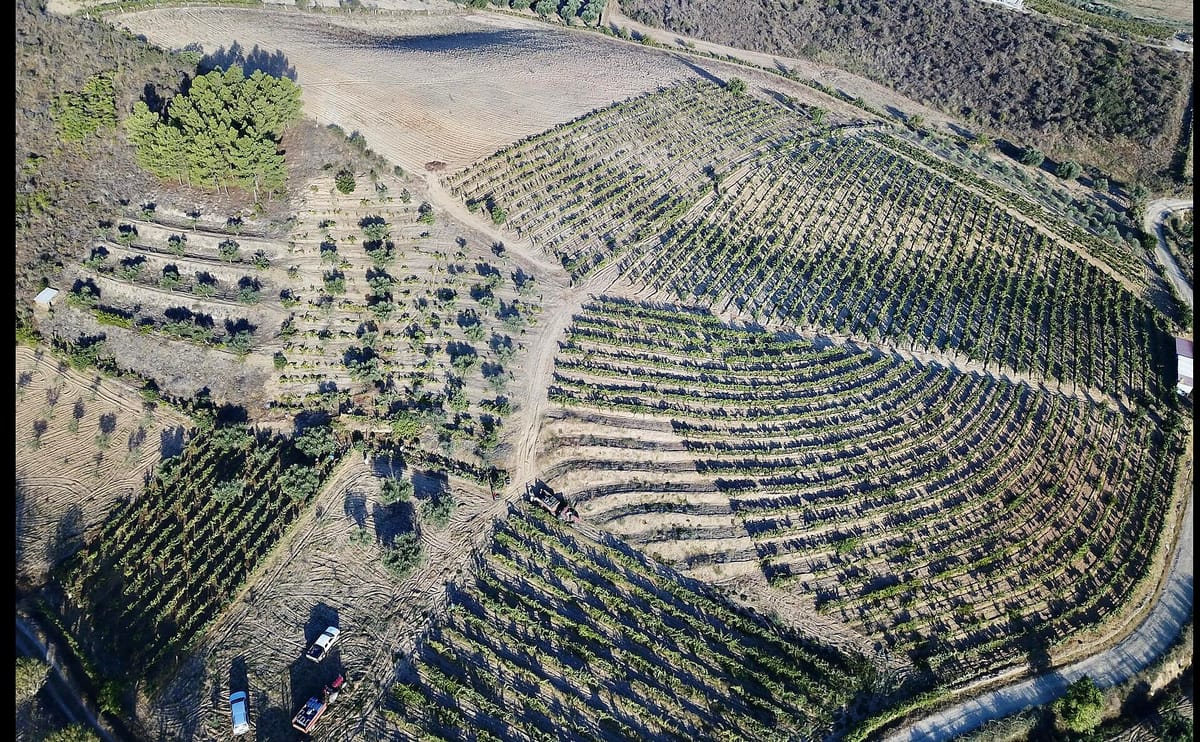
For chestnut groves and olive groves, the despacho does something unusually practical. Instead of only funding replanting, it makes eligible the interventions that try to bring a damaged tree back: regeneration pruning, protection of cuts, plant-health treatments, grafting (for chestnut) and fertilisation. The technical guidance goes further and creates five named sub-headings in the application form for exactly those operations, under an "Outros investimentos" (Other investments) heading.
That is a recognition that a century-old olive tree is not replaced by a grant. As the minister put it: "The scale of the fires is enormous and there are losses that cannot be recovered. We know no support can restore an old vine, a hundred-year-old olive grove or years of work, but we are not going to leave farmers on their own."
What you have to do before you can even apply
Applications run through the Balcão dos Fundos para a Agricultura (Agriculture Funds Desk) at fundosparaagricultura.pt, from 27 August until 17:00 on 27 October 2026. The steps that trip people up all sit before the form:
- Register with the IFAP first. You must already be registered with the Instituto de Financiamento da Agricultura e Pescas (Institute for the Financing of Agriculture and Fisheries) before filling in anything, and your Identificação do Beneficiário record must be current, including start of activity and at least one agricultural CAE code. Information cannot be corrected after submission.
- Create your investment polygons at an SIP counter. Go to a Sistema de Identificação Parcelar (Parcel Identification System) service room and draw the polygons over the affected parcels. Where a parcel is farmed under a lease or loan agreement, the contract's end date has to guarantee the operation continues for at least five years after the final payment.
- Take georeferenced photographs, after 27 August. Digital geotagged photographs of each investment site must be submitted through the IFAP Mobile app, and they must have been taken after the call opened. Photographs from the week of the fire will not do.
- Get three quotes for everything. Three valid budgets are required for every proposed investment regardless of value, including work already carried out, unless the item uses simplified unit costs. Quotes have to identify the supplier, describe the item in detail, carry a date, and come from certified invoicing software or a digital signature for companies. Quotes that suggest a conflict of interest between applicant, consultant and supplier make the expense ineligible.
- One application per beneficiary. If you spot an error before the deadline, you must cancel and resubmit, and the new submission counts as a new application with a new date.
Separately from the online form, you have to lodge a declaração de prejuízos (damage declaration) with the territorially competent Comissão de Coordenação e Desenvolvimento Regional (Regional Coordination and Development Commission). It can go in at the same time as the application or up to the end of the CCDR's own deadline, but the application does not replace it. The CCDR confirms the 30 percent threshold by site visit, and it has 30 days from the close of the window to finish that verification.
What is eligible, and what is not
Eligible expenditure covers tangible fixed assets, including farm buildings, agricultural machinery and equipment, greenhouses and on-farm infrastructure, and it stretches to rebuilding walls in stone masonry, gabion or another construction solution. It also covers biological assets: restocking animals and replanting annual and multi-annual crops. General consultancy costs are eligible up to 3 percent of the approved total.
Expenditure only counts if it was incurred after the date the relevant fire started, as set out in the annex, so a Centro applicant works from 2 July and a Norte applicant from 28 July. Second-hand capital goods are not eligible. Recoverable VAT is not eligible.
Why the timing matters
This is the sixth call under the C.4.1.3 line. The one that ran for the 2025 fire season carried a 44 million euro envelope and stayed open from 31 October 2025 to 16 January 2026, close to eleven weeks. This one runs nine weeks on a quarter of the money, and it lands in the middle of the olive and chestnut season in Trás-os-Montes. For anyone weighing whether the paperwork is worth it, the honest calculation is that the first 10,000 euros of eligible spending is fully covered, which for a small holding is often most of the fence, the water line and the regeneration pruning.
The wider record on Portuguese disaster money is not encouraging on speed. Six months after Storm Kristin, the hardest-hit towns were still waiting to rebuild, and Portugal's Ombudsman has since urged the creation of a national catastrophe fund precisely because the ad hoc route is slow. Against that, this despacho moved from fire to open call in eight weeks for the Norte event, which by the standards of the file is quick. It also arrives in the same week the North's fire brigades were handed 23 new forest firefighting vehicles funded by Timor-Leste, several of them going to the same councils named in the annex.
If your land is in one of the 32 parishes, the sequence is: check the IFAP registration, book the SIP counter, take the photographs, collect the three quotes, file the damage declaration with the CCDR, and submit. The window shuts at 17:00 on 27 October and the minister has already said he will not extend it.