The Alga Smothering Algarve Beaches Is Worth Money, and the Only Lawful Route to Selling It Runs Through a Plan Portugal Has Not Written
Rugulopteryx okamurae has been on the EU list of invasive alien species since August 2022, and Article 7 of Regulation 1143/2014 bans placing it on the market. The one door left open, in Article 19(2), needs a control plan the government's own strategy says still has to be drawn up.
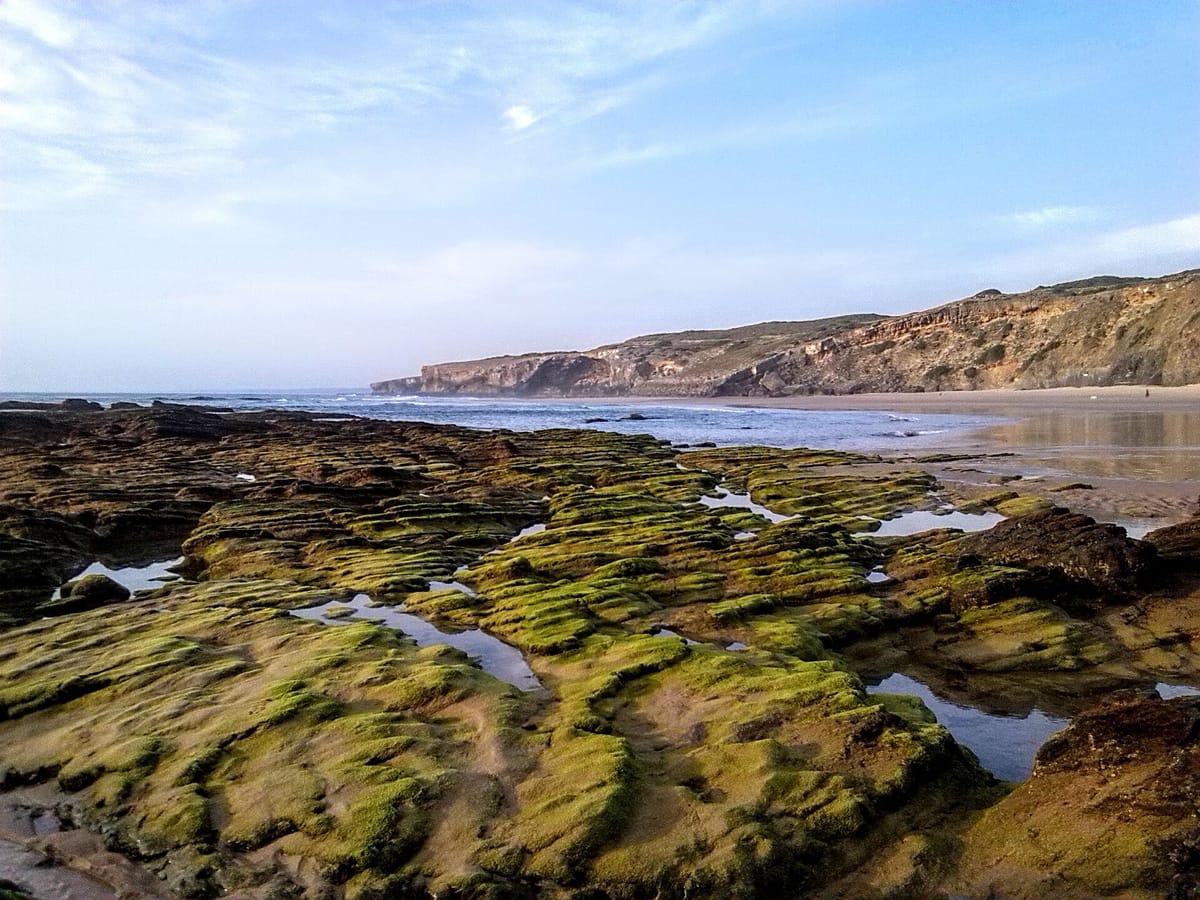
There is a brown alga smothering the rocks along the Algarve coast that Portuguese researchers now believe is worth money. There is also a state strategy, approved by two ministers a year ago, whose third pillar is explicitly about turning that biomass into something saleable. And there is a body of law, most of it made in Brussels, that says the one thing you may not do with this particular species is place it on the market.
RTP reported on Sunday from the Algarve, where an experimental method is being tested to vacuum the alga off the sand and where there are plans for a biorefinery to process it. The report's framing was that the law does not allow the species to be commercialised. That is very nearly right, and the detail of why it is only nearly right is the more interesting story: the law does contain a route, the route is narrow, and it runs through a document Portugal has said it will write but had not written when it set the strategy in motion.
The species, and how it got onto the banned list
The alga is Rugulopteryx okamurae, a brown macroalga native to the north-west Pacific, off Japan and Korea. It reached the western Mediterranean early this century and was first recorded in Portugal in 2019, in the Azores. The University of the Algarve and the Centro de Ciências do Mar (Centre of Marine Sciences), which have run the citizen-science platform Algas na Praia since 2021, report that from 2024 onwards it became the most frequently logged invasive species on their platform, dominant along the Algarve coast between Vilamoura and Sagres and still moving north, with confirmed records around Cascais. Cascais council is far enough into the problem that in June it funded EO4RO, a 12-month satellite-and-artificial-intelligence pilot with GMV and the Plymouth Marine Laboratory, to track the alga along the Atlantic coast.
On 12 July 2022 the European Commission adopted Implementing Regulation (EU) 2022/1203, which added a dozen species to the list of invasive alien species of Union concern. Rugulopteryx okamurae (E.Y.Dawson) I.K.Hwang, W.J.Lee and H.S.Kim, 2009 is one of them, entered against customs code ex 1212 29 00. The regulation was published in the Official Journal on 13 July 2022 and entered into force on the twentieth day following, which put the alga on the Union list from 2 August 2022. Two other species in the same act, the African clawed frog and the mummichog, had their listing deferred to 2024, and two more to 2027. The alga got no such grace period.
What the Union list does is trigger Article 7 of Regulation (EU) No 1143/2014, which is directly applicable in every member state and needs no Portuguese statute to bite. Species on that list "shall not be intentionally" brought into the Union, kept, bred, transported, "placed on the market", used or exchanged, permitted to reproduce or grown, or released into the environment. Point (e), placing on the market, is the operative one here.
The permit that does not help
The regulation has two derogation mechanisms, and neither is a general commercial licence.
Article 8 obliges member states to run a permit system for research and ex-situ conservation, and allows scientific production and subsequent medicinal use where products derived from a listed species are unavoidable to advance human health. But Article 8 is drafted as a derogation from points (a), (b), (c), (d), (f) and (g) of Article 7(1). Point (e) is conspicuously absent from that list. A research permit lets a laboratory hold, move and work on the alga. It does not let anyone sell it.
Article 9 goes further, allowing permits "in exceptional cases, for reasons of compelling public interest, including those of a social or economic nature", but only "subject to authorisation by the Commission" and only through a procedure the article then sets out in detail. That is a Brussels file, not a Portuguese one.
Where the route actually is
The provision that matters sits in Article 19, the management-measures article, and it is a single sentence tucked into paragraph 2: "The commercial use of already established invasive alien species may be temporarily allowed as part of the management measures aimed at their eradication, population control or containment, under strict justification and provided that all appropriate controls are in place to avoid any further spread."
That is the door. But read the conditions. The commercial use has to be temporary. It has to be a part of management measures, not a substitute for them. It has to be strictly justified. And the controls against further spread have to be in place first. In other words, a member state cannot simply announce that harvesting an invasive species is now a business; it has to build the eradication or containment programme, and then hang the commercial use off it.
Article 19(1) sets the clock. Within 18 months of a species being included on the Union list, member states "shall have in place effective management measures" for those Union-concern species they have found to be widely spread on their territory. Counting from 2 August 2022, that is 2 February 2024.
What Portugal has, and what it does not
Portugal's own statute reaches the same place by a different road. Decreto-Lei n.º 92/2019, de 10 de julho, which gives full effect in national law to Regulation 1143/2014, states at Article 16 that "the detention, cultivation, breeding, commerce, introduction into nature and restocking of specimens of species included in the National List of Invasive Species is prohibited". Article 17(1)(d) provides that the National List includes "the invasive alien species of Union concern, identified in a list adopted under Regulation (EU) n.º 1143/2014". The alga is on that list, so it is caught.
A point worth noting for the record: Annex II to the decree-law, which is the printed National List, has an algae section running to eighteen names, from Anotrichium to Undaria pinnatifida. Rugulopteryx okamurae is not among them, and adding a species to that annex requires a decreto-lei of its own under Article 18(5). It does not need to be there. The Union-list route in Article 17(1)(d) is enough on its own, and Article 7 of the regulation would apply in Portugal even if the decree-law said nothing at all.
Article 21(2) of the same decree-law is the national mirror of Article 19(2). It allows licences to be issued, exceptionally, for the detention, transfer, purchase, sale, offer for sale and transport of specimens of species "already present, at the entry into force of the present decree-law, in a given territory, or part of it, whose capture or collection is provided for in action plans or in control, containment or eradication plans" drawn up under Articles 28 and 29. Article 22(4) adds that where the species is one of Union concern, recognition of economic or social public interest "depends on prior authorisation by the European Commission". For how the same decree-law applies to gardens, ponds and pets, see our guide to Portugal's invasive species list.
So the national route also runs through a control, containment or eradication plan. That is the document that does the work.
The strategy that says the plans still have to be written
Portugal has a strategy for this alga, and it is a serious one. Portaria n.º 270-A/2025/1, signed by Environment and Energy Minister Maria da Graça Carvalho on 17 July 2025 and Agriculture and Sea Minister José Manuel Fernandes on 22 July, was published in a supplement to the gazette on 23 July 2025 and took effect the next day. It approves the Estratégia Nacional para a Gestão da Macroalga Invasora Rugulopteryx okamurae (National Strategy for the Management of the Invasive Macroalga Rugulopteryx okamurae) and creates an inter-institutional working group coordinated by the Agência Portuguesa do Ambiente (Portuguese Environment Agency), with the ICNF, the CCDRs, the Área Metropolitana de Lisboa, universities, the DGRM, affected coastal councils, the Algarve tourism board, Turismo de Portugal and the Algarve intermunicipal community. Members are paid nothing for sitting on it. The CCDR Algarve hosted the first meeting on 1 August 2025.
The strategy's third pillar is titled "Valorisation and Waste Management" and instructs the state to "study the potential of the biomass in applications such as fertilisers, feed, composting, biofuels or bioplastics, pharmaceuticals and cosmetics", to build logistics circuits for transporting and treating the alga, and to look at temporary storage sites, possibly in disused salt pans. That is a valorisation programme in everything but the licence.
And the fifth of its strategic objectives is the one that closes the circle. It commits Portugal to "guarantee a rapid and articulated response through the drawing-up of control, containment or eradication Plans of regional scope and a control, containment or eradication Plan of national scope, as provided for in Decreto-Lei n.º 92/2019, de 10 de julho", adding that these should follow the model template drawn up by the ICNF and available on its website.
Read that against Article 21(2) of the decree-law and Article 19(2) of the regulation and the position becomes clear. The plans that the strategy lists as something still to be drawn up are the same plans that both the national and the European licensing routes require to exist before commercial use of the harvested biomass can be authorised. A year after the strategy was approved, we could find no national plan published for this species. That programme has since been published: Portugal's national action programme for the invasive alga, which reads dead or non-viable seaweed as outside the sales ban.
The strategy is candid about where this ends. Under "Expected Results" it lists the "definition of a replicable national model for the management of invasive marine alien species, with eventual legislative change". The government wrote into its own strategy that the law may have to change.
What is being left on the beach
The research is not speculative. The University of the Algarve reports that its work has identified Rugulopteryx okamurae as a new natural source of vitamin K1, and that this is feeding the development of a food supplement based on vitamin K1 extracted from the alga. The Algas na Praia team frames the whole exercise as turning an environmental problem into a bioeconomy opportunity, which is the same language the state strategy uses.
Meanwhile councils are paying to shift the stuff. The alga's arrival on Portuguese beaches is a removal cost, a bathing-season problem and, in the words of the portaria's preamble, a hit to "marine biodiversity, fishing activity, bathing uses and the local coastal economy". It lands on beaches that the Environment Agency is already monitoring closely for what washes up on them.
There is one more wrinkle, and it is a genuine one. The exceptional licensing route at Article 21(2) of the decree-law is written for species "already present, at the entry into force of the present decree-law". Decreto-Lei n.º 92/2019 was published on 10 July 2019 and entered into force the following day. The first Portuguese record of this alga also dates from 2019. Whether the alga clears that threshold, and whether "in a given territory, or part of it" is read as Portugal, as the mainland, or as the stretch of coast where the species had actually been found, is not a question the text answers. It is the kind of question that gets settled the first time someone applies for a licence.
Nobody appears to have applied yet. On the invasive insect the region is now racing to remove, our report on the twelve-month, EU-funded attempt to erase the Asian hornet from São Miguel before it does in the Azores what it has done across the north of the mainland since 2011 sets the latest reference.