Invasive Plants and Animals in Portugal in 2026: A Practical Guide to the National List, the Pampas Grass and Acacias in Your Garden, the Slider Turtle You Already Own and the Environmental Fines
Pampas grass, ice plant, mimosa, nasturtiums, goldfish and slider turtles are all on Portugal's national invasive list. What Decreto-Lei 92/2019 bans, what to do if you already have one, the Madeira-only asterisk, and fines that run into the tens of thousands.
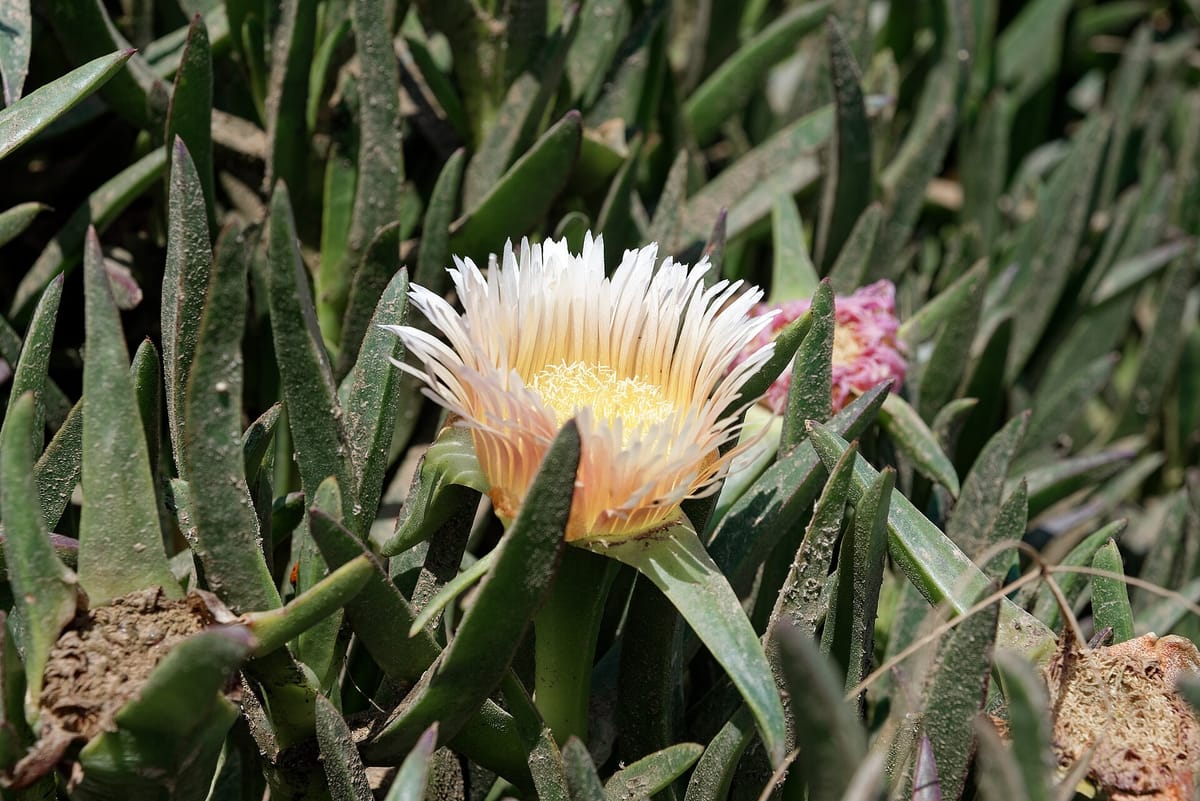
Walk along almost any stretch of the Portuguese coast and you will tread on a thick carpet of fleshy, finger-shaped leaves with big pink or pale-yellow flowers. It is chorão, the ice plant, Carpobrotus edulis. Drive inland and you will pass stands of mimosa glowing yellow in February and clumps of pampas grass waving silver plumes at the edge of a car park. All three are on Portugal's national list of invasive species. So is the goldfish. So is the red-eared slider turtle a previous owner may have left in the garden pond.
Few newcomers have heard of the law that covers them. It is Decreto-Lei n.º 92/2019, of 10 July, which applies the European Union's invasive-species regulation in Portugal and sets up a Lista Nacional de Espécies Invasoras (National List of Invasive Species). What it bans is broad, the fines are set by the environmental offences framework law and start in the thousands of euros, and the rules reach into ordinary gardens, ponds and aquariums. This guide sets out what the law actually says, which common plants and animals are on the list, what to do if you already have one, and the traps for anyone moving plants or pets into the country.
What counts as invasive, and where the list lives
The decree distinguishes between two categories. An espécie exótica (alien species) is any living plant or animal introduced outside its natural range, including seeds, eggs and any other part that could survive and reproduce. An espécie invasora (invasive species) is an alien species whose introduction or spread threatens or harms biodiversity and the ecosystem services that depend on it, or has other adverse impacts. The first category is regulated. The second is, in practice, banned.
Article 17 creates the national list and places it in Annex II of the decree. It includes species with scientific evidence of invasiveness on the mainland, species invasive in the Azores or Madeira, species classified as risky under other national or international instruments, and every species on the EU's own list of invasive alien species of Union concern. The list must be reviewed at least every six years, and additions are made by decree-law after a public procedure that anyone can start (Article 18).
The list has been amended once. Lei n.º 25/2023 of 30 May moved the largemouth bass, Micropterus salmoides, out of Annex II and into Annex III, the separate list of species used in aquaculture, farming and inland fishing that are controlled rather than banned. Annex III now holds the Pacific oyster, the common carp, the largemouth bass, the rainbow trout and the prickly pear, Opuntia ficus-indica.
One detail in Annex II is easy to miss and matters a great deal: species marked with an asterisk are classified as invasive only in the Autonomous Region of Madeira. On the mainland those entries do not apply.
What the ban covers
Article 16 is one sentence long. It prohibits keeping, cultivating, breeding, trading, releasing into the wild and restocking any species on the national list. Article 19 spells out what that means in practice:
- no release into nature or restocking;
- no keeping, giving away, buying, selling, offering for sale, transporting, cultivating, breeding, or use as an ornamental plant or companion animal;
- no putting back into the wild of anything caught or harvested in a regulated activity such as hunting or fishing;
- and a duty on keepers, breeders and nurseries, "even without commercial purposes", to eradicate the species they hold.
Two exclusions in Article 1 are worth knowing. The regime does not apply to agricultural, horticultural, fruit and vine varieties listed in the official variety catalogues, and it does not apply to disease-causing organisms, plant pests and certain microorganisms that have their own rules.
There are narrow licensing routes in Article 21: confined scientific work, some existing aquaculture in closed systems, and commercial exploitation recognised as being in the public economic or social interest. None of them is a route for a private garden or a household pet.
The garden plants on the mainland list
Annex II lists 197 plants, 84 of them flagged for Madeira only. Most are weeds nobody plants on purpose. A good number are, or were, sold as garden or pond plants. These are among the ones on the mainland list, without the Madeira-only asterisk:
- Acacia spp. Every acacia species, including the mimosa widely planted for its winter flowers.
- Carpobrotus edulis and Carpobrotus acinaciformis. The ice plant, chorão, used for decades to stabilise dunes and cover dry banks.
- Cortaderia selloana. Pampas grass, erva-das-pampas.
- Ailanthus altissima. The tree of heaven.
- Robinia pseudoacacia. The false acacia or black locust.
- Arundo donax. The giant reed, cana.
- Pittosporum undulatum. A common hedging shrub.
- Lantana camara, Ipomoea indica (the blue morning glory) and Tradescantia fluminensis.
- Agave americana and Opuntia maxima.
- Pennisetum setaceum and Pennisetum villosum. Ornamental fountain grasses.
- Paulownia tomentosa, Ricinus communis (the castor-oil plant) and Nicotiana glauca (tree tobacco).
- Tropaeolum majus. The garden nasturtium.
- Oxalis pes-caprae. The yellow-flowered Bermuda buttercup, azedas, that covers olive groves and verges in spring.
- Pond and aquarium plants: water hyacinth (Eichhornia crassipes), water lettuce (Pistia stratiotes), parrot's feather (Myriophyllum aquaticum), Egeria densa, Cabomba caroliniana, giant salvinia (Salvinia molesta) and the water fern Azolla filiculoides.
Entries such as hydrangea (Hydrangea macrophylla), agapanthus, the arum lily (Zantedeschia aethiopica), the jade plant (Crassula ovata), gorse and broom carry the asterisk. They are listed only for Madeira.
The animals on the mainland list
The animal half of Annex II reaches further into ordinary households than most people expect:
- Turtles: Trachemys spp., which covers the red-eared and yellow-bellied sliders long sold as pets, plus Pseudemys spp. (cooters), Chrysemys picta (the painted turtle), Graptemys spp. (map turtles) and the snapping turtles Chelydra serpentina and Macroclemys temminckii.
- Fish: the goldfish, Carassius auratus, along with the Prussian carp, the mosquitofish Gambusia holbrooki, the pumpkinseed Lepomis gibbosus, the wels catfish, the pike, the pikeperch and the lionfishes (Pterois spp.), among others.
- Invertebrates: the red swamp crayfish (Procambarus clarkii) and the marbled crayfish, the giant African land snail (Achatina fulica), the apple snails Pomacea canaliculata and Pomacea insularum, the Argentine ant, and every non-European hornet (Vespa spp.), which includes the Asian hornet.
- Amphibians: the cane toad, the American bullfrog and the African clawed frog.
- Mammals: the raccoons (Procyon spp.), the coati, the grey squirrel, the Siberian chipmunk (Tamias sibiricus), the coypu, the muskrat and the American mink, among others.
- Birds: species including the common myna, the Egyptian goose, the sacred ibis, the ruddy duck and the red-billed quelea.
Again, the asterisk matters. The ring-necked and monk parakeets, the common waxbill, the collared dove, hedgehogs, rabbits, goats and the domestic cat all carry it, which means they are listed for Madeira only. How Madeira applies its entries is set by the region under Article 43, and this guide does not cover it.
If you already have one
This is where most readers will land: the house came with pampas grass, or the family has kept a slider turtle for fifteen years.
Pets. Article 19(2) and Article 40 apply the EU regulation's transition rule to companion animals kept without commercial purpose. Under Article 31 of Regulation (EU) No 1143/2014, owners may keep such an animal "until the end of the animals' natural life" provided two conditions are met: the animal was kept before its species was listed, and it is kept "in contained holding" with every appropriate measure taken "to ensure that reproduction or escape are not possible." An owner who cannot meet those conditions may not keep the animal. The regulation lets member states offer to take such animals, with due regard to their welfare.
In practice that means a slider turtle in an escape-proof tank, not a garden pond with a low wall, and no breeding. It also means a pet of a listed species acquired after its listing has no transition protection at all. Never release one. Release into nature is the most serious offence the decree contains.
Garden plants. There is no equivalent transition for plants. Article 39 gave owners of ornamental plants of newly listed species six months from the decree's entry into force on 11 July 2019 to tell the ICNF (Nature and Forest Conservation Institute) where the plants were and to eradicate them, and to stop them spreading in the meantime. That window closed in January 2020. Only botanic gardens were allowed to keep specimens, under containment and with a ban on sale or giving them away. For everyone else, Article 19(1)(e) now simply puts the duty to eradicate on the holder.
The decree does not prescribe a removal method for a household. Two points from the wider legal framework help. First, the regime defines alien species by living material capable of surviving and reproducing, and the new national programme for the invasive alga reads the law the same way: once specimens are dead or non-viable, the restrictions on keeping and transporting them no longer apply. Second, what is regulated is moving live material, so seed heads, cuttings and roots that can regrow are the part to contain. Do not put pampas plumes or chorão cuttings on a compost heap or leave them at the roadside.
The fines
Article 33 classifies breaches as environmental offences under Lei n.º 50/2006, the framework law on environmental offences, and the bands in its Article 22 are substantial:
- Very serious (muito grave): releasing a listed species into nature or restocking it; and buying, selling, offering for sale, giving away, cultivating, breeding or trading it as an ornamental plant or companion animal. For an individual: 10,000 to 100,000 euros for negligence, 20,000 to 200,000 euros for intent.
- Serious (grave): keeping, giving away, transporting or using a listed species as an ornamental plant or pet; putting a captured specimen of a listed species back into the wild; and releasing an alien species that is not on the list without authorisation. For an individual: 2,000 to 20,000 euros for negligence, 4,000 to 40,000 euros for intent.
- Minor (leve): including failing to report an escape or accidental spread. For an individual: 200 to 2,000 euros for negligence, 400 to 4,000 euros for intent.
Companies face higher bands in each category. Convictions for very serious offences, and for serious ones where the fine exceeds half the maximum, are published. On top of any fine, Article 37 obliges the offender to remove the cause and restore the previous situation, and if you do not, the ICNF may do the work itself and recover the cost through the tax enforcement procedure.
Enforcement is shared widely. Article 35 lists the ICNF, the regional coordination commissions (CCDR), the regional agriculture directorates, the veterinary authority (DGAV), the maritime authority (DGRM), the environment agency (APA), the tax and customs authority (AT), the GNR and the PSP. The ICNF runs the offence proceedings.
Buying, moving house and crossing borders
At the shop. Article 11 obliges shops selling ornamental plants or pets to display a prescribed notice warning buyers of their responsibility for the risk of alien species spreading or escaping, to give buyers that information in writing along with the measures to prevent it, and to keep a register of sales. If you buy an exotic plant or animal and receive none of this, the shop is in breach.
At the airport or port. Under Article 30, customs officers at passenger terminals check for live plants and animals of alien species. Where they find a listed species, it is refused entry and the holder has no more than 48 hours to choose between destruction and return to the country of origin. The costs of holding, euthanasia, destruction or re-dispatch fall on the holder. This catches people moving to Portugal with a pond's worth of plants, an aquarium or a turtle. Check the list before you pack.
Anywhere else. Releasing an alien species into nature needs the ICNF's authorisation under Article 13, even when it is not on the invasive list. Emptying an aquarium into a stream is an offence whether or not the fish in it are listed.
Reporting
Article 24 requires that any accidental escape or spread of a listed species, or any sighting in the wild where it was not known to occur, be reported to the ICNF immediately, preferably through the public electronic platform the ICNF runs on its website under Article 23. Failing to report an escape is itself a minor offence under Article 33(3)(e). The same platform feeds the rede de alerta (alert network) that links the ICNF, the veterinary and plant-health authorities, customs, the GNR and the regional governments.
The Azores and Madeira
Article 43 applies the regime to both autonomous regions with adaptations made by regional legislation, and gives each region the power to set its own lists under the EU regulation. Until regional rules are in force, the national regime and its annexes apply, and the regional authorities enforce it. If you live on either archipelago, check the regional rules as well as Annex II; this guide is written for the mainland.
What this means for you
- Check your garden against the list. Pampas grass, ice plant, acacias, tree of heaven, Pittosporum hedges and nasturtiums are the most common hits on a mainland property. If you have them, the legal duty is to remove them without spreading seed or live cuttings.
- Do not buy replacements. Buying or planting a listed species as an ornamental is in the very serious band, whoever sold it to you.
- If you keep a slider turtle or another listed pet, keep it contained, stop it breeding, and never release it. If you cannot meet those conditions, you are not permitted to keep it.
- Moving here? Leave listed plants, fish and reptiles behind. At the border they are refused and the costs are yours.
- See something spreading? Report it to the ICNF. It is a legal duty, and the national alga programme published this week shows how quickly an invader can outrun the people trying to track it.
For related rules on the land around your home, our guide to burning garden and farm waste covers what you may do with the cuttings once they are dead and dry, and our pet import guide covers the paperwork for dogs, cats and ferrets.
Sources
This guide is written from official Portuguese and EU sources.
- Diário da República, Decreto-Lei n.º 92/2019, de 10 de julho, regime jurídico das espécies exóticas, original text with Annex II (Lista Nacional de Espécies Invasoras) and its Madeira-only markings (Portuguese only)
- Procuradoria-Geral Regional de Lisboa, Decreto-Lei n.º 92/2019, consolidated text as amended by Lei n.º 25/2023, de 30 de maio, Articles 1, 2, 11, 13, 16 to 19, 21, 23, 24, 30, 33 to 37, 39, 40 and 43 and Annexes II and III (Portuguese only)
- Procuradoria-Geral Regional de Lisboa, Lei n.º 50/2006, de 29 de agosto, Lei-Quadro das Contraordenações Ambientais, consolidated text, Article 22 (fine bands) (Portuguese only)
- EUR-Lex, Regulation (EU) No 1143/2014 on the prevention and management of the introduction and spread of invasive alien species, Article 31
- Diário da República, Despacho n.º 11629/2026, de 22 de setembro, Programa de Ação Nacional para o Controlo da Macroalga Invasora Rugulopteryx okamurae 2026-2030, section 2 (legal status of dead or non-viable specimens) (PDF, Portuguese only)