Portugal's Plan for the Invasive Alga on Its Beaches Arrives, and It Treats Dead Seaweed as Outside the EU Sales Ban
A 47-page programme published on Tuesday concedes the alga cannot be eradicated, sets a 48 to 72 hour clean-up target for bathing beaches, and reads dead or non-viable seaweed as outside the invasive-species ban. The test for non-viability has still to be written.
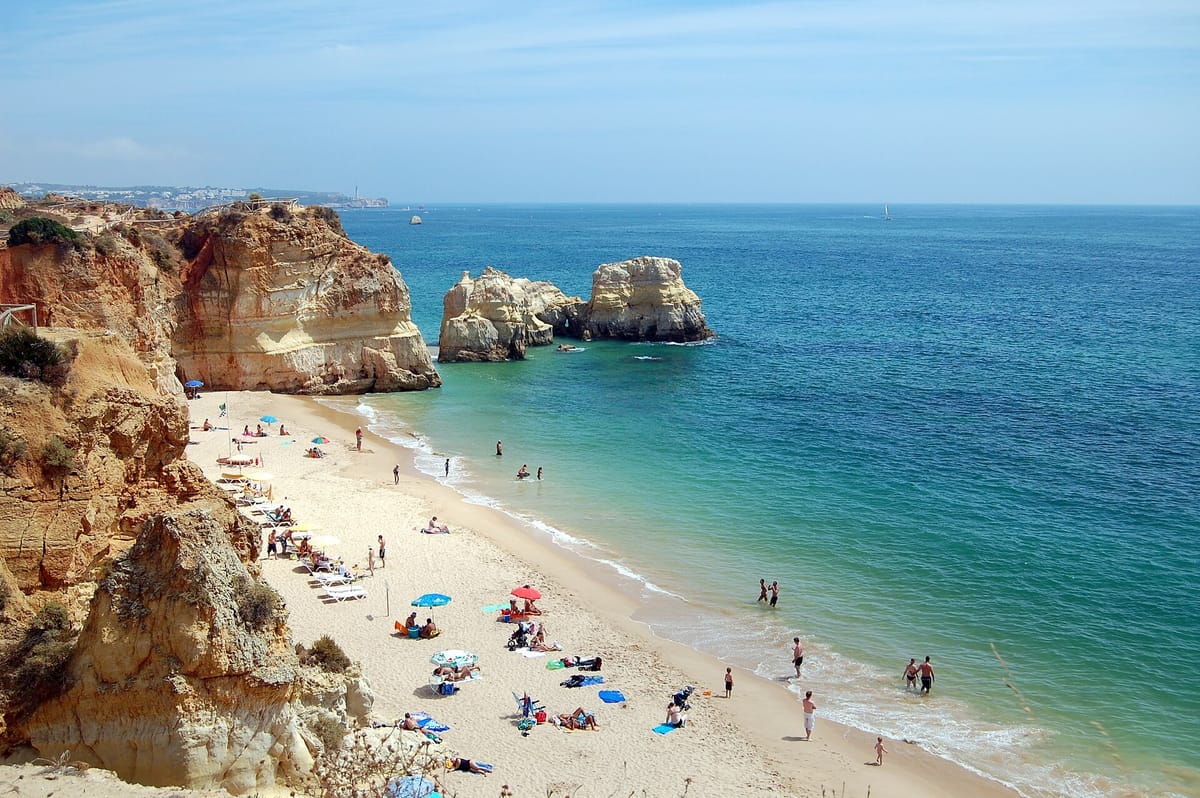
Portugal now has a written plan for the invasive brown alga that has been piling up on Algarve beaches, carpeting the sea floor off Sines and turning up on the Cascais coast. Despacho n.º 11629/2026, signed by the Minister of Environment and Energy, Maria da Graça Carvalho, on 10 September and published in the second series of the official gazette on Tuesday, approves the Programa de Ação Nacional para o Controlo da Macroalga Invasora Rugulopteryx okamurae 2026-2030 (National Action Programme for the Control of the Invasive Macroalga Rugulopteryx okamurae). It takes effect today, the day after publication.
The document runs to 47 pages. It does three things that matter to anyone who lives on, works on or swims off the Portuguese coast. It gives up on eradication in plain words. It sets a clean-up target for bathing beaches. And it settles, on its own reading of the law, the question that has hung over every proposal to turn the alga into fertiliser or bioplastic: whether the stuff can be sold at all.
Eradication is off the table
The programme is candid about what it can achieve. "The characteristics of the species, in particular its dissemination, make its eradication practically impossible," it says, so the plan concentrates on monitoring, control and containment. Elsewhere it repeats the point: the chance of controlling invasive seaweeds is small where the spread is already very significant, "which is confirmed in the assessment of the current population of R. okamurae in Portugal".
That assessment is the most complete public account yet of how far the species has travelled. The programme dates the first records in southern mainland Portugal to 2021, spreading along the coast from Loulé to Vila do Bispo. It names Praia da Rocha and Armação de Pêra as large beaches regularly buried under it, and Manuel Lourenço in Albufeira, Carvoeiro in Lagoa and Dona Ana in Lagos as enclosed coves that fill periodically. It was recorded on the Alentejo coast in 2022, confirmed there in 2023 and found in greatest abundance near the port of Sines. Off Cascais it was first recorded in 2024, with strandings concentrated between Praia das Moitas and Praia da Rainha during the bathing season.
The islands were first. The programme places the earliest Portuguese record in the Azores in 2019, near the main port of São Miguel, probably arriving in ballast water or on a hull rather than drifting from Gibraltar. By 2024 it had reached eight of the nine islands, with only Corvo still clear. It was found on the north coast of Madeira in December 2021.
A 72-hour target for bathing beaches
The operational heart of the plan is Measure C.1, rapid response. Its target is to remove all the biomass from bathing beaches within 48 to 72 hours of detection in 80 percent of events, measured by the interval between the alert and the end of the clean-up. Manual removal is to be preferred wherever volume and access allow, because it disturbs the least sand and can be done while people are on the beach. Mechanical removal on long beaches, extraction from the water column, containment barriers and sealed transport to temporary storage make up the rest of the toolkit.
Every removal is supposed to be logged: date and time, place, length of beach cleaned, distance to the sea, method, tonnes or cubic metres removed, cost and destination. Cleared areas are to be fenced and signposted while work is under way. None of this is a legal obligation on councils with a penalty attached. It is a programme target, and the programme itself admits that nobody has yet counted what the strandings have cost Portuguese councils, fishing or tourism.
There are also expectations of people who use the sea. Diving centres and nautical tourism companies working in affected areas are asked to wash and disinfect suits, masks, fins and cameras, to tell clients not to carry fragments away, and to set up washing and drying points. Boat trips are asked to check anchors, lines and recreational fishing gear before leaving an infested area. Fishers are asked to clean nets, lines and pots before moving, and to put algae caught as by-catch in port containers rather than back over the side. The plan floats paying fishing boats to harvest the alga as a sideline, using gear that is already approved, such as surface trawling.
The question of selling it
When we looked at the commercial value of the alga in August, the obstacle was Article 7 of EU Regulation 1143/2014, which bars listed invasive species from being placed on the market. The only route we could find ran through Article 19 of the same regulation, which allows temporary commercial use as part of formal management measures. Portugal had not written those measures.
The programme takes a different route. Its legal section reads the definitions in Decreto-Lei n.º 92/2019 and in the EU regulation together and concludes that the invasive-species regime applies only to living specimens and viable propagules capable of surviving and reproducing. "From the moment the specimens are dead or non-viable, the restrictions provided for in the decree-law and in the European regulation do not apply to them," it states, and it says this holds both for alga collected in the water and for alga washed up on beaches. What remains regulated is getting live material to wherever it is rendered non-viable, which must follow biosecurity rules so the transport does not spread it.
There is a catch, and it sits in a footnote. The conditions that define when the alga counts as non-viable "must be defined in advance, through trials to be included in the base measures." Until those trials are done, the legal test the whole biomass economy depends on is not yet written down.
Annex III lists what the programme imagines the biomass becoming: fertiliser and compost, biogas and biofuels, alginates, carotenoids and other compounds for the pharmaceutical and cosmetics industries, bioplastics and building materials, and animal feed after a safety assessment. Measure D.1 targets two pilot projects to add value to the biomass by the end of year two. But the programme is careful about motive. Any economic gain from the collected biomass, it says, "can only be understood as a means of meeting the high costs of its removal," not as a benefit in its own right.
Who runs it, and who pays
The Agência Portuguesa do Ambiente (APA, Portuguese Environment Agency) coordinates the programme with the Instituto da Conservação da Natureza e das Florestas (ICNF, Nature and Forest Conservation Institute). A monitoring committee drawn from the environment, fisheries, economy and sea, and defence ministries and the two regional governments sits above four working groups: strategic coordination, a technical and scientific group, a biomass group charged with building an economic chain for the alga, and operational groups of councils and regional bodies that are to write regional programmes. The plan recommends coordinated action with Andalusia for the Algarve and floats an Iberian observatory sharing satellite data with Spain.
What the programme does not contain is a budget. Its financing chapter is a list of places to apply: the Fundo Ambiental (Environmental Fund), the research agency, Portugal 2030 and its cohesion and regional development funds, Interreg, the EU LIFE programme, EEA Grants and private money. Under its governance section it suggests weighing a mixed fund that could draw on an "environmental responsibility" levy on large maritime-tourism or port operators. That is an idea to be considered, not a tax.
What this means for you
- If you swim at an Algarve or Cascais beach, the plan's measure of success is a beach cleared within two to three days of a stranding. If a council takes a week, the national programme gives you something concrete to cite when you complain.
- If you dive, sail or fish, expect the washing, inspection and disposal routines above to start appearing as signage in marinas, ports and dive centres. Carrying live fragments between sites is exactly how the programme says new areas get colonised.
- If you run a business eyeing the biomass, dead or non-viable alga is now officially read as outside the ban, but the test for non-viability has still to be set by trials. Until it is, any venture is building on a definition that does not yet exist.
The alga's march up the west coast is already visible on the sea floor off Sines, and Cascais has been tracking it by satellite since June. The programme notes that a local plan for Cascais is at a more advanced stage than any other. The national one runs to 2030, and on its own admission it is a plan for living with the alga, not for getting rid of it.