Portugal Signs Off a 2.3 Billion Euro Waste Plan, and the Diagnosis Behind It Says 13 of 32 Landfills Are Nearly Full
Resolução do Conselho de Ministros n.º 181/2026, published on 17 September, adopts the Estratégia TERRA+ for 2026 to 2030, creates a delivery committee with ten days to form, and splits 1.644 billion euros of investment support across five heads.
The government's waste strategy for the rest of the decade was formally adopted this week. Resolução do Conselho de Ministros n.º 181/2026, approved in Cabinet on 4 September and published in Diário da República, Série I, n.º 181, on 17 September, puts the Estratégia TERRA+ 2026-2030 on the statute book, sets up a standing committee to police its delivery, and signs off a financing programme of 1.644 billion euros of investment support inside a total investment of 2.3 billion euros. The headline figures are the ones the government trailed when the strategy was first presented in May; what is new is that they now sit in a published act, with a named committee and a delivery timetable attached.
The resolution took effect the day after publication. It applies to mainland Portugal only: the Azores and Madeira sit on the governance committee, but the money and the investment targets exclude them, because waste policy in the autonomous regions runs on regional law and regional funding.
The numbers behind the plan
The case the resolution makes for itself is a blunt one, and it is set out in the preamble before any measure is proposed.
In 2024, 54 percent of the urban waste Portugal produced went into landfill. The European target is a maximum of 10 percent by 2035. Thirteen of the country's 32 landfills have roughly 20 percent of their capacity left. And the rate of preparation for reuse and recycling stood at 37 percent in 2024, against a target of 60 percent by 2030 and 65 percent by 2035.
The resolution describes this as a point of inflexion in national waste policy, and says that without a transformative intervention the country risks not only missing its targets but losing the operational continuity of the systems themselves. It is unusually candid about the second point: several landfills are showing evident signs of saturation, and the available treatment capacity is short of what is needed. The Algarve is the clearest case: two of its landfills are almost full and the government has been planning an energy recovery plant for the region.
Where the 2.3 billion euros goes
The financing programme is split across five heads, each with a figure for public investment support and a figure for the operators' own resources or complementary finance. The table at the end of the strategy sets them out.
Prevention and circular economy takes 82 million euros of support inside 96 million euros of total investment, and covers awareness campaigns, environmental education centres and work on food waste. Separation and multimaterial collection takes 385 million euros of support inside 582 million euros. Biowaste collection, the brown bin and the vehicles, containers, monitoring systems and logistics platforms behind it, is the single largest line at 527 million euros of support inside 622 million euros.
Preparation for reuse, multimaterial recycling and organic recovery takes 425 million euros of support inside 670 million euros, and this is the head with the hardest physical targets attached: eleven sorting plants adding 274,000 tonnes a year of capacity, and seven anaerobic digestion plants adding 340,000 tonnes a year. Technological modernisation takes 225 million euros inside 330 million euros, for upgrading sorting centres, updating waste management and monitoring software, adding automation, and adapting units to handle electronic waste, complex plastics and multilayer packaging.
The money is to come from the Portugal 2030 operational programmes, the Programa de Apoio à Transição Climática e Sustentabilidade, the European Union's 2028-2034 multiannual financial framework, the Fundo Ambiental and credit lines including the European Investment Bank. Two caveats sit in the text. Commitments depend on the public bodies concerned actually having budget available. And if additional European funding turns up, the national contribution falls by the same proportion.
Burning the leftovers, and the conditions attached
The most contested part of any Portuguese waste plan is what happens to the residual fraction, and the resolution addresses it in the fourth axis of action.
Energy recovery is described as a complementary operation, a guarantee of resilience and one of the solutions for the residual fraction after efficient pre-treatment, and without prejudice to the operations above it in the waste hierarchy. The text states that any increase in energy recovery capacity is transitory and does not compromise the reuse and recycling targets, which remain the priority. Refuse-derived fuel for use in industrial processes in place of fossil fuels is named as an alternative to landfilling. Portugal already burns a substantial share of its residual waste for power: Lipor alone turned 186,000 tonnes into electricity across Greater Porto last year.
Crucially, an increase in incineration capacity is made conditional on three separate verifications: by the Autoridade Nacional de Resíduos (National Waste Authority) that the environmental framework and the targets are met, by the Entidade Reguladora dos Serviços de Águas e Resíduos (ERSAR, the water and waste regulator) that the economic and financial feasibility studies, tariff sustainability and public service obligations hold up, and by the Agência para o Clima (Climate Agency) that the carbon emission targets are met. Those investments, and the reengineering of landfills, are pointed at credit lines rather than at the grant programme, the European Investment Bank included.
Landfill itself is defined in the fifth axis as an end-of-line treatment that may only happen where the absence of higher options in the hierarchy is proven.
Who has to make it work
The resolution creates the Comissão de Acompanhamento da Estratégia TERRA+, shorthand CA-Resíduos, a temporary structure coordinated by the Autoridade Nacional de Resíduos. It brings in one representative each from the Azores and Madeira regional governments, the Associação Nacional de Municípios Portugueses, the five mainland regional coordination commissions, the Direção-Geral da Economia, ERSAR and the Agência para o Clima, plus two representatives each from the urban waste management systems, the producer responsibility scheme operators and the waste treatment operators. Nobody is paid for sitting on it: the text expressly rules out attendance fees, allowances and expenses.
Those bodies have ten days from publication to name their members, which puts the deadline at the end of September.
The committee has to publish an annual execution report and periodic revisions of the strategy, and to make public a defined set of indicators through the National Waste Authority. Those include urban waste per inhabitant per year, selective collection and recycling rates by material and by stream, the quantity and share of waste diverted from landfill, recycling rates by region against the PERSU 2030 targets, installed and effective capacity by type of infrastructure, and, pointedly, the average time taken to issue licences and opinions.
The Agência Portuguesa do Ambiente (the Portuguese Environment Agency) is given the job of defining the monitoring model, the indicators, the intermediate targets and the evaluation criteria, and of chasing the licensing processes alongside the regional coordination commissions. At the intermunicipal level, support groups are created within each metropolitan area and intermunicipal community to follow the municipal waste plans.
What it means for households
Two lines in the strategy point directly at the household.
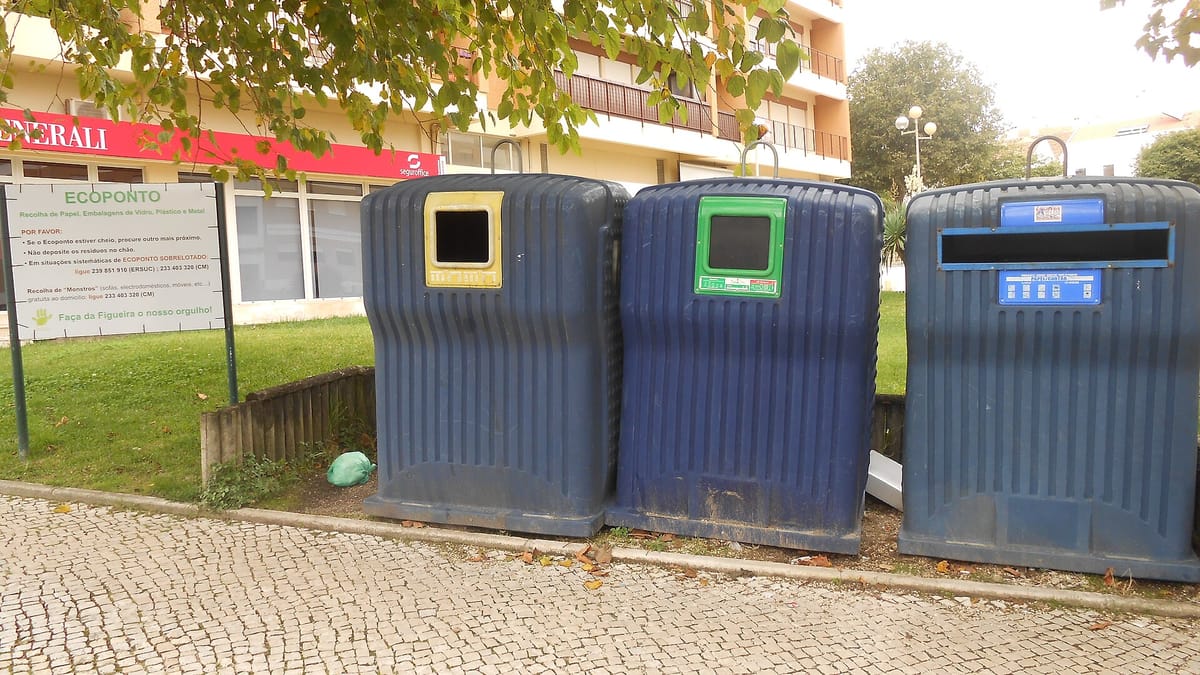
The first is the expansion of separate biowaste collection with solutions adjusted to local realities, which is the brown bin reaching more of the country. The second is the reinforcement of technical and financial support for economic instruments based on the quantity and type of waste a user produces, applying the polluter-pays principle where possible. That is pay-as-you-throw, and the resolution frames it as an incentive to reduce and separate correctly rather than as a revenue measure. What goes in which container today, and where to take oil, batteries and bulky items, is set out in our guide to recycling and household waste in Portugal.
Beyond that, the strategy leans on prevention: repair and reuse networks with traceability and safety guarantees, ecodesign encouraged through ecomodulation of producer fees, food-waste measures tied to the national food-waste strategy including incentives to donate and the provision of reusable or biodegradable containers for leftovers, and green public procurement under the ECO360 strategy. The deposit return scheme for drinks containers is not named in the resolution, which is notable given that the Environment Minister conceded this month that Volta has problems.
Non-urban waste gets its own axis, with measures by sector: prevention and reduced hazardousness at source for industrial waste, prevention and management plans and the use of recycled inert material in public works for construction and demolition waste, organic recovery for agricultural and agro-industrial waste, and separation at source with mandatory routing to licensed operators for hospital waste.
The bodies consulted before the resolution went to Cabinet ran from the municipalities' association and the competition authority to Sociedade Ponto Verde, the Electrão, Valorpneu, Sogilub and the environmental association ZERO.