Portugal Recycled 39 Percent of Its Urban Waste in 2025, 16 Points Below the EU's 55 Percent Target, as Rubbish Kept Growing
Portugal produced 5.667 million tonnes of urban waste in 2025 and recycled 39 percent, against a 55 percent target. Landfill still took 52 percent, and 34 municipalities have no real bio-waste collection, the Environment Agency's annual report shows.
Portugal produced 5.667 million tonnes of urban waste in 2025, about 2 percent more than in 2024, and prepared only 39 percent of it for reuse or recycling. The target for 2025, set in EU law and written into Portuguese law, was 55 percent. The country finished 16 percentage points short.
The figures are in the Relatório Anual de Resíduos Urbanos 2025 (Annual Urban Waste Report), published in October 2026 by the Agência Portuguesa do Ambiente (APA, the Portuguese Environment Agency) on its urban waste data page. The agency's own conclusion is that progress in 2025 was limited and that the sector's performance needs to speed up significantly.
More waste, still mostly buried
On the mainland, each resident produced 494 kilograms of urban waste in 2025, or 1.35 kilograms a day. That is below the EU average of 517 kilograms the report cites from Eurostat for 2024, but APA says the per-person figure fell mainly because the Instituto Nacional de Estatística (INE, the national statistics institute) revised the resident population upwards. The total kept growing: the report puts the rise partly down to population growth, with waste systems also pointing to tourism and unregistered residents. Counting Madeira and the Azores, the figure is 509 kilograms per person; the Azores alone reached 629.
Landfill took 52 percent of all urban waste nationally, against a legal target of 10 percent by 2035, and APA describes progress towards that goal as stalled. On the mainland, landfill was the final destination for about 55 percent of the waste produced, one point more than in 2024. Another 15 percent was burned for energy and 14 percent was recycled as material. About 27 percent of the waste handled by the mainland systems went into landfill without the pre-treatment that EU landfill rules require, and the report notes that an infringement procedure against Portugal is under way over that breach.
The pressure on landfill space is the backdrop to the government's Terra+ waste plan, whose diagnosis found 13 of the country's 32 landfills nearly full.
Separate collection barely moves
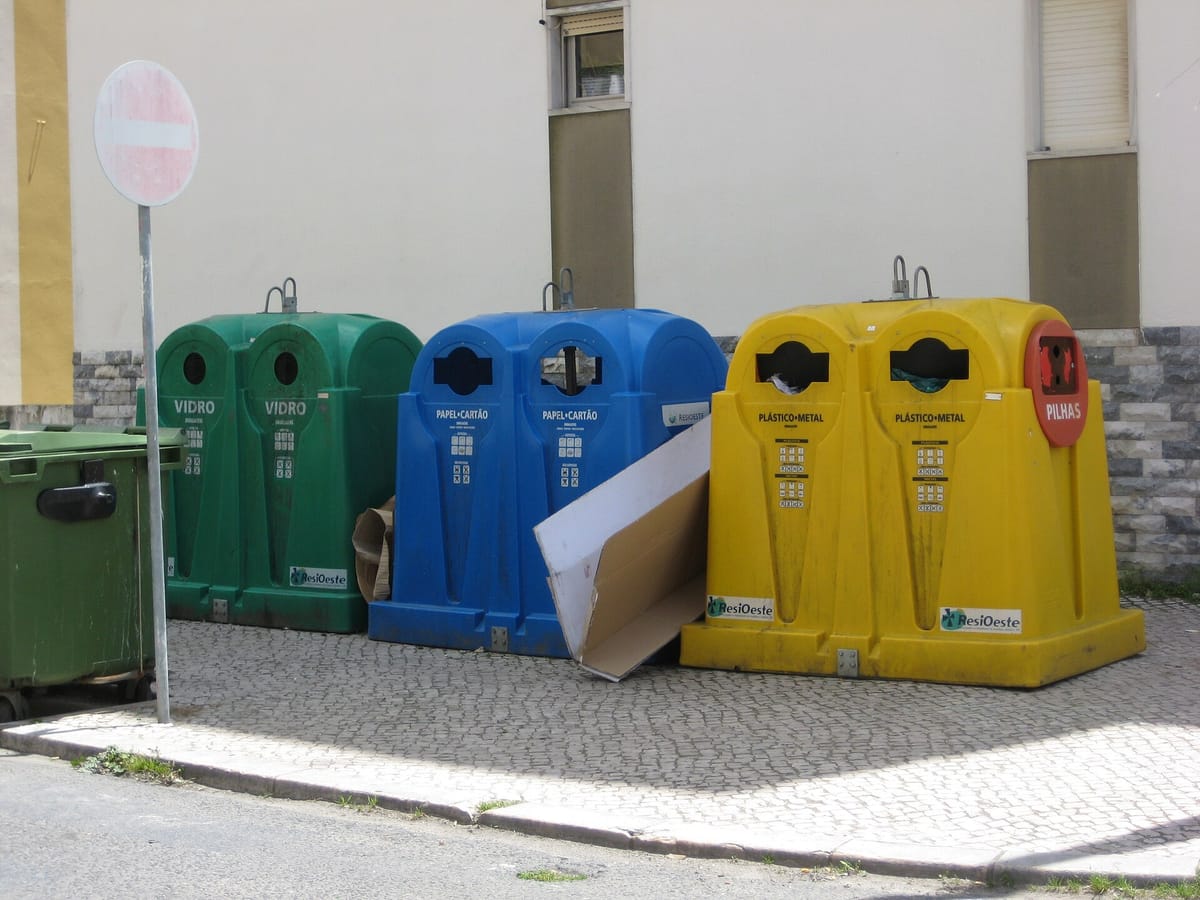
Only 24 percent of the urban waste collected on the mainland came through separate collection in 2025, one point more than the year before, while 75 percent still arrived as mixed rubbish. Of the plastic available in the waste stream, only about 24 percent was recovered, unchanged from 2024. Glass is the exception: more than half of it is already kept out of the mixed bin.
Food and garden waste is the biggest single fraction, about 37 percent of everything thrown away. Under the Regime Geral de Gestão de Resíduos (General Waste Management Regime), approved by Decreto-Lei n.º 102-D/2020, municipal waste systems had until 31 December 2023 to put separate collection of bio-waste, or home and community composting, in place (Articles 36 and 45 of the regime, as originally published).
Two years on, 208 municipalities collect bio-waste separately, eight more than in 2024 and roughly three quarters of the mainland total. The amount collected separately and sent for composting or digestion rose by more than 38,000 tonnes, to about 286,000 tonnes. But 34 municipalities either have no bio-waste collection or composting at all or capture practically none, and 102 more capture only 1 to 5 percent of the bio-waste their residents produce. Only 22 municipalities met the capture rate they had committed to in their own municipal waste plans.
The timing matters. From 2027, bio-waste recovered from mixed rubbish will no longer count towards the recycling target, and that category made up 46 percent of what counted towards Portugal's 39 percent result in 2025. APA warns that the gap to the targets will widen once the rule changes unless separate collection grows quickly.
Where the gaps are widest
Results vary widely between the 23 mainland waste systems. Ambisousa, which serves Castelo de Paiva, Felgueiras, Lousada, Paços de Ferreira, Paredes and Penafiel, sent 89 percent of its waste to landfill, recycled 10 percent and captured none of its bio-waste. Ecolezíria, in the Ribatejo municipalities of Almeirim, Alpiarça, Benavente, Cartaxo, Coruche and Salvaterra de Magos, recycled 8 percent and landfilled 87 percent. In the Algarve, ALGAR landfilled 82 percent and recycled 27 percent; the region also has the highest waste per resident on the mainland, 2.06 kilograms a day, which APA links to a floating population not counted in the calculation. Planalto Beirão, which serves Viseu and 18 neighbouring municipalities, had the lowest figure, 1.15 kilograms.
At the other end, Lipor in Greater Porto sent 3 percent to landfill and VALORSUL, whose area includes Lisbon, Amadora, Loures and Odivelas, 9 percent; both run incinerators. Resialentejo in Baixo Alentejo and ERSUC, which covers the Aveiro and Coimbra areas, recorded recycling rates of 61 and 60 percent. APA cautions that systems with mechanical and biological treatment plants score higher under the current formula, which counts 54 percent of what enters those plants as recycled.
What it means at home
The waste regime makes residents responsible for separating household waste and putting it in the collection points their service provides, and lets municipalities set fines in their regulations for not doing so (Article 46 of the original text). Where a council offers a brown bin or composting, using it now counts directly towards the targets: 184 municipalities run home or community composting schemes. APA ran a national awareness campaign, "Vamos Lixar o Lixo", from Christmas 2025, focused on bio-waste.
The report also points to pay-as-you-throw charging, which links a household's waste bill to how much it throws away, as a tool still little used in Portugal; APA plans to tender a study in 2026 to help municipalities introduce it. The bottle and can deposit scheme, which reached full operation in April 2026, falls outside the 2025 figures; APA calls its early results promising, though the scheme has had its own teething problems. And prevention starts in the kitchen: Portuguese households waste more food than any others in the EU.