Recycling and Household Waste in Portugal in 2026 — A Practical Guide to the Ecoponto Colour Codes, the Biorresíduos Brown Bin, the New Volta Deposit-Return System, and Where to Drop Oil, Batteries, Electronics, Monstros and Textiles
Recycling and household waste in Portugal in 2026 — the four Ecoponto colour codes (amarelo / azul / verde / castanho), the biorresíduos rollout under DL 102-D/2020, the new Volta deposit-return system, and where to drop oil, batteries, electronics, monstros and textiles.
The Portuguese household-waste-management system runs on a layered architecture that the foreign resident decodes one channel at a time: the four colour-coded Ecopontos on the street corner (yellow / blue / green / brown) that take packaging, paper, glass and biorresíduos; the dedicated containers for batteries, textiles and used cooking oil that drop into the same network; the Câmara-Municipal-operated monstros pickup for furniture and oversized waste; the Pontos Eletrão / Amb3E drop-off network for end-of-life electronics; the pharmacy VALORMED drop-off for expired medication; and, new from 2026, the Volta Sistema de Depósito e Reembolso for single-use beverage containers, which adds a refundable 15-cêntimo deposit on every plastic bottle and metal can under 3 litres. This guide walks the legal frame, the colour codes, the operational system, the new biorresíduos and Volta rails, the bulky-waste and end-of-life-electronics channels, and the foreign-resident-specific friction points.
The Legal Frame — Decreto-Lei 102-D/2020 and the Regime Geral de Gestão de Resíduos
The core legal instrument is the Regime Geral de Gestão de Resíduos (RGGR), approved by Decreto-Lei n.º 102-D/2020 of 10 December — the consolidating statute that transposed the EU Waste Framework Directive (Directiva 2008/98/CE) and the EU Single-Use Plastics Directive (Directiva 2019/904/UE) into Portuguese law, and that sets out the universal-extended-producer-responsibility (UNILEX) framework. The RGGR is the statutory anchor for: (i) the selective-collection obligations on municipalities; (ii) the obligations of the extended-producer-responsibility (EPR) entities — Sociedade Ponto Verde (SPV) on packaging, Amb3E on electronic and electrical equipment (EEE), ValorPneu on tyres, ValorFito on plant-protection-product containers, VALORMED on medication waste, Recibateria on batteries, and others; (iii) the consumer-side obligations on the segregation of household waste at source; and (iv) the regulatory framework that the Agência Portuguesa do Ambiente (APA) administers as the competent national authority.
The supporting framework includes Lei n.º 76/2019 (single-use plastics restrictions), Decreto-Lei n.º 78/2021 (the Single-Use Plastics transposition), Despacho n.º 14202-BB/2020 (selective-collection-of-textiles-and-mobiliário operational framework), and the parallel Decreto-Lei n.º 152-D/2017 on the framework for fluxos específicos de resíduos (specific waste streams: packaging, EEE, batteries, tyres, oils, vehicles in end-of-life).
The Ecoponto Colour Codes — The Four-Bin Standard
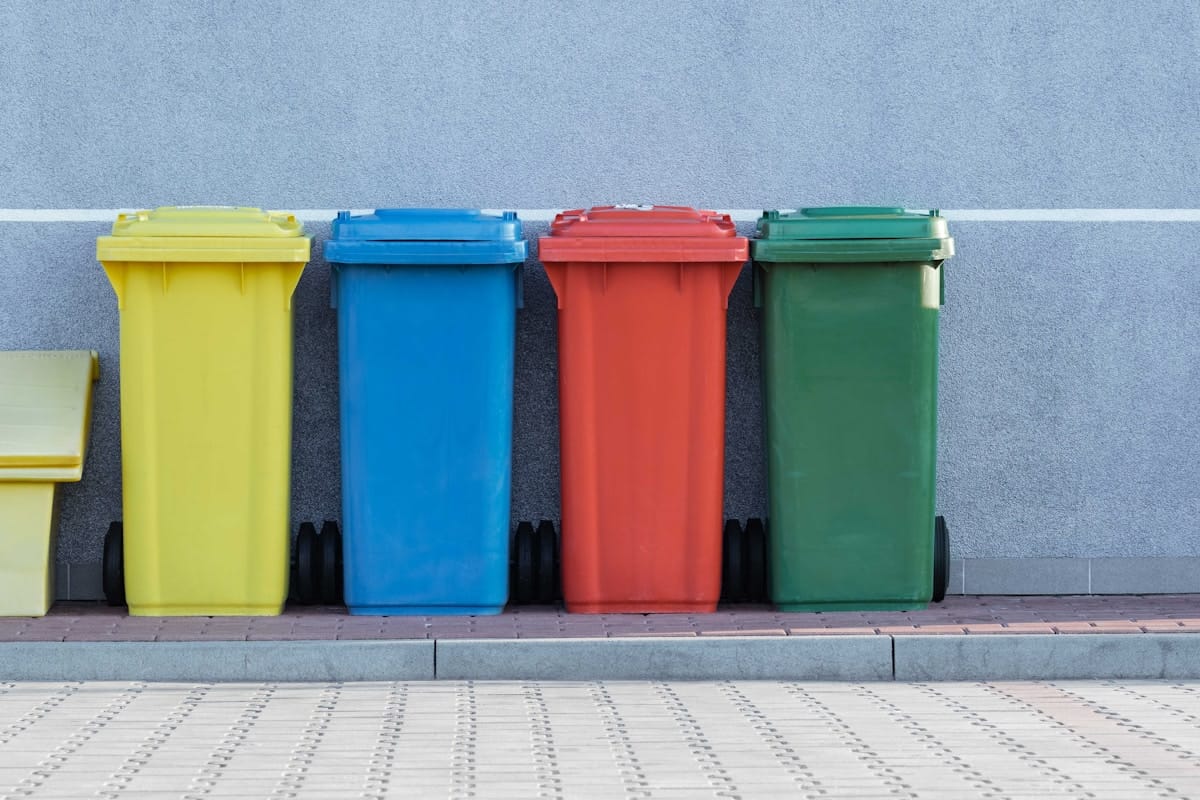
The standard Portuguese kerbside-and-public-space Ecoponto system runs on four colour-coded containers:
- Amarelo (Yellow) — Embalagens — for plastic, metal and beverage-carton packaging. What goes in: plastic bottles (water, soft drinks, oils, detergents, shampoos), plastic packaging and pots (yogurt pots, butter tubs, ice-cream containers), plastic bags and films, metal cans (food, beverages, beer, soft drinks), aluminium trays and foil, beverage cartons (Tetra Pak — milk, juice, soup, broths, sangria). What does NOT go in: hard plastic toys, garden hoses, PVC plumbing, pressurised gas canisters, syringes, used cooking oil (separate channel — see below).
- Azul (Blue) — Papel e Cartão — for paper and cardboard. What goes in: newspapers, magazines, books, paper packaging, cardboard boxes (flattened), egg cartons, kitchen-roll cores, brown paper bags. What does NOT go in: oily pizza boxes (cooking-grease contamination kills the recyclability), used napkins or kitchen tissue, photographic paper, plastic-laminated paper, tetra-pak (goes to amarelo).
- Verde (Green) — Vidro — for glass packaging. What goes in: wine bottles, beer bottles, water bottles, jam jars, conserve jars, perfume bottles, olive-oil bottles. Remove caps and corks (caps go to amarelo if metal-or-plastic; corks have a separate Pontos de Recolha de Cortiça network operated by Quercus). What does NOT go in: glass ovenware (Pyrex), mirrors, light bulbs (separate channel — see below), porcelain, ceramic crockery, drinking glasses, eyeglass lenses.
- Castanho (Brown) — Biorresíduos — the newer fourth-bin colour, for organic biodegradable household waste. What goes in: fruit-and-vegetable peelings, coffee grounds and filters, tea bags, eggshells, cooked-food leftovers (small quantities, no oils or sauces), garden trimmings (small leaves, grass clippings), food-soiled napkins. What does NOT go in: meat or fish (large quantities, smell), oils or fats, animal excrement, large garden waste (separate Câmara channel).
The fifth standard waste stream — resíduos indiferenciados / mistos (mixed undifferentiated waste, the residual after segregation) — goes to the standard general-waste container, in many municipalities the contentor cinzento (grey) or the standard street container, which is collected on the daily-or-near-daily municipal-collection-truck rail and routed to incineration or landfill under the regional waste-management-system operator (Valorsul in Greater Lisbon, Lipor in the Porto metropolitan area, Algar in the Algarve, and the broader network of regional sistemas de gestão de resíduos urbanos).
The Biorresíduos Rollout — Mandatory Since End-2023, Implementation Still Patchy
The selective collection of biorresíduos (organic biodegradable waste) became mandatory under Decreto-Lei n.º 102-D/2020 as of 31 December 2023. Implementation has been operationally patchy: the APA's Relatório Anual Resíduos Urbanos 2024 reported that biorresíduos selective-collection reached around 12% of total biorresíduos produced in 2023, and that only 43% of the 185 responding municipalities were operating any selective-collection of biorresíduos. The principal reasons cited: capex shortfall for the container-and-truck infrastructure, the operational-cost-and-frequency demands on the collection rail, and the consumer-side adoption curve. The Lipor system in greater Porto and the Valorsul system in greater Lisbon are the two most-advanced implementations; the smaller-municipality network is uneven.
For the foreign resident, the practical read: check your municipality's website (câmara municipal) for the local biorresíduos schedule — some municipalities have rolled out kerbside brown-bin collection to residential households on a once-weekly cycle; others operate only voluntary-drop-off brown bins at central locations; and a residual minority have not yet implemented the brown bin at all. The Lisbon Municipal Council (CML), Porto Municipal Council (CMP), and the larger Algarve municipalities are operationally well-advanced.
The Volta Sistema de Depósito e Reembolso — New From 2026
The most significant 2026 change to the consumer-side packaging-recycling rail: the rollout of the Sistema de Depósito e Reembolso (SDR) for single-use beverage packaging, branded as Volta, the official symbol of Portugal's deposit-return system. From 2026, single-use beverage containers — plastic bottles and metal cans under 3 litres — that carry the Volta mark are subject to a refundable deposit at the point of purchase: the consumer pays an extra amount (the deposit) at the till and reclaims it by returning the empty container to a Volta drop-off point — supermarkets and convenience-store networks are the primary collection channel, with reverse-vending machines (RVMs) or counter-return processes accepting the empty container and refunding the deposit by cash or by store credit.
The Volta target curve: 40% to 70% of in-scope packaging collected through the SDR in 2026 (the first year); 80% by 2027; 90% by the end of the decade — the latter the EU-level target under Directiva 2019/904/UE. The SDR is operationally distinct from the standard Ecoponto Amarelo route — once the Volta mark is on a beverage container, the consumer's incentive is to take it back through the SDR channel for the refund, rather than into the amarelo where the deposit is lost.
For the foreign resident: the operational change is gradual and depends on the in-scope packaging carrying the Volta brand. Through 2026 most beverage packaging in Portuguese supermarkets is still on the legacy non-deposit framework; the rollout is progressive as suppliers transition their packaging to the SDR-compliant marked form. The practical advice: keep the receipt for any clearly-Volta-marked beverage container; return it to the nearest participating drop-off (typically signalled at the supermarket entrance with the Volta logo and the RVM).
Used Cooking Oil — The Oleão Network
Used cooking oil (óleo alimentar usado, OAU) is one of the household waste streams with the highest cost-of-mismanagement: a litre of oil poured down the drain contaminates a thousand-plus litres of fresh water and clogs the sewage-and-treatment infrastructure. Portugal has a structurally-underused OAU-collection rail — the ZERO environmental association estimates that around 96% of household cooking-oil that could be recovered is not, despite a wide network of Oleão drop-off containers across the major municipalities.
The operational instructions: pour cool used cooking oil into a clean plastic bottle (a standard 1.5L water bottle or a 5L PET bottle works), seal it tightly, and drop it at the nearest Oleão container — typically located at supermarket entrances, parking lots, and selected street-corner locations under the Câmara Municipal sign-posting. Oil is taken to processing for biodiesel and other industrial uses under the regional system operator. The Lisboa-Oleão, Porto-Oleão, and Algarve-Oleão networks are the most developed; the rural-and-interior network is more limited but expanding.
Used Batteries — The Pilhão Network
Used batteries — both alkaline single-use and rechargeable — are collected through the dedicated Pilhão network operated under the EPR framework by Ecopilhas and Electrão. Drop-off points are located at: supermarkets and convenience stores (the small countertop Pilhões near the till), pharmacies, post-office (CTT) branches, school entrances, town-hall lobbies, and selected street-corner Pilhões. Both household batteries (AA, AAA, button cells, 9V) and the larger rechargeable-tool batteries (cordless-drill packs, electric-bike batteries) are in-scope. Car batteries and industrial batteries operate on a separate professional-collection rail.
The legal frame: batteries are subject to the extended-producer-responsibility regime under Decreto-Lei n.º 152-D/2017 and the EU Battery Regulation (Regulamento (UE) 2023/1542). The producer-fee paid at the point of sale funds the collection-and-recycling network.
End-of-Life Electronics — The Pontos Eletrão Network
End-of-life electrical-and-electronic equipment (REEE — Resíduos de Equipamentos Eléctricos e Electrónicos) operates on the EPR rail through the Amb3E system and the parallel Electrão network. The drop-off channels:
- Pontos Eletrão — fixed drop-off containers at supermarkets, Câmara Municipal buildings, schools and large retailers — for small electronics (mobile phones, tablets, small kitchen appliances, electric razors, hair dryers, computer accessories).
- Retailer take-back at point-of-purchase — under EU and Portuguese REEE rules, retailers selling new electronics must accept the equivalent end-of-life item back at no charge (1-for-1 take-back). Larger retailers also operate 0-for-1 take-back for small electronics (a small phone or charger can be dropped off without buying a replacement).
- Câmara-Municipal-operated Ecocentros — fixed waste-management centres operated by the municipality, accepting larger end-of-life electronics, white goods (refrigerators, washing machines, dishwashers, ovens), monitors, TVs and computer towers. Free for residents on production of a Comprovativo de Morada.
- Recolha de Monstros (bulky-waste pickup) — for large end-of-life appliances, the Câmara Municipal-operated monstros service (see below) typically also accepts white-goods alongside furniture.
Pharmacy Waste — VALORMED
Expired or unused medication — including the original blister-pack packaging and the cardboard box — should go to the VALORMED container at any farmácia (pharmacy). Most pharmacies in Portugal have a marked VALORMED container at the counter where the customer can drop the package. VALORMED operates under the parallel EPR framework for the pharmaceutical-waste stream. Sharp items (syringes from diabetes-management or other home-care use) operate on a separate channel — request a contentor de cortantes from the pharmacy or the centro de saúde.
Textiles, Shoes and Soft Furnishings — The Refundo / Humana / Cáritas Network
Used textiles, clothes, shoes, bedding, towels and small soft-furnishings (cushions, curtains) are collected through a network of:
- Textile-drop-off containers on the kerbside, operated by Refundo, Humana Portugal, Cáritas, the Banco de Bens Doados network, and assorted municipality-operated containers.
- Charity drop-off points at parish (Igreja Católica / Misericórdia) and community-organisation premises.
- Retailer take-back — H&M, Zara, Tiffosi and other fast-fashion retailers operate in-store collection bins for used clothing.
Under Decreto-Lei n.º 102-D/2020 and the Despacho n.º 14202-BB/2020, the selective collection of textiles became mandatory at the municipality level from 1 January 2025. Implementation continues to roll out; the kerbside-textile-container network is now operational in the major urban municipalities and expanding into the smaller-municipality network.
Bulky Waste — Recolha de Monstros
Furniture, mattresses, large white goods, garden waste in volume, and other oversized end-of-life household items operate on the Recolha de Monstros rail — a Câmara-Municipal-operated pickup service. The standard process:
- Phone the Câmara Municipal monstros line (number varies by municipality — Lisboa is 808 200 530, Porto is 800 200 011, Cascais is 800 203 092, and so on) or use the online-booking portal where available.
- Schedule the pickup — typically a specified day-and-time window (often early morning the day after the booking), with the resident placing the items at the kerbside the evening before.
- The service is generally free for residents up to a per-household-per-period limit (varies by municipality, typically 1m³ per pickup, with periodic free pickups across the year).
- Alternative: drop off the items at the nearest Ecocentro directly. Free for residents on production of Comprovativo de Morada.
Dumping bulky items at the kerbside without a scheduled pickup is an administrative offence (contraordenação) under the RGGR framework with fines of €50-€2,500 for individuals (more for legal persons). The Câmara Municipal enforces this through the municipal-police (Polícia Municipal) and the municipal-sanitation inspectors.
Construction and Demolition Waste — The CIRVER Network
Construction-and-demolition waste (RCD — Resíduos de Construção e Demolição) from home renovations operates on a separate professional-collection rail under Decreto-Lei n.º 102-D/2020 Capítulo VI and the parallel CIRVER (Centro Integrado de Recuperação, Valorização e Eliminação de Resíduos) framework. The principal pathways for foreign residents undertaking a home renovation:
- Contracted construction company — the construction company is responsible for the RCD-disposal as part of the project, including the documentary trail (Guia de Acompanhamento de Resíduos — GAR — on the SILiAmb electronic platform of the APA).
- Self-managed renovation — the resident contracts directly with a licenced RCD-disposal operator, rents a caçamba (skip) for the duration of the works, and pays for the removal-and-disposal.
- Small-quantity household disposal — small quantities of household construction waste (a broken tile, a small piece of plaster) can go to the Ecocentro on a fee-or-free basis depending on municipality and quantity.
Garden Waste
Garden waste — branches, leaves, grass clippings — operates on a hybrid rail: small quantities of grass clippings and small leaves can go to the Castanho biorresíduos bin where available; larger quantities should go through the Ecocentro or via a specific Câmara Municipal pickup. Some municipalities operate a dedicated recolha de verdes service for residents with gardens; check the Câmara website. Burning garden waste is regulated under the fire-prevention framework, with seasonal prohibitions during the Critical Fire-Risk Period (15 May to 31 October by default, with annual adjustments by ICNF and Proteção Civil).
Hazardous Household Waste
Hazardous waste from household sources — paints and solvents, fluorescent tubes and energy-saving bulbs, garden chemicals, automotive fluids, old fire extinguishers — go to the Ecocentro on a separate hazardous-waste channel. The Ecocentro accepts these in small quantities free for residents. Do not put hazardous waste in the standard Ecopontos or in the indiferenciado bin.
The Cost Structure — Tarifa de Resíduos on the Water Bill
The household waste-management service is funded through the Tarifa de Gestão de Resíduos Urbanos, typically charged on the monthly water bill alongside the water-supply-and-sewage tariffs. The structure varies by municipality and water-utility operator, but is generally either a flat-rate component plus a variable component indexed to water consumption (the proxy for household size), or a fully-flat-rate per-household charge. The 2026 charges run roughly €5-15/month for a standard household in the major municipalities, with municipal-level variation.
The Tarifa is in some municipalities subject to the Tarifa Especial social rate for low-income households, with eligibility on the same framework as the Tarifa Social de Eletricidade and the Tarifa Social de Comunicações (see the parallel files on these social-tariff mechanisms).
Common Failure Modes for Foreign Residents
- Mixing food waste into the amarelo (yellow) bin — yogurt pots, butter tubs and ice-cream containers are accepted in amarelo only if rinsed clean; food-soiled packaging contaminates the recyclate and is rejected at the sorting line. Solution: rinse before depositing.
- Glass cookware in verde — Pyrex, drinking glasses and porcelain crockery have a different melting temperature from container glass and contaminate the verde stream. Solution: take to Ecocentro as bulky waste or specialised drop-off.
- Plastic bags as the household waste container — putting a tied plastic shopping bag of segregated recyclables into the amarelo is a common mistake; the sorting line cannot easily open the bags and the entire bag may be diverted to the residual stream. Solution: tip the loose recyclables directly into the amarelo.
- Tetra Pak in azul (blue) — beverage cartons are technically composite packaging (paper-aluminium-plastic) and go to amarelo, not azul. Solution: remember Tetra Pak follows the bottle-and-can rail, not the paper rail.
- Pizza boxes in azul — oily-cardboard contaminates the paper stream. Solution: clean cardboard to azul, oily portions to indiferenciado or biorresíduos.
- Caçamba dumping — leaving the construction-renovation skip overdue or overfilled triggers fines. Solution: rent the skip for the right duration, do not exceed capacity.
- Bulky waste at the kerbside without booking the monstros — common foreign-resident mistake on the first major move-out or refurbishment. Solution: phone the Câmara Municipal monstros line and book.
The Complaint Channel — APA, ERSAR and the Câmara Municipal
If you have a complaint about the household-waste-management service (missed collection, broken Ecoponto, unauthorised dumping site, the lack of biorresíduos collection in your area), the institutional channels run: (i) the Câmara Municipal sanitation department (Direção Municipal de Higiene Urbana / equivalent); (ii) the regional system operator (Valorsul, Lipor, Algar, etc.) for cross-municipality issues; (iii) the Entidade Reguladora dos Serviços de Águas e Resíduos (ERSAR) at ersar.pt — the national regulator for the water and waste service sector, which handles consumer complaints about service quality and tariffs; (iv) the Agência Portuguesa do Ambiente (APA) at apambiente.pt for the broader policy-and-framework concerns; (v) the universal Livro de Reclamações at livroreclamacoes.pt, which routes complaints to the relevant supervisory authority.
The Cross-Link Read
The household-waste-management rail intersects with several other foundational-onboarding files for the foreign resident: the Utilities Guide (electricity, water, gas, broadband setup — the tarifa de resíduos sits on the water bill); the Renting Guide (the rental contract typically specifies who pays the waste tarifa); the Banking Guide (the water-and-waste-bill direct-debit setup); the Pets Guide (pet waste is part of the household waste tape, with the small-quantity dog-waste-bag etiquette on public streets); the Cycling Guide and the Hiking Guide (the Leave-No-Trace etiquette on the EuroVelo and the Rota Vicentina, where pack-it-out is the operational norm). The Volta SDR launch in 2026, the biorresíduos rollout completing through 2026-2027, and the textile-recollection mandate of January 2025 are the three structural changes the recent-arrival foreign resident should track through the rest of the decade.
Portugal's waste-management infrastructure is, on the European scoreboard, mid-pack: better than the southern-European median on selective-collection rates, behind the northern-European frontier on the circular-economy-and-landfill-diversion tape, with 57% of waste still going to landfill in the most recent published cycle. The household-side participation — segregating at source, walking the four-colour Ecoponto routine, using the dedicated Oleão / Pilhão / Eletrão / VALORMED channels for the specific waste streams — is the lever that moves the system forward.
Source whitelist compliance: Agência Portuguesa do Ambiente (APA) institutional disclosures — Tier 1, apambiente.pt — including the Relatório Anual Resíduos Urbanos 2024, the Biorresíduos framework, and the SILiAmb electronic waste-management platform. Diário da República — Tier 1, dre.pt — for Decreto-Lei n.º 102-D/2020 (Regime Geral de Gestão de Resíduos), Decreto-Lei n.º 152-D/2017 (specific waste streams), Decreto-Lei n.º 78/2021 (Single-Use Plastics transposition), Lei n.º 76/2019 (single-use plastics restrictions), Despacho n.º 14202-BB/2020 (textiles and bulky-waste selective collection). European Union — Tier 1, ec.europa.eu — for Directiva 2008/98/CE (Waste Framework Directive), Directiva 2019/904/UE (Single-Use Plastics Directive), Regulamento (UE) 2023/1542 (Batteries Regulation). Entidade Reguladora dos Serviços de Águas e Resíduos (ERSAR) — Tier 1, ersar.pt. Instituto da Conservação da Natureza e das Florestas (ICNF) and Autoridade Nacional de Emergência e Proteção Civil (ANEPC) — Tier 1 institutional, for the burning-of-garden-waste seasonal framework. Sociedade Ponto Verde (SPV), Amb3E, Electrão, Ecopilhas, ValorPneu, ValorFito, VALORMED, Recibateria, Volta — Tier 1 corporate EPR-system institutional. Valorsul, Lipor, Algar — Tier 1 regional waste-management system operators. Câmara Municipal de Lisboa (CML), Câmara Municipal do Porto (CMP) and the broader municipality network — Tier 1 institutional. Quercus and ZERO environmental associations — Tier 1 institutional. Refundo, Humana Portugal, Cáritas, Banco de Bens Doados — Tier 1 third-sector institutional. Observador (observador.pt), Público (publico.pt), ECO (eco.sapo.pt), Notícias ao Minuto (noticiasaominuto.com) — Tier 2 — for story discovery and corroboration on the Volta SDR launch and the biorresíduos rollout. Portugal Post not consulted (blacklisted).