General Daily Briefing: Monday, 24 August 2026

Good morning. Here is your Monday briefing for 24 August 2026: the day's essential Portugal stories for residents, expats and anyone keeping an eye on the country, running from the quiet end of Lisbon's financial quarter and forty households in the path of the high-speed line to a mental-health reform arriving at its deadline, a Caparica laboratory funded by the European Space Agency, the Festa do Avante!'s fiftieth year and a rewritten rulebook for inclusive schooling.
- The Banco de Portugal is moving its 1,400 Lisbon staff to Entrecampos, and Fidelidade goes first in September, closing out the Baixa as the city's financial quarter.
- About 40 households in Campanhã sit inside the high-speed line's expropriation area, and Porto is studying whether municipal land at Noeda can rehouse them together.
- Portugal had 598 mental-health residential places approved at the end of July, clearing a target of 500, with the European money behind them expiring this year.
- Astro Power, an ESA-funded project at NOVA in Caparica, turns muscle activity into a beep so users can hear their own power output, tested first on people aged 63 to 78.
- The Festa do Avante! reaches its fiftieth year on 4 to 6 September at the Quinta da Atalaia, with Beethoven's Ninth on the bill and the labour package as its political theme.
- A revised inclusive-education regime takes effect in January 2027, creating a national support system and a named manager per pupil, in schools that say they lack the technicians to run it.
Cutting Down a Tree on Your Own Land in Portugal in 2026
Portugal has no general felling permit, which is why so many owners assume a tree on their own land is theirs to cut. Four categories override that assumption: cork oak and holm oak, olive, wild holly and classified trees. Our new guide sets out what needs authorisation and from whom, why you have to band the trunk in paint before anyone touches it, when official silence counts as approval, what the fines look like, and why an illegal cut freezes the land's use for 25 years.
With the Bank of Portugal Bound for Entrecampos, Lisbon's Baixa Loses the Last of Its Financial Quarter
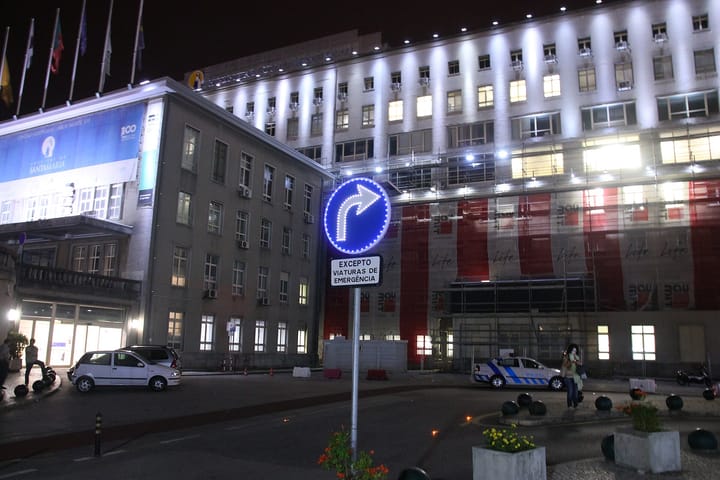
Fidelidade takes possession of a new head office at Entrecampos in September, on the old Feira Popular ground beside the Rego tunnel, and the Banco de Portugal follows onto the same site with more than 1,400 Lisbon staff. Público reported on Monday that the two departures end the Baixa's run as the city's financial quarter and kill a plan two decades old to keep it that way. The building deal has already been rewritten: the contract signed in May 2024 under Mário Centeno covered two blocks for about €192 million, and in July his successor Álvaro Santos Pereira cut it to a single block at €165.7 million, saving €35 million to €40 million, with the fit-out budget trimmed from €72 million to €62 million and the €57 million already advanced untouched. The bank says it needs less space because 160 staff have volunteered for regional branches and remote working has widened; the European Central Bank separately blocked an audit of the project by the Inspecção-Geral de Finanças on independence grounds. What stays downtown is the public-facing remnant: the tesouraria, the historic seat and the Museu do Dinheiro in the shell of the old São Julião church. The drift is old. Millennium BCP left Rua Augusta for Taguspark in 2008, and Pombaline floorplates have been losing to whole modern buildings ever since.
About 40 Campanhã Households Sit in the High-Speed Line's Path, and Porto Is Weighing Municipal Land at Noeda to Rehouse Them
Porto city council has confirmed that it has identified municipal land at Noeda, a rural pocket immediately behind Campanhã station, and is examining whether it can be used to rehouse the roughly 40 families whose houses the Lisbon to Porto high-speed line will take. The land was raised once before, at a public meeting in the closing months of Rui Moreira's mandate, and then dropped out of the conversation. The executive led by Pedro Duarte now says it is working with LusoLav, the consortium contracted to design, build, finance and maintain the first sections of a line meant to run Porto to Lisbon in 1h15 from 2032, on a solution covering both owners and tenants, based on a detailed characterisation of the households to be rehoused. It also concedes it is still studying "the most appropriate model", including the legal basis for using council property, which is a careful way of saying the mechanism does not exist yet. Porto is not the expropriating authority: under the concession the consortium runs the expropriations in the state's name and pays the compensation. The execution project foresees 236 demolitions between Porto and Oiã, the expropriations carry urgent public-utility status, and residents in the Bairro da Alegria say that since the route was first published in 2024 nobody from the câmara has visited them.
Portugal Now Has 598 Approved Mental-Health Residential Places, and the European Money Behind Them Runs Out This Year
Portugal had 598 places approved in residential integration structures at the end of July, clearing the 500 the Recovery and Resilience Plan set as its target. The timing is the story. These residences are the mechanism for moving three groups out of institutions: long-stay psychiatric patients, people who have completed security measures in forensic units, and people with serious mental illness who are readmitted repeatedly because nothing exists between the ward and the family home. The €88 million earmarked inside the PRR came with a milestone requiring the first 100 responses in 2022. The tender was launched in March 2025, its deadline was extended eight times, and it drew 23 applications covering just under 400 places; a fresh call opened at the start of this year, and the count moved from 388 in February to 598 in July. Approval is not occupancy: the places open as building works finish, and of four inpatient-unit projects in general hospitals, one is complete. Some investments have been reallocated entirely. Work left unfinished when the plan's window closes has to be paid for from the national budget instead, and nobody has published a staffing plan for the psychiatric nurses, monitors and psychologists 598 beds will need.
A Caparica Laboratory Is Teaching Muscles to Beep, and the European Space Agency Is Funding It
In a room in the physics department at NOVA's Faculdade de Ciências e Tecnologia in Caparica, researchers have been wiring electrodes to volunteers in their seventies and asking them to listen to their own muscles. The project is Astro Power, and the European Space Agency is paying for it. The premise turns on a word coined by the Portuguese researcher Sandro Freitas: powerpenia, the gradual loss of explosive muscular power as fast-twitch motor units decline. It happens with age and it happens in orbit, where a month in microgravity costs an astronaut roughly a year's worth of muscle ageing. The system is cheap by design. Electrodes made by the Portuguese company PLUX read the muscle, a Bluetooth unit feeds a computer or a phone app, and software converts the electrical activity into sound in real time: a loud, steady beep means the muscle is producing power in the target band, a weak or wavering one means the form needs correcting. Led by Hugo Gamboa and Luís Silva with the doctoral student Dania Furk, the team tested 23 people aged 63 to 78 alongside the Universidade Sénior de Almada and recorded faster squat contraction, higher bench-press peak force and greater contraction overall. A third phase now runs a single session with 107 participants aged 18 to 89.
The Festa do Avante! Reaches Its Fiftieth Year at the Quinta da Atalaia, With Beethoven's Ninth and a Fight Over Labour Law
Volunteers are painting murals on the Quinta da Atalaia in Amora, Seixal, ahead of the PCP's festival on 4, 5 and 6 September. Fifty years in, the Festa do Avante! is older than almost every music festival now running in Portugal, and unlike any of them it is built and dismantled each year by unpaid militants and sympathisers. It has changed site more than once and survived setbacks that would close a commercial event, including an explosion and a torrential downpour, before settling at the Atalaia in 1990. "It is incredible to show that for fifty consecutive years, even with difficulties, we managed to build something like this," Maria Rôlo told Público on the grounds last week. The music programme is broad by design: Carolina Deslandes, Carlão, Ney Matogrosso, António Zambujo and the guitarist Pedro Jóia, with the trumpeter Laurent Filipe on Miles Davis, the American group Erica Brown & The Bluegrass Connection, and Portuguese acts including King Bigs, Luta Livre and Ghoya. The traditional symphonic concert takes Beethoven's Ninth, played by the Orquestra Sinfonietta de Lisboa with the Coro Sinfónico Lisboa Cantat. The politics are not incidental: the theme this year is opposition to the government's pacote laboral, which returns to Parliament in the autumn alongside the 2027 budget.
Portugal Rewrote Its Inclusive-Education Rulebook for January 2027, and Schools Say the Staff to Run It Are Not There
The Council of Ministers approved a revision of the Regime Jurídico da Educação Inclusiva on 30 July, replacing the framework in force since 2018, built on 492 contributions from the public consultation and on an ISCTE external evaluation carried out in 2025. It takes effect in January 2027, once complementary legislation is published. Four things change. A Sistema Nacional de Apoio à Inclusão provides a continuous response through to the end of compulsory schooling, coordinated through regional sub-commissions and local inclusion support teams. A single Plano de Desenvolvimento Integral replaces the scattered documents that followed a pupil. A Gestor de Apoio à Inclusão is named for each child, so one identifiable person owns a complex case. And differentiated curricular pathways are explicitly recognised for high-ability pupils. As the 2026/2027 year opens, directors are making a different point: what is missing is people. The scarcest technicians are speech therapists, occupational therapists and psychologists. In April the Education Ministry opened procedures to put 1,406 specialised technicians onto permanent staff, 758 of them psychologists, and the Ordem dos Psicólogos Portugueses replied that 758 posts will not even absorb the roughly 900 psychologists already working in schools on contracts.