A Caparica Laboratory Is Teaching Muscles to Beep, and the European Space Agency Is Funding It
Astro Power, run at NOVA's Faculdade de Ciências e Tecnologia, turns muscle activity into sound so the user can hear their own power output. Trials with 23 people aged 63 to 78 recorded faster squats and higher peak force. A month in orbit costs about a year of muscle ageing.
In a room in the physics department at NOVA's Faculdade de Ciências e Tecnologia in Caparica, a group of researchers has been wiring electrodes to volunteers in their seventies and asking them to listen to their own muscles. The project is called Astro Power, the European Space Agency is funding it, and the first results are in: the beep works.
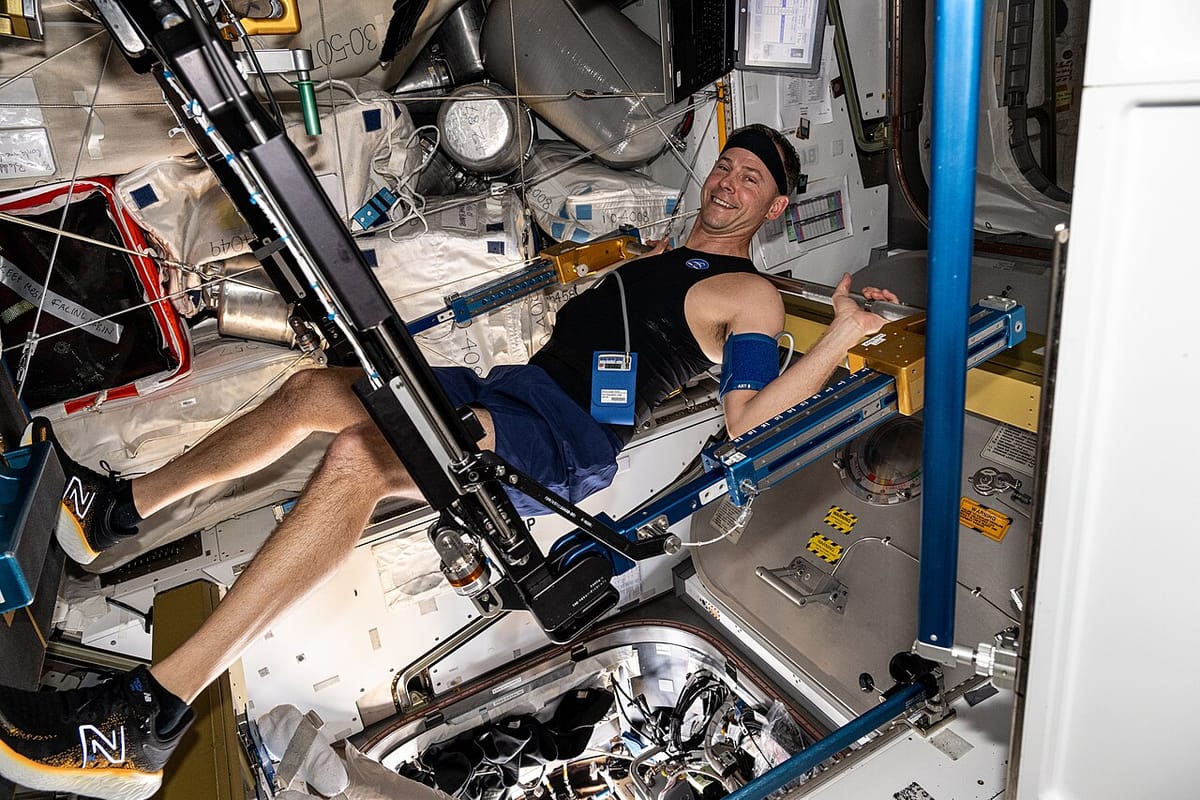
The premise starts with a word. Sandro Freitas, a Portuguese researcher, coined "powerpenia" to describe the gradual loss of explosive muscular power that comes from the decline of fast-twitch motor units. It happens with age, and it happens in orbit. A month in microgravity costs an astronaut roughly a year's worth of muscle ageing, which is why the ESA became interested in a Caparica laboratory studying pensioners.
How acoustic biofeedback works
The set-up is deliberately simple. Electrodes made by the Portuguese company PLUX attach to the muscle, a Bluetooth unit sends the signal to a computer or a phone app, and software converts the muscle's electrical activity into sound in real time. A loud, steady beep means the muscle is producing power in the target band for the exercise. A weak or wavering one means the form needs correcting. The user is not reading a screen; they are hearing their own contraction.
The team is led by professors Hugo Gamboa and Luís Silva alongside Dania Furk, a biomedical engineering doctoral student who took the best-poster prize at the first international conference devoted to powerpenia, held in Lisbon this summer. "What we noticed was that by having a perception of the force they were exerting, people manage to unlock their muscular potential," Gamboa told Observador.
What the three studies found
The first cohort was 23 people aged 63 to 78, recruited with the Universidade Sénior de Almada. They were split in two: one group exercised to music, the other to the beeps from their own muscles. Both used the same cable-resistance gym machine, hauled out to Almada and back. The results recorded faster contraction velocity in squats, a higher peak force on the bench press, and greater muscle contraction overall.
A second study applied the same method to 24 adults aged 18 to 29. Bench-press performance improved; neuromuscular coordination did not change. Across the three studies, 27 researchers, interns and students worked with 154 participants in total. The third and largest phase is a single-session protocol with 107 people aged 18 to 89, adding body composition, muscle coordination and grip strength measured on a redesigned dynamometer that logs time, force and intensity rather than a single peak reading. The object is to compare functional biological age with the age on the cartão de cidadão.
What this means for readers in Portugal
- Explosive power fades before strength does. The capacity to stand up quickly or catch a stumble goes first. Training it is a different exercise from lifting heavy.
- Senior universities are research partners. The Universidades Seniores network runs in most Portuguese municipalities and is frequently how these trials recruit. Joining one is the practical route into studies like this.
- There is no product yet. Astro Power is a research protocol, not a device you can buy, and the team is explicit that it complements rather than replaces existing exercise.
- Portugal's space work is not only satellites. The ESA also runs a business incubator in Oeiras, and human physiology is now a Portuguese thread inside its programme.
There is no timetable for putting the system on a crewed ESA mission, and the researchers claim no cure for either ageing or microgravity. What they have is a cheap signal that tells a body, out loud, when it is doing the thing that matters.