Cutting Down a Tree on Your Own Land in Portugal
Researched and written with AI tools from official sources. How we make our guides
Most trees on your land need no permit. Cork oaks, holm oaks, olive groves, wild holly, and classified trees do. How to apply, and the fines if you do not.
Last verified: October 2026.
Who this is for
- You own or rent rural land, a quinta, or a garden in mainland Portugal and want to fell or prune a tree.
- You are buying rural land and want to know what rules come with the trees on it.
- You have a neighbour's tree hanging over your land.
Not for you if: you need to clear vegetation around your house for fire safety. Read Preparing for Wildfire Season in Portugal instead.
For most trees on private land in Portugal, you need no permit to cut them down. A pine, a eucalyptus, a fruit tree, or a garden ornamental is yours to fell. Five groups are different. Cork oaks and holm oaks need authorisation from the nature and forests institute (ICNF), even a single tree. Olive groves need authorisation from your regional coordination commission (CCDR). Wild holly may not be cut at all. Trees classified as being of public interest need ICNF approval for any work. Fines for the oaks and classified trees can reach tens of thousands of euros.
The default: no general felling permit
Portugal has no national law that makes you ask before cutting down an ordinary tree on your own land. ICNF confirmed this in March 2026 about a large stone pine felling on private land near Sesimbra. The land was not in a protected area, no protected species were cut, and ICNF said the work needed no authorisation from it.
That default has limits:
- Protected species and classified trees. These are covered in the sections below.
- Protected areas and Natura 2000 sites. A natural park's management plan, or a Natura 2000 site, can add conditions. So can your council's master plan (Plano Diretor Municipal, PDM). This matters for other oak species too.
- Riverbanks. Work inside the public water domain along rivers and streams needs prior authorisation from the Portuguese Environment Agency (APA).
- Selling the wood. If you cut more than 10 forest trees and sell the wood, a cutting manifest is required (see below). The fire management agency also says cutting conifers, such as pine, requires a cutting manifest.
- Council trees. Street and park trees belong to the council or the state, and their own rules apply. They are not yours to cut.
Cork oaks and holm oaks: you need ICNF authorisation
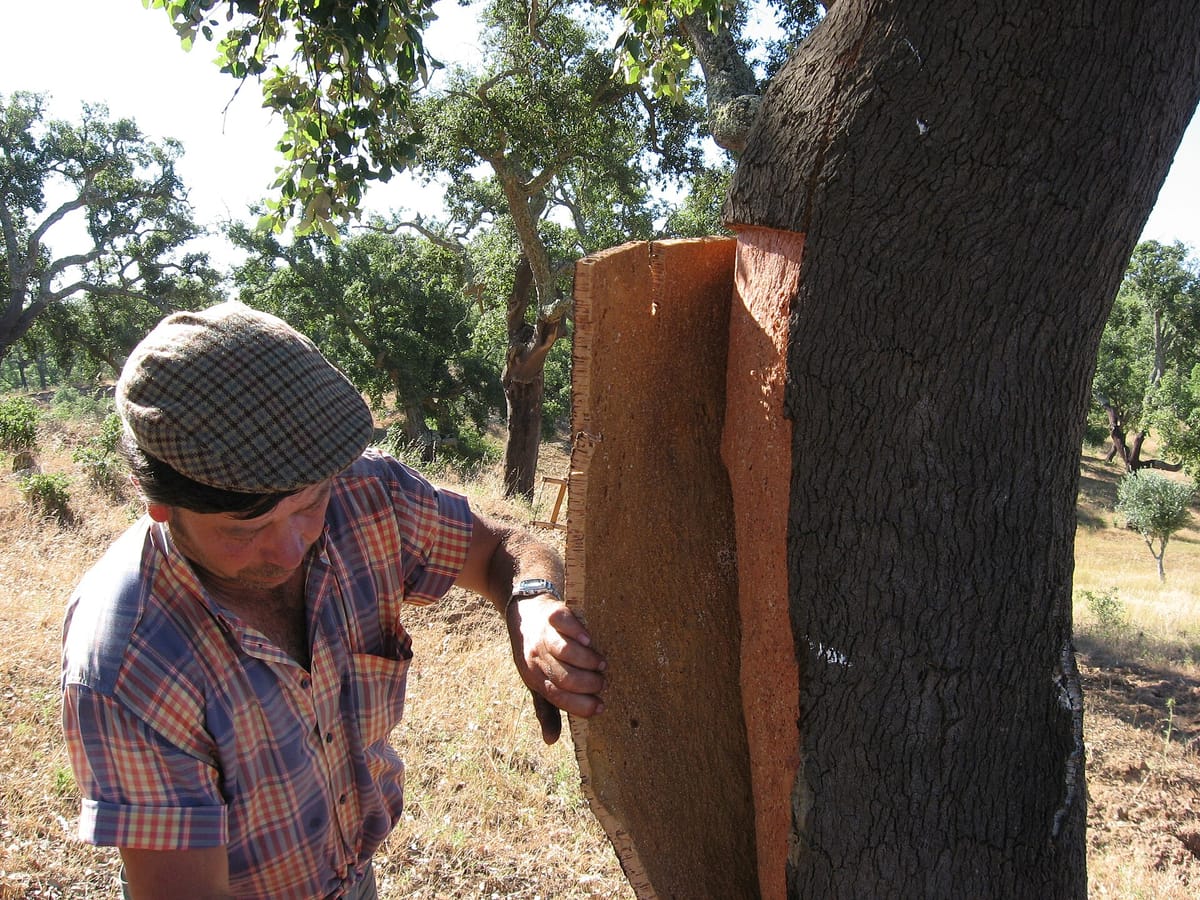
The cork oak (sobreiro) and the holm oak (azinheira) are protected by their own law. Cutting or uprooting either tree needs authorisation from ICNF. This applies to trees in a stand (povoamento) and to isolated trees alike. ICNF says it applies to any number of holm oaks, young or old, even dead ones.
Be careful with local names. In some regions "carrasco" means the kermes oak, which this law does not protect. In others, the same word means the holm oak, which it does. ICNF publishes an identification key on its tree protection FAQ page. If you are unsure, ask the regional ICNF office before you cut.
When authorisation can be given
Inside a stand, the law allows felling only in a few cases:
- thinning to improve the stand's productivity, where there is no approved forest management plan;
- conversion for a project formally declared to be of essential public use, or an agricultural project of relevant interest to the local economy, with no alternative site;
- plant health reasons, where a pest or disease justifies it;
- stands that grew from natural regeneration in production forest, where the oaks are not the dominant species and their average girth at breast height is 130 cm or less.
Conversion cuts come with compulsory compensation. You must plant or improve an area of cork or holm oak larger than the one you lose.
If thinning is already set out in a forest management plan approved by ICNF, you do not need authorisation. You send a prior notice instead, at least 30 days before work starts.
How to apply
- Check that you are the right person. ICNF only accepts requests from the owner of the trees or someone the owner has authorised in writing.
- Register on RUBUS. Since 15 September 2023, requests to prune or fell cork and holm oaks go only through ICNF's online system, RUBUS (rubus.icnf.pt). You can log in with your Citizen Card, Digital Mobile Key, or tax number (NIF). If you cannot use it yourself, a representative can file for you with your signed authorisation.
- Gather the documents. ICNF publishes an indicative list of documents for a felling request on its tree protection forms page. Expect to supply proof that you own the land, maps of the trees, and photographs.
- Mark the trees. Before anything is cut, every tree to be felled must be banded with indelible paint, clearly visible. Inspectors look for these marks.
- Wait for the decision. ICNF must decide within 45 days for plant health requests and 60 days for the other grounds. If you are not notified of a decision within that time, the request counts as approved. Keep proof of the date you applied.
- Keep the paperwork. Store the authorisation, photos of the marked trees, and all correspondence with the property records.
To find your regional ICNF office (Direção Regional de Conservação da Natureza e Florestas), use the map on ICNF's geographic catalogue, then the contacts page.
Pruning needs authorisation too
Pruning a cork or holm oak also needs ICNF authorisation, filed through RUBUS. The rules are strict:
- ICNF can only authorise pruning that improves the tree's productive qualities. Cuts that mutilate the tree are banned.
- Pruning is allowed only from 1 November to 31 March. ICNF warns that the end date may come earlier in some years and regions, to protect nesting birds.
- On cork oaks worked in the usual way (pau batido), you may not prune in the two seasons before the cork harvest year or the two after it.
- The decision is due within 30 days. Silence after that counts as approval.
If your council's civil protection service confirms a tree is a danger to people or property, ICNF can allow heavier pruning. Where pruning would amount to mutilation, ICNF suggests felling the tree flush with the ground so it can regrow from the stump.
Storm damage
If a storm uproots a cork or holm oak, snaps its trunk, or breaks off branches, you do not need authorisation to deal with the damage. ICNF advises you to keep proof that the storm caused it, such as photographs or witnesses.
Ground work counts too
In cork and holm oak stands, the law also bans:
- deep ploughing that damages roots or destroys natural regeneration;
- machine work on slopes steeper than 25%;
- ploughing that does not follow the contour lines on slopes between 10% and 25%;
- any work that moves or removes the topsoil.
Damage that kills the trees is fined as heavily as felling them.
What happens after an illegal felling
The fines are still written in escudos in the law. Converted to euros, felling a cork oak without authorisation can cost from about €50 up to about €149,600. For a holm oak, the ceiling is about €74,800. Attempt and negligence are both punishable. The state can also seize the machinery and vehicles used, take the cork and firewood, and bar you from public aid for up to two years.
Two rules reach further than the fine:
- The 25-year freeze. On land where a cork or holm oak stand was illegally cut or uprooted, the following are banned for 25 years from the date of the cut: any conversion not of essential public use; building, construction, urban development, and plot division works; changes to the shape of the ground or the vegetation cover; and any new farming, industrial, or tourism activity.
- The same freeze after fire or damage. A 25-year ban on changing land use also applies where a stand was lost to fire, to unauthorised cutting, or to harmful work that killed the trees.
The freeze stays with the land, not the person. If you are buying rural land in cork oak country, ask what stood on it and when. The authorities will also order replanting with the same species, within a deadline of no more than two years. If you do not do it, they can do the work and recover the cost through tax enforcement.
Olive groves: authorisation from the CCDR
You need prior authorisation to uproot or clear-fell olive trees. The regional agriculture services now sit inside the regional coordination and development commissions (CCDR), so you apply to the CCDR for your area.
Isolated olive trees need no authorisation. The rule applies to groves.
The law lists the grounds on which authorisation is given. They include:
- trees so old or diseased that the grove no longer pays;
- groves on land so steep or poor that farming them is too costly;
- densities below 45 trees per hectare;
- making way for a more profitable crop, a new olive grove, or a pure vineyard in a demarcated wine region;
- regenerating an existing grove;
- farm buildings or farmers' housing;
- land in an urban expansion zone in the council's master plan;
- public works recognised by the relevant ministry.
How to apply
Apply at least 60 days before you plan to start. If you get no decision within 60 days of handing in the request, it counts as approved. CCDR Lisboa e Vale do Tejo publishes this document list:
- the application form;
- the parcel identification map (P3) from the land parcel system;
- your Citizen Card or ID and NIF (or company documents);
- proof that you own the land, such as the land registry certificate or tax record (caderneta predial);
- signed consent from every co-owner, if the land is held in common;
- a power of attorney, if someone signs for you;
- a lease registered with the tax office that expressly allows the removal, if you are a tenant;
- a council document, if you rely on the urban expansion ground.
Two practical points follow. A tenant cannot clear a grove on the lease alone. And inherited rural land is often co-owned, so every co-owner has to sign.
Removing a grove without authorisation is fined, again in escudos. For an owner, that is about €100 to €1,000 for each hectare affected.
Wild holly: do not cut it
Cutting, uprooting, transporting, or selling wild holly (azevinho espontâneo) is banned across mainland Portugal. The ban covers partial cutting too, so taking a few berried branches home at Christmas breaks the law. The only exception, under licence from ICNF, is for public or private works of general interest.
The fine converts to about €100 to €1,000 for a person, and up to about €10,000 for a company. Attempt is punishable, and the plants and tools can be seized.
The ban covers wild holly only. Cultivated holly is legal to grow and sell. Growers can ask ICNF for a voluntary credential by 15 September each year. A copy must travel with every sale to the final buyer. Do not take seeds or cuttings from a wild plant to start your own; ICNF says that is also banned.
Classified trees of public interest
ICNF can classify single trees, groups, avenues, and gardens as trees of public interest (arvoredo de interesse público). The classification is published in the official gazette and listed in a national register. ICNF describes the status as similar to a listed building.
If a tree is classified, or in the process of being classified, these are banned:
- cutting the trunk, branches, or roots;
- digging or removing soil in the protection zone;
- dumping materials, burning debris, or using plant-killing products in the protection zone;
- anything that damages or harms the tree.
Every improvement job, including pruning, needs ICNF authorisation. The protection zone is 50 metres around the base of each tree, unless the classification order sets a different size.
The fines are the heaviest in this guide. Cutting the tree, its branches, or roots, or harming it, costs €25,000 to €100,000 for a person and €100,000 to €500,000 for a company. Digging or dumping in the protection zone costs €500 to €5,000 for a person. Negligence and attempt are punishable, with the limits halved.
Councils can also protect trees of municipal interest through their own regulations. Before working on a large, old, or notable tree, check ICNF's register and your council's rules.
Selling the wood: the cutting manifest
If you sell forest trees, or the wood from them, the operator must declare the cut to ICNF in advance. This is the cutting manifest (manifesto de corte de árvores), filed online through SiCorte on RUBUS. The duty falls on the buyer if the buyer does the cutting.
You do not need a manifest if:
- the wood is only for your own use (unless it goes for industrial processing);
- you cut 10 trees or fewer;
- the trees are farm trees, such as fruit trees;
- the trees stand in a garden.
A neighbour's tree over your land
The Civil Code lets you cut roots and branches that cross onto your land, if you ask the owner to do it and they have not done so within three days.
Cork and holm oaks are different, because only ICNF can authorise pruning them. ICNF accepts pruning requests from the neighbouring landowner, if you attach proof that you asked the tree's owner and they did not act within three days. You file the request on RUBUS with a copy of your notice and the signed delivery receipt. ICNF still refuses any cut that would mutilate the tree.
Trees in the shared garden of a building held in horizontal property are a matter for the condominium, not one owner. A cork oak in a shared garden is still protected.
Fire safety clearing and protected trees
Every year you must manage vegetation around buildings on rural land. Clearing for fire safety does not cancel the rules above. The fire management agency's own guidance says cutting or pruning cork and holm oaks still needs ICNF's prior authorisation, and wild holly may not be cut. If the two duties seem to clash, ask ICNF and your council in writing before you start.
Before you cut: a checklist
- Identify the species. Young cork oaks and holm oaks are easy to miss. Get help if in doubt.
- Check classification. Look at ICNF's register and your council's rules, including any pending classification.
- Check the land's history. A 25-year freeze after illegal felling or fire may still apply.
- Check protected areas and riverbanks. Extra rules may apply.
- Apply to the right body. ICNF through RUBUS for cork and holm oaks and classified trees; the CCDR for olive groves.
- Mark the oaks with indelible paint before cutting.
- Note the deadlines. 45 or 60 days for oak felling, 30 days for oak pruning, 60 days for olive groves.
- File a cutting manifest if you sell the wood.
If you also keep hives under those trees, see Keeping Bees in Portugal.
This guide is general information about mainland Portugal, not legal advice. Madeira and the Azores have their own rules. For a specific tree, ask ICNF, the CCDR, or your council before you act.
Sources
This guide is written from official sources and, where relevant, organisations' own websites.
- ICNF, cork oak and holm oak protection: https://www.icnf.pt/florestas/protecaodearvoredo/sobreiroeazinheira (authorisation from ICNF for trees in a stand or isolated, conversion cuts, compensation), checked 2 October 2026
- ICNF, tree protection FAQs: https://www.icnf.pt/florestas/protecaodearvoredo/protecaodearvoredofaqs (felling and pruning need ICNF authorisation, banding with paint, pruning 1 November to 31 March and earlier end for nesting, only owners or authorised persons, RUBUS, regional offices, mutilation banned, civil protection exception, neighbour's tree and three-day rule, carrasco versus holm oak, any number of holm oaks even dead, storm damage, holly), checked 2 October 2026
- ICNF, tree protection forms: https://www.icnf.pt/florestas/protecaodearvoredo/protecaodearvoredoformularios (RUBUS only from 15 September 2023, requests by a representative, indicative document list for felling, holly credential form, classification request form), checked 2 October 2026
- ICNF, RUBUS online system: https://rubus.icnf.pt (cork and holm oak requests and cutting manifests), checked 2 October 2026
- ICNF, wild holly: https://www.icnf.pt/florestas/protecaodearvoredo/azevinhoespontaneo (ban on cutting, transport, and sale; voluntary credential by 15 September, valid to 15 September the following year; copy travels with each sale), checked 2 October 2026
- ICNF, trees of public interest: https://www.icnf.pt/florestas/protecaodearvoredo/arvoredodeinteressepublico and https://www.icnf.pt/florestas/protecaodearvoredo/aipclassificacao (classification by published order, status similar to listed buildings, 50 m protection zone, ICNF authorisation for any cutting or pruning), checked 2 October 2026
- ICNF, urban trees: https://www.icnf.pt/florestas/protecaodearvoredo/arvoredourbano (urban trees regime covers council and state trees), checked 2 October 2026
- ICNF, statement on tree felling at Herdade do Cabeço da Flauta, 13 March 2026: https://www.icnf.pt/noticias/cortedearvoredo (felling of unprotected trees on private land outside protected areas needs no ICNF authorisation), checked 2 October 2026
- ICNF, SiCorte cutting manifest: https://www.icnf.pt/florestas/fileirasflorestais/sicorte (manifest filed in advance through SiCorte, duty on buyer when buyer cuts, garden and farm trees outside scope), checked 2 October 2026
- Diário da República, Decreto-Lei n.º 169/2001, de 25 de maio (cork oak and holm oak protection), original text: https://files.diariodarepublica.pt/1s/2001/05/121a00/30533059.pdf (articles 3 thinning notice 30 days and authorisation grounds, 4 and 5 the 25-year freezes, 8 compensation, 9 banding, 15 pruning season, pau batido rule and 30-day tacit approval, 16 soil work limits, 17 mutilation ban, 21 and 22 fines in escudos and accessory sanctions, 23 replanting within two years), checked 2 October 2026
- Diário da República, Decreto-Lei n.º 155/2004, de 30 de junho: https://files.diariodarepublica.pt/1s/2004/06/152a00/39673968.pdf (amendment to Decreto-Lei n.º 169/2001, small groups of trees, stand definition), checked 2 October 2026
- Diário da República, Decreto-Lei n.º 11/2023, de 10 de fevereiro: https://files.dre.pt/1s/2023/02/03000/0000300192.pdf (article 9 amending Decreto-Lei n.º 169/2001: natural regeneration ground with 130 cm girth, decisions in 45 and 60 days, tacit approval; article 8 amending Decreto-Lei n.º 120/86), checked 2 October 2026
- Diário da República, Decreto-Lei n.º 31/2020, de 30 de junho (cutting manifest): https://files.dre.pt/1s/2020/06/12500/0001100016.pdf (article 2: exemptions for own use and 10 trees or fewer), checked 2 October 2026
- Diário da República, Decreto-Lei n.º 423/89, de 4 de dezembro (wild holly): https://files.dre.pt/1s/1989/12/27800/52915292.pdf (articles 1 ban and works exception, 3 fines of 20,000 to 200,000 escudos and 2,000,000 for companies, 4 seizure), checked 2 October 2026
- Procuradoria-Geral Regional de Lisboa, Lei n.º 53/2012, de 5 de setembro (trees of public interest): https://www.pgdlisboa.pt/leis/lei_mostra_articulado.php?nid=2168&tabela=leis (article 3 classification, 50 m protection zone, municipal regimes; article 4 banned interventions and ICNF authorisation; article 5 fines), checked 2 October 2026
- Procuradoria-Geral Regional de Lisboa, Código Civil, article 1366: https://www.pgdlisboa.pt/leis/lei_mostra_articulado.php?nid=775&tabela=leis (cutting a neighbour's roots and branches after three days), checked 2 October 2026
- CCDR Lisboa e Vale do Tejo, olive groves: https://www.ccdr-lvt.pt/agricultura-desenvolvimento-rural-e-pescas/olival/ (prior authorisation from the CCDR, document list), checked 2 October 2026
- CCDR Lisboa e Vale do Tejo, Decreto-Lei n.º 120/86, de 28 de maio (olive trees), consolidated text: https://www.ccdr-lvt.pt/wp-content/uploads/2024/12/DL-120_86-versao-consolidada-.pdf (article 2 grounds, article 3 apply 60 days ahead, tacit approval after 60 days, isolated trees exempt; article 5 fines of 20,000 to 200,000 escudos per hectare), checked 2 October 2026
- SGIFR (AGIF, Agency for Integrated Rural Fire Management), land clearing: https://www.sgifr.gov.pt/pt/limpeza-de-terrenos (cork and holm oak authorisation still needed when clearing, wild holly banned, cutting manifest for conifers, APA authorisation in the public water domain; carried from verified guide W2D-21), checked 2 October 2026
Last verified October 2026. Rules and fees change; check the official source before acting.