General Daily Briefing: Monday, 14 September 2026
Good morning. Here is your Monday briefing for 14 September 2026: the day's essential Portugal stories for residents, expats and anyone keeping an eye on the country, running from a first full portrait of fifty years of Portuguese ministers to the constitutional rule that decides when a tax cut can reach your wallet.
- Politics: a new study of every minister since 1976 finds an average tenure of about 600 days and parties that have absorbed technical expertise without surrendering control of appointments.
- Society: only 60 of the 398 people who entered a Portuguese cabinet since 1976 were women, and half of them hold a doctorate against a quarter of the men.
- Law: the Constitutional Court is holding the first request in Portuguese history to dissolve a party for extremism, and one of its judges says it has not had time to decide.
- Energy: Lightsource bp has abandoned a 240 million euro solar plant in the Beira and cut its neighbouring megaproject by more than a third.
- Education: Portugal's mathematicians want national assessments to count towards pupils' grades again after the latest PISA score fell below its 2003 level.
- Cost of living: two bills cutting VAT on fuel and food are voted on 24 September, and the Constitution stops either of them taking effect before January.
Seguro Escolar in Portugal in 2026
Every child in a Portuguese state school is covered by a statutory scheme that has no insurer, no policy document and no premium, which is exactly why so few parents know what it does. Our new guide sets out what it actually pays for: public treatment, travel, and compensation worth up to 300 times the minimum wage; which part of the journey to and from school counts; the seven exclusions; and the one mistake that voids the lot, which is paying for private care before the school has been told.
Portuguese Ministers Stay About 600 Days, and the Parties Still Pick Them
The Fundacao Francisco Manuel dos Santos published "Quem Governa Portugal? Perfis ministeriais em perspetiva comparada (1976-2025)" on Monday, a profile of every Portuguese minister across five decades of democracy, coordinated by Marcelo Camerlo and Antonio Costa Pinto and benchmarked against Spain, Italy and Greece. Its central finding is that ministers have grown markedly more specialised without the parties loosening their grip. "The ministers who come from the parties also have a profile better suited to the portfolio," Costa Pinto told Lusa, while the study itself concludes that "despite the growing pressures in favour of specialisation, the parties continue to dominate ministerial appointments in Portugal". It sorts office holders into four types, and finds Portugal distinguished by the hybrid political-specialist profile and by non-party ministers who are more accurately semi-independent. Accession to the European Community in 1986 was one of the engines of the shift. Loyalty still governs the allocation of portfolios: foreign affairs stays with the trusted, energy, environment and transport draw experts, and finance combines both. The PS has historically appointed more specialists, the PSD more experienced political operators. And the average Portuguese ministerial career runs about 600 days, below several European peers, with party ministers turning over faster than independents.
Sixty of Portugal's 398 Ministers Since 1976 Were Women
The gender chapter of the same study, written by Edna Costa, counts 60 women among the 398 people who held a ministerial portfolio in an incoming Portuguese government between 1976 and 2025, against 338 men. That is 15 percent. There were almost no women until Leonor Beleza became health minister in 1985; Socrates first passed 30 percent in 2009, Passos Coelho appointed two women in 2011, and a Costa government crossed 40 percent for the first time in 2019 before reaching 53 percent in 2022. Montenegro's governments have held 41 and 37.5 percent, which the author calls a possible consolidation but too early to call durable. The sharper number is the qualification gap: 50 percent of women ministers hold a doctorate, against 25 percent of the men, and the study reads that as women depending "disproportionately on technical credentials to access power". Where they serve matters too. Women are concentrated in peripheral and social portfolios, and "the female presence in the strategic core of government, where decision-making power and the most significant budget resources are concentrated, is residual". A party card is what opens the core: in the peripheral departments, 53.7 percent of the women appointed are independents recruited for their expertise.
A Request to Dissolve Chega Is Sitting at the Constitutional Court
Maria Benedita Urbano, a judge of the Constitutional Court and a lecturer at the University of Coimbra, confirmed at a public law conference in Macau that the court holds a request to dissolve Chega, and that it is the first application it has ever received resting on an allegation of political extremism. "So far we have not had time to decide," she said. The court is the only body in Portugal able to dissolve a party, and only on an application from the Public Prosecution Service; the lawyer Antonio Garcia Pereira filed in October 2025 and renewed the request in February, citing what he calls the party's racist and fascist nature, alleged links to the neo-Nazi group 1143, and the December court order requiring Andre Ventura to remove posters about the Roma community and Bangladesh. Urbano said she personally believes parties of the extremes should be banned, and was equally blunt that the test is close to unworkable: "Is it enough for the leader to make a Nazi salute at a public event?" She cited Germany, where the Federal Constitutional Court refused to dissolve the NPD in 2017. Her broader complaint was that the court's rulings are sometimes ignored: Chega's 2023 and 2024 internal elections were voided in May 2025 and its statutes remain unamended, and she gave the PS and the Daniel Adriao case as a second example.
Lightsource bp Dropped One Beira Solar Megaproject and Shrank the Other
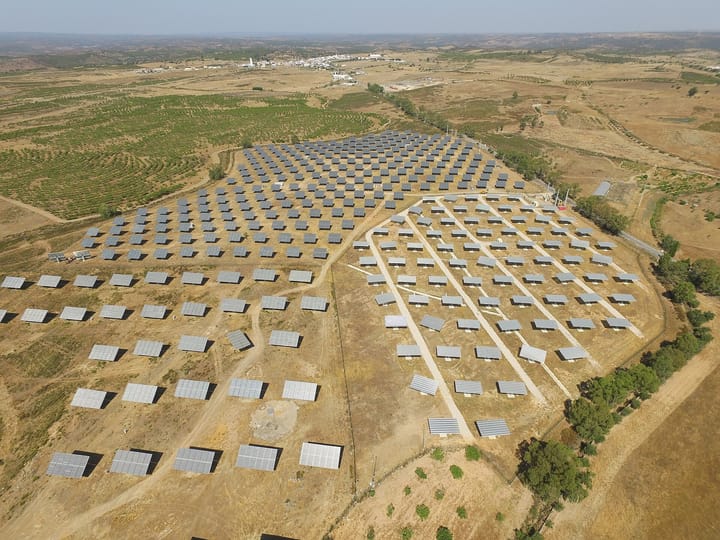
Lightsource bp has cancelled the Beira solar plant, a 266 megawatt project across more than 500 hectares of Castelo Branco and Idanha-a-Nova carrying an estimated 240 million euros of investment. The environmental assessment committee had returned a negative opinion at the end of 2025, citing cumulative impacts, a threat to the Iberian imperial eagle, proximity to the Tejo Internacional nature park and the felling of 479 cork and holm oaks. Given six months to reconfigure, the company concluded that "the conditions of financial viability necessary to proceed with the development of the reformulated solution were not met". On the same day it set out the opposite course for its other Beira Baixa megaproject, Sophia, which has been redrawn rather than dropped: panels fall from 395 hectares to 258, capacity from 867 to 573 megawatts peak, two very high voltage lines become one, and Fundao loses its entire allocation of panels. The original design drew 12,693 submissions in public consultation. Chief executive Miguel Lobo would not put a new price on Sophia against the earlier 591 million euro estimate, said it would not be operational before 2031, and confirmed the final investment decision "has not been taken". The reformulated project must be filed by 2 October.
Portugal's Mathematicians Want the National Tests to Count Again
The Sociedade Portuguesa de Matematica has issued a formal opinion on the latest PISA results, published by the OECD last Tuesday, in which Portuguese 15-year-olds fell again in mathematics, reading and science. The mathematics score was 460 points, down 12 and below the 466 recorded in 2003. The society's reading is that the country has fallen back to a level it passed more than two decades ago, with a 15-year-old in 2025 performing on average like a pupil of just over 13 in 2018. Its central proposal is to turn the ModA national digital assessments "into consequential tests, with real weight in pupils' final classification", on the model of the end-of-cycle examinations that ran from 2012 to 2015. It also wants structured support for struggling pupils reactivated with credit hours restored to schools, noting that more than a third of 15-year-olds are low performers and that socioeconomic inequality is worth 99 points of difference in mathematics. Textbook certification should return, and the law needs a "deep revision" to restore the primacy of disciplinary knowledge and free teachers from paperwork. Measuring what is measurable, it argues, "is not a step backwards", it is a condition of rigour.
Two VAT Bills Reach Parliament on 24 September, and Neither Lands Before January
Parliament votes on 24 September on two Chega bills: cutting VAT on fuel from 23 percent to 13, and applying a zero rate to a basket of essential foods. Neither can reduce a bill this year, and the reason is constitutional. Article 167(2) of the Constitution, known as the lei-travao, bars members of parliament and parliamentary groups from tabling bills that involve, "in the current financial year, an increase in state expenditure or a reduction in the state revenue provided for in the Budget". The PS parliamentary leader Eurico Brilhante Dias made that the basis of his attack, calling the bills "pure ineffective propaganda" and arguing that resolution proposals, which recommend rather than legislate, are "the possible effectiveness of opposition parties". He also said the need is immediate: "The Portuguese need help with fuel and with the food basket today. And today is already late." Both sides claim authorship. Jose Luis Carneiro said the PS proposed the 23 to 13 percent cut three times and that Chega voted down the first two; Andre Ventura answered that the PS voted down two Chega bills on 10 April and has never tabled a bill of its own, adding that "VAT does not come down by recommendation. It comes down by law." Brilhante Dias would not say how the PS will vote, and did not rule out backing changes in the 2027 Budget debate.