The Constitutional Court Holds the First Request in Portuguese History to Dissolve a Party for Extremism, and Has Not Yet Found Time to Decide It
A judge of the court set out the difficulty in public: is a Nazi salute enough, or billboards against an ethnic group? She also said the court's own rulings are sometimes simply ignored.
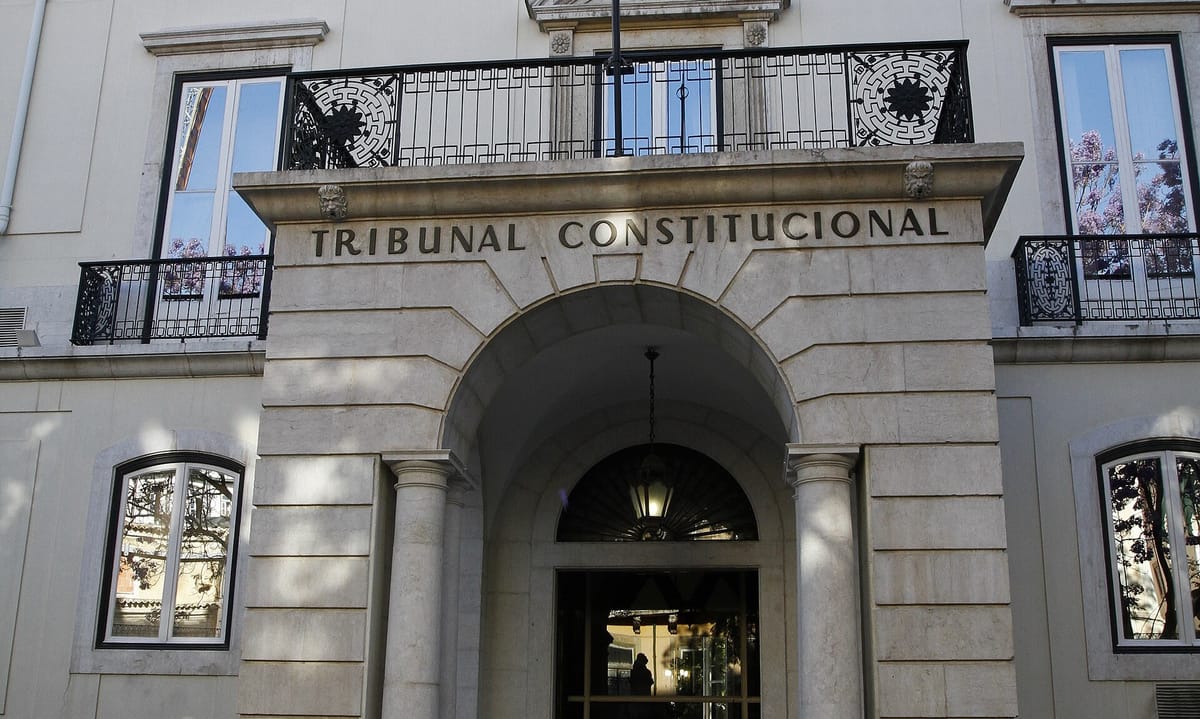
Portugal's Constitutional Court is holding a request to dissolve Chega, and one of its judges has confirmed that nothing has been decided because the court has not had the time.
Maria Benedita Urbano, a judge of the court and a lecturer at the University of Coimbra, confirmed the request over the weekend at the 29th Encontro de Professores de Direito Público, held for the first time in Macau. She described it as the first application the court has received that rests on an allegation of political extremism.
"So far we have not had time to decide," she said, having first complained about what she called the excessive number of constitutional review requests reaching the court and the current "fashion for preventive review" of draft laws.
How a party gets dissolved in Portugal
The Constitutional Court is the only body in Portugal with the power to declare a political movement dissolved, and it can only act on an application from the Public Prosecution Service. That makes the route long. The lawyer António Garcia Pereira lodged an initial complaint in October 2025 and renewed his request to the prosecutors in February this year, arguing that Chega's "evident nature, successively reaffirmed and reinforced, racist and fascist" puts it in breach of the Constitution.
The complaint invokes alleged links between Chega and the neo-Nazi group known as 1143, and a court ruling in December that ordered André Ventura, then the party's leader and a presidential candidate, to remove campaign posters referring to the Roma community and to Bangladesh.
The court has dissolved a party before, but on very different grounds. In June 2025 it confirmed the dissolution of the far-right nationalist party Ergue-te at the request of the prosecutors, because the party had failed to file accounts for three consecutive years. That is an administrative failure, not a judgment on what a party believes.
The judge's own doubts
Urbano was candid that she personally believes "parties of the extremes should be banned in Portugal", and equally candid that the legal test is close to unworkable. "It is very difficult to ban a party and say that it is fascist," she said, and then put the problem as a pair of questions: "Is it enough for the leader to make a Nazi salute at a public event? Is it enough to have ordered billboards against certain ethnic groups?"
She pointed to Germany, where the Federal Constitutional Court refused in 2017 to dissolve the National Democratic Party despite its neo-Nazi links, and to a German lawyers' and jurists' organisation which argued in June that Alternative für Deutschland is "demonstrably unconstitutional" and should be banned. "Perhaps after the German Constitutional Court addresses the matter it can share that experience with us," she said.
A wider complaint about being ignored
Garcia Pereira's complaint also raises the state of Chega's governing bodies. In May 2025 the Constitutional Court confirmed that the party's national elections in 2023 and 2024 were invalid. Urbano's frustration was that this changed nothing on the ground: "Chega still has not altered its statutes, which were not approved by the Constitutional Court, they were rejected, and in the meantime it has even held a congress."
She said the case illustrates how "the Constitutional Court's decisions are not always respected, sometimes they are ignored", and she was careful to spread the criticism. She cited the Socialist Party, which she said did not comply with a court decision rejecting the expulsion of Daniel Adrião, a former candidate for the party leadership. In June the PS argued the ruling did not require his reinstatement and opened a fresh expulsion process.