Algarve Hospitals Are Holding Thinner Blood Stocks Than a Normal August, and the Region's Health Chief Stops Short of the Word Crisis
Tiago Botelho, president of the Unidade Local de Saude do Algarve, says reserves across the region's hospitals are down even on the usual summer dip, and appeals for donors while rejecting the word crisis. Collection sessions are running at Fatacil in Lagoa.
Blood stocks in Algarve hospitals are lower this August than they usually are in August, which is already the worst month of the year for them. The president of the Unidade Local de Saúde do Algarve (Algarve Local Health Unit), Tiago Botelho, confirmed on Tuesday that reserves across the region's hospitals are down, appealed for donors, and was careful to add that he does not consider this a crisis.
Both halves of that statement are worth taking seriously. A summer dip is routine. Portugal empties out in August, donors go on holiday, mobile collection teams lose their usual venues in schools and workplaces, and high temperatures deter people who might otherwise turn up. The Instituto Português do Sangue e da Transplantação (Portuguese Institute of Blood and Transplantation) has been flagging that pattern since the start of July.
What Botelho described is that pattern, but deeper than usual.
The arithmetic works against the Algarve specifically
The Algarve is the one Portuguese region where the summer donor problem and the summer demand problem land on top of each other.
The resident donor base thins out in August exactly as the region's population multiplies with visitors. More people means more road traffic, more water incidents, more surgical trauma. The Unidade Local de Saúde do Algarve runs the hospitals in Faro, Portimão and Lagos, and those are the units that absorb it. In the early hours of Tuesday morning the same health unit took in twelve people hurt when a car was driven into a crowd on the Oura strip in Albufeira, two of them seriously enough to still be admitted at Portimão by the afternoon.
Trauma of that kind is precisely what a thin reserve is bad at absorbing. Red cells keep for about 42 days under refrigeration; platelets keep for five to seven. A reserve is not a warehouse, it is a flow, and when the inflow slows the shelf empties on a timer that nobody can pause.
What the national picture looks like
Since March the IPST has published national and regional reserve levels every Monday. Its recent readings have described a national strategic reserve that can meet patient needs across the blood groups while sitting below ideal levels, which is roughly where the country has been all summer.
The July readings were sharper. At that point the institute reported one to two days of cover for some groups and three to five days for others, and the donors' federation went as far as calling the position critical. Those are July numbers and should not be read as today's, but they set the range the system has been operating in.
Where to give in the Algarve this week
Botelho pointed to collection sessions running at Fatacil, the agricultural and trade fair in Lagoa, over the coming days. Hospital blood services in the region also take donors directly during their opening hours, without a scheduled campaign.
What this means if you live here
- Foreign residents can give blood in Portugal. Nationality is not a barrier. The requirements are age 18 to 70, a minimum weight of 50 kilograms, and the ability to communicate well enough to complete the health questionnaire honestly. Our practical guide to giving blood in Portugal covers eligibility, the intervals between donations, and the relaxed rule on UK residence that used to exclude a large share of British residents here.
- The intervals are asymmetric. Men may donate every three months, women every four, up to four and three times a year respectively.
- You are entitled to the time off. Portuguese law treats a donation session as a justified absence from work on the day, without loss of pay.
- Bring identification and your número de utente. If you are registered with the Serviço Nacional de Saúde (National Health Service), your user number speeds up the paperwork considerably.
The Algarve has spent this summer being counted in other ways, from hoteliers bracing for softer occupancy to councils lagging on vaccination coverage. The blood reserve is the quietest of those numbers and the one that reverses fastest: a single well-attended collection session moves it in an afternoon.
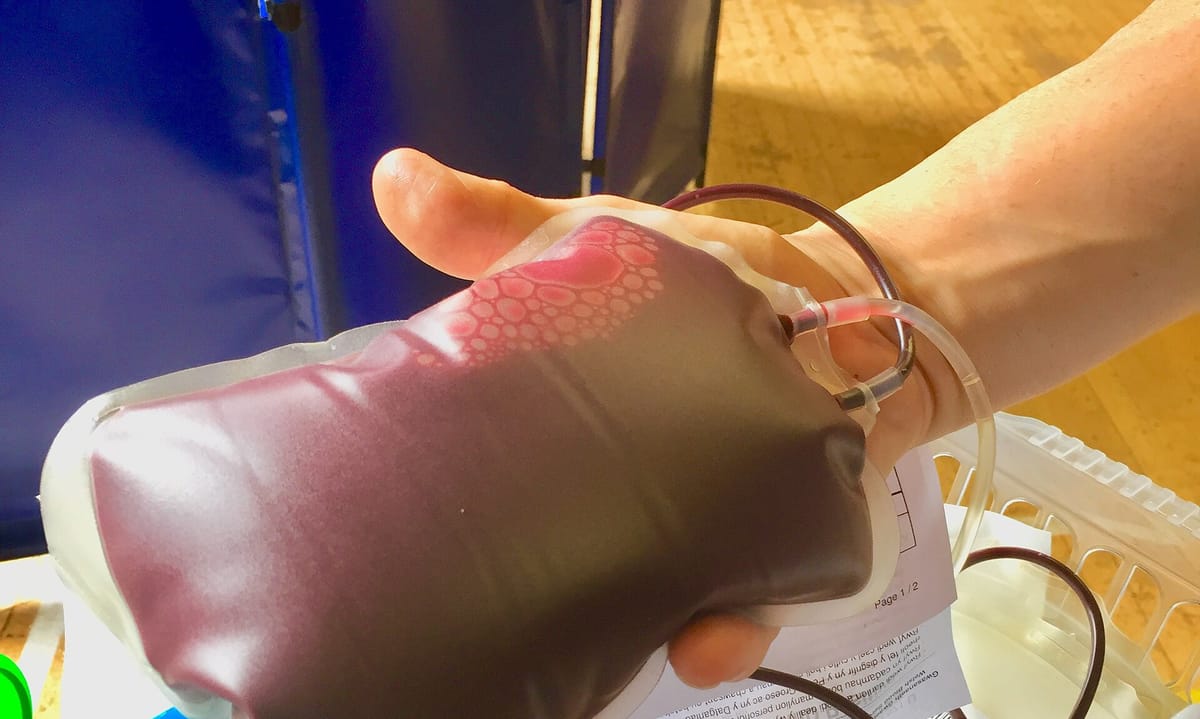
Feature image: a completed unit of donated whole blood at a collection session. Photo by Bibeyjj via Wikimedia Commons, CC BY-SA 4.0.