A Decade Added 98 Non-Native Marine Species to Portuguese Waters, and the Scientists Say Nobody Verifies the Ballast Rules
A survey by 31 researchers from 11 Portuguese institutions counts 231 non-indigenous marine species against 133 ten years ago. Shipping is the main route, Sines is a strategic entry point, and MARE says no compliance reports on ballast-water treatment are published in Portugal.
Portuguese coastal waters now hold 231 confirmed non-indigenous marine species, against 133 counted a decade ago, according to a nationwide survey published in the journal Marine Pollution Bulletin and released to the Lusa news agency on Friday. The work was carried out by 31 researchers from 11 Portuguese universities and research centres, led by the Centro de Ciências do Mar e do Ambiente (MARE, Centre for Marine and Environmental Sciences) and the Rede de Investigação Aquática (ARNET, Aquatic Research Network).
The 98 additional species amount to roughly three quarters more than the previous inventory. The researchers are explicit that this is not simply better looking: the authors of the first survey suspected their high count reflected a backlog of arrivals never catalogued, but the coast has been repeatedly surveyed since, so the new entries read as genuine introductions rather than as accounting.
Where they are, and where they came from
Of the 231 species, 159 occur on the mainland, 81 in the Açores and 62 in Madeira. Those figures exceed the total because many species are recorded in more than one region. Five are entirely new regional records. Land and freshwater invaders are regulated too, and our guide sets out which garden, pond and pet species are banned.
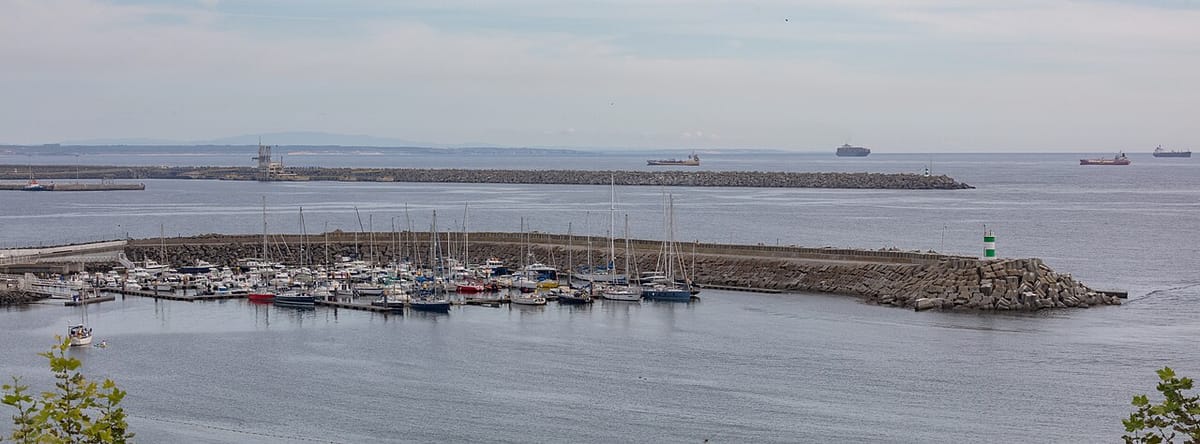
The origins split along a clean geographical line. On the mainland, 39 percent come from the North Pacific and a further 24 percent from elsewhere in the North Atlantic. In the two archipelagos the pattern reverses, with North Atlantic origins dominating. The authors argue that this divergence is itself the finding: a single national rule is the wrong instrument, and the mainland and the islands need separately designed controls. The port of Sines appears as a strategic point of entry, sitting where routes linking Asia, the Mediterranean, the United States and Africa converge.
The two doors nobody is watching
Paula Chainho of MARE, one of the project leads, told Lusa that shipping is the main introduction route, either through organisms encrusted on hulls or through ballast water. Cargo ships take on water to stay balanced when they discharge freight and release it at another port when they load again, carrying whatever lives in the tanks across the globe. One of those arrivals now has its own national programme: the action plan for the invasive brown alga Rugulopteryx okamurae.
An international convention obliges ships to treat ballast water before discharging it. Chainho's point is about what happens next: "in Portugal we have no official reports we can consult on how this has been implemented." Aquaculture is the second route. Introducing a non-indigenous species for aquaculture requires a specific application, but here too, she says, nothing in Portugal verifies whether the rule is followed.
That matters because of a detection lag. A marine species is generally only found once it is thoroughly established, at which point removal stops being realistic. The Japanese clam, an invader here for many years, is now managed only through fishing pressure.
The study's second half tries to get ahead of that lag. A genetic gap analysis found that while 71 percent of the 231 species appear in global sequence repositories, only 12.5 percent have locally sourced sequences, which weakens Portugal's ability to identify what it finds. The researchers therefore publish a first watchlist of 22 species detected only through environmental DNA, molecular traces in seawater with no physical specimen yet confirmed.
What this means for foreign residents
- Seafood: Several established invaders, the Japanese clam among them, are already fished commercially. What lands on a Portuguese table is increasingly a species that was not here a generation ago.
- Boat owners: Hull fouling ranks alongside ballast water as a leading vector. Cleaning a hull before moving a boat between the mainland and the islands is the one practical step a private owner can take.
- Coastal conditions: This sits alongside other recent readings of the coast, including the APA marine-litter report and the marine heatwaves off Faro. Warmer water widens the range of species that can survive here.
- What to watch: Whether Portugal starts publishing ballast-water compliance data. The complaint is not that rules are missing but that nobody can see whether they work.
Cascais has already funded a satellite and artificial-intelligence pilot to track one Pacific brown alga along the Atlantic coast, described here in June. This inventory gives that kind of local effort a national baseline, and sets the number the next decade's survey will be measured against.