The Sea off Faro Climbed to 26.1°C in Two Marine Heatwaves, Navy Buoy Data Show
The sea off Faro warmed to 26.1°C through two marine heatwaves between mid-June and early July, a Portuguese Navy coastal buoy recorded. The stronger event ran about 2.2°C above the seasonal threshold, part of a warming trend along the Algarve's touristed coast.
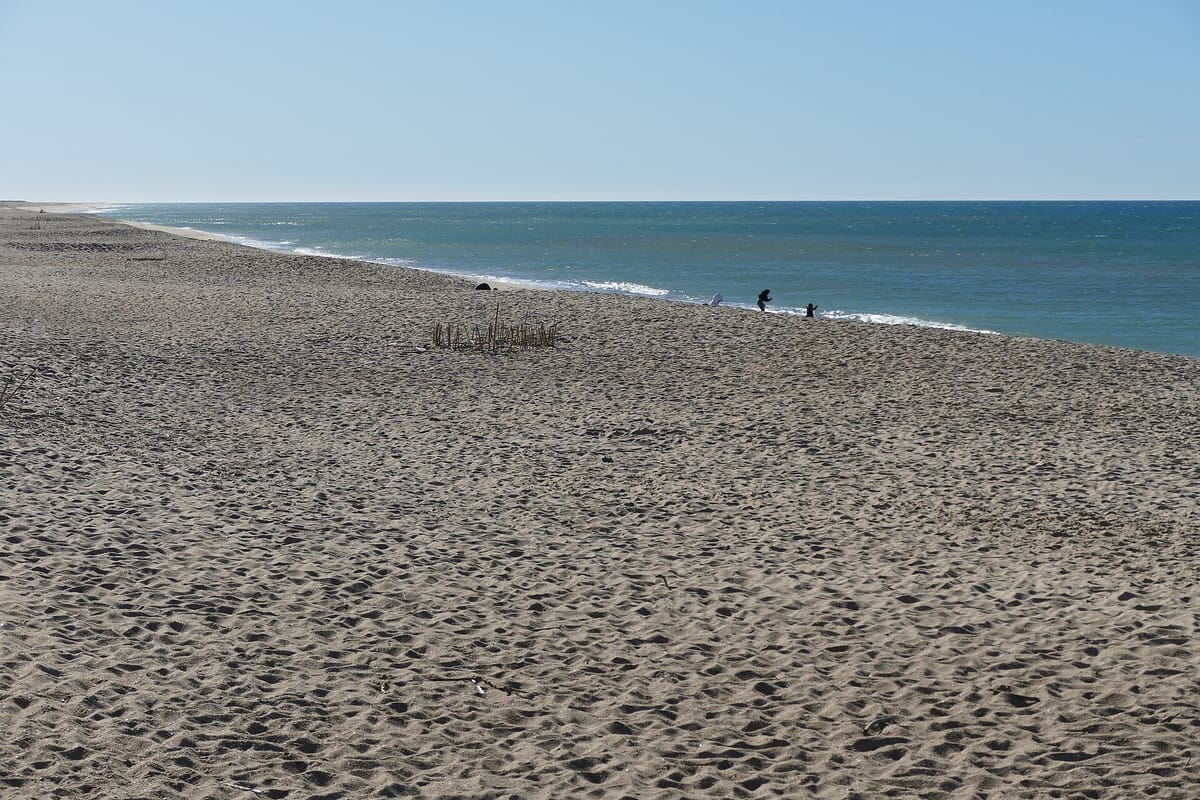
The sea off Faro warmed to 26.1°C over recent weeks, its surface running well above the seasonal norm through two distinct marine heatwaves, according to measurements from a coastal buoy operated by the Portuguese Navy. The readings, taken between mid-June and early July, offer a precise local snapshot of a phenomenon that is becoming steadily more common along the Algarve coast: the ocean itself, not just the air above it, spiking into extreme heat.
What the buoy recorded
The data come from the Faro Coastal Buoy, part of MONIZEE, the national coastal-monitoring network run by the Instituto Hidrográfico (Hydrographic Institute), the Navy's oceanographic body. Between 15 June and 9 July, the sea surface averaged around 25°C day to day, peaking at 26.1°C — a figure the institute said "illustrates well the magnitude of the warming observed."
A single hot reading, though, is not the same as a marine heatwave. The classification depends on how far the temperature climbs above a long-term local threshold — the 90th percentile for the time of year — and, crucially, on how long it stays there. By that measure the institute logged two separate events. The first was rated moderate, reaching a maximum of 23.3°C, about 1.5°C above the threshold. The second, stronger, hit 24.8°C, roughly 2.2°C above the seasonal baseline and sustained long enough to qualify as a significant anomaly.
Why persistence matters
The distinction between a peak and a heatwave is more than a technicality. Marine life can tolerate a brief spike, but sustained warmth is what does the damage: it stresses fish, seagrass and shellfish, shifts the distribution of species, and can disrupt the coastal food chain that Algarve fisheries and aquaculture depend on. A sea that holds well above its normal temperature for days or weeks changes the conditions for everything living in it, in ways a one-day reading never captures — which is why the institute stresses that classification rests on persistence rather than isolated highs.
A warming ocean, monitored in detail
The Instituto Hidrográfico frames the exercise as part of a broader effort to characterise extreme ocean events and to track the thermal variability of Portuguese waters over time. That matters for more than science: sea temperature shapes fishing yields, the health of coastal ecosystems, tourism and even local weather, since a warmer sea feeds more energy into the atmosphere.
Marine heatwaves have drawn growing attention across the Atlantic and Mediterranean as global ocean temperatures trend upward, and the Algarve — Portugal's warmest and most touristed coastline — sits on the front line of that change. The Faro readings are a modest, carefully-caveated dataset rather than a dramatic headline, but that is rather the point. Steady, instrument-grade monitoring of when and how far the sea overheats is what will let scientists say, with confidence, whether events like this summer's two heatwaves are becoming the new normal off Portugal's southern shore.