Wrong Coordinates and a Cloud of Dust: Investigators Dissect the INEM Helicopter Accident at a Mondim de Basto Quarry
The GPIAAF's final report on the September 2024 INEM helicopter accident at a Mondim de Basto quarry finds wrong coordinates, an alternative landing site nobody told the crew about, and a dust-cloud brownout on final approach. All four aboard escaped with minor injuries.
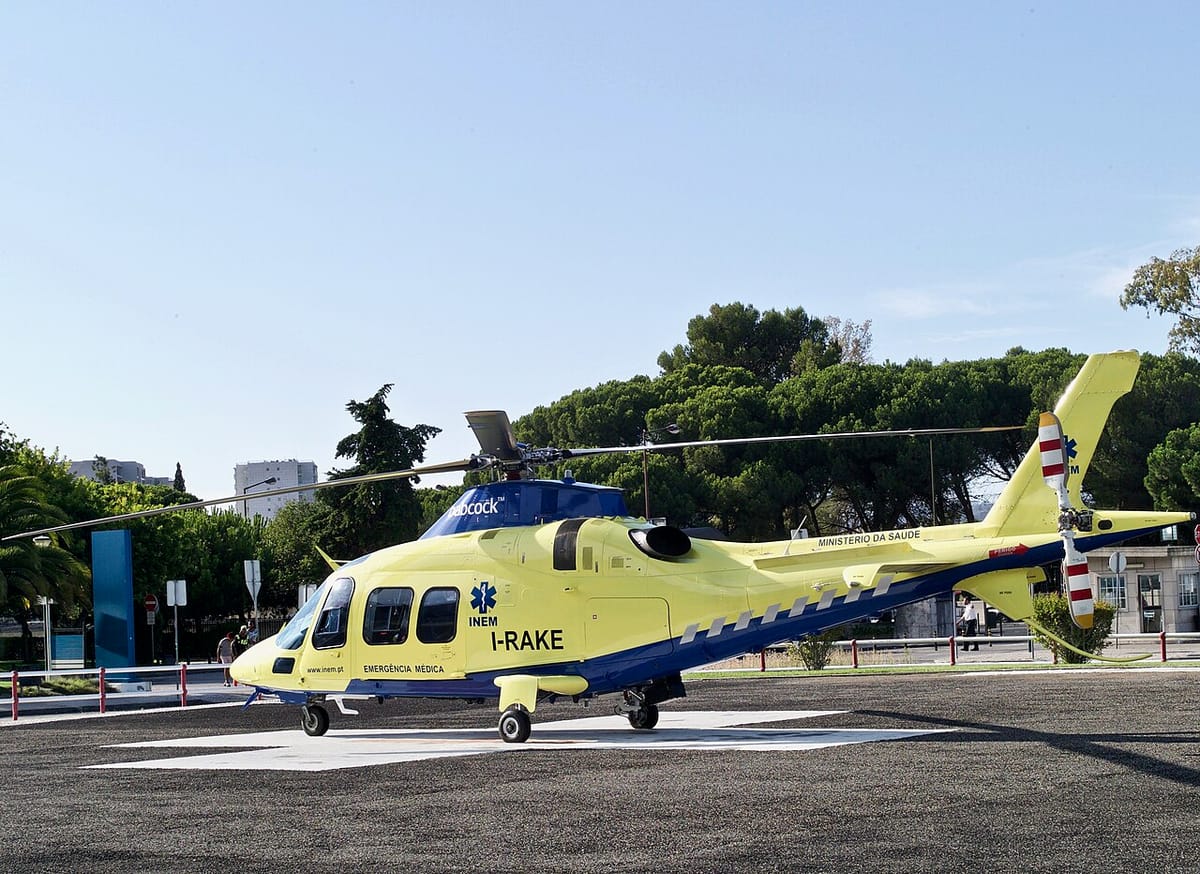
When an INEM (Instituto Nacional de Emergência Médica — National Institute of Medical Emergency) helicopter tipped into the trees beside a quarry in Mondim de Basto in September 2024, the four people on board walked away with minor injuries and Portugal was spared a tragedy. The final investigation report, released this week by the GPIAAF (Gabinete de Prevenção e Investigação de Acidentes com Aeronaves e de Acidentes Ferroviários — the state office that investigates air and rail accidents), reads as a case study in how small failures stack up: wrong coordinates, a briefing nobody shared, and a cloud of dust at the worst possible moment.
The mission began at around 11:11 on the morning of 2 September 2024, when the helicopter — carrying two pilots, a doctor and a nurse — lifted off for a quarry in Atei, in the municipality of Mondim de Basto in the Vila Real district, where a worker had been injured in a workplace accident. The first link in the chain failed before the aircraft was anywhere near the site: the geographic coordinates passed to the crew for the quarry were incorrect, and had to be converted before they could even be entered into the flight-management system. The investigators traced the error to the way INEM's grid-based location system and Google Maps processing had identified the quarry, and delivered a blunt verdict: grid references and ground-level geographic detail of that kind are “incompatible with safe helicopter operations”.
The second failure was one of silence. On the ground, local emergency teams had sensibly prepared an alternative landing zone at the Senhora da Graça park — but never clearly communicated it to CODU (Centro de Orientação de Doentes Urgentes — the urgent-patient coordination centre that dispatches INEM's helicopters). The crew circling overhead had no idea a prepared site existed; the teams below had no idea the helicopter intended to land at the quarry itself. Only after several orbits did the crew spot an emergency vehicle and pick out a possible landing spot beside it.
The pilots did anticipate the final hazard. They recognised that the rotor's downwash could raise dust from the dry quarry floor and agreed a plan to abort the landing if visual references were lost — the phenomenon pilots call brownout. On final approach that is exactly what happened. But the report notes that the captain hesitated before breaking off the approach in degrading visibility, and that coordination between captain and co-pilot had become ambiguous, with the first officer remaining passive as the dust concern materialised. By the time the go-around was flown, it was too late: the aircraft struck several medium and large trees, damaging the main rotor beyond any possibility of flying out. All four occupants escaped with light injuries.
The GPIAAF's recommendations follow the failures one by one: give helicopter crews precise, validated coordinates in a timely way; maintain lists of helicopter-suitable alternative landing sites; guarantee direct visual and radio contact between crews and ground teams; and strengthen brownout training for operators flying medical missions.
The report lands at a sensitive moment for Portugal's air-ambulance service. INEM has just been handed a new charter bringing AI-assisted triage and a reshaped board, even as its 2025 accounts showed a widening loss and hundreds of unfilled posts. For residents, the practical architecture of the system — who answers 112, when a helicopter is sent, and what CODU does — is laid out in our guide to medical emergencies in Portugal. The Mondim de Basto report is a reminder that the weakest link in that chain is rarely the aircraft: it is the information handed to the people flying it.