Fire Station Sirens Will Sound Together in Lisbon at 09:40 on Sunday, the Minute the 1755 Earthquake Began
The sirens are a commemoration, not an alert. The Recordar 1755 campaign uses the anniversary to urge preparedness, with purple monuments, school bells, Sintra's drill activities on 5 November and ANEPC's advice.
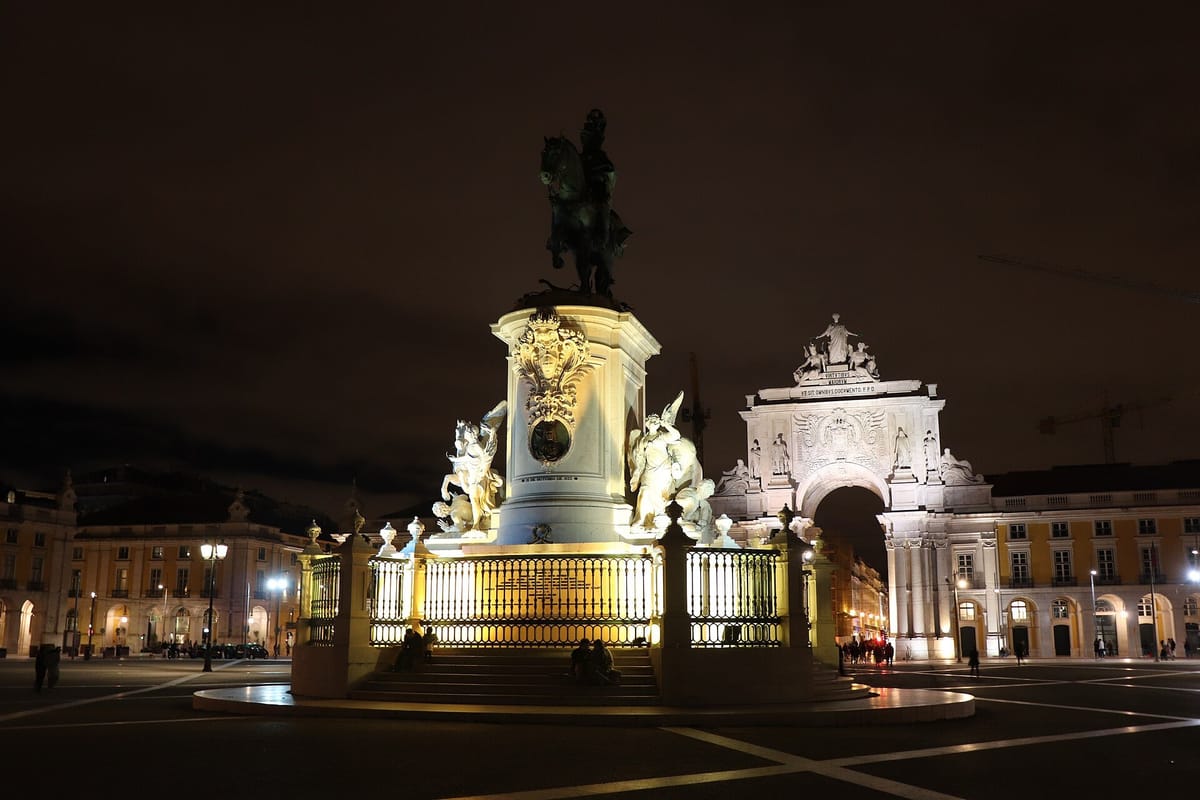
Fire station sirens across Lisbon will sound together at 09:40 on Sunday 1 November, the time the great earthquake of 1755 began on All Saints' Day 271 years ago. They are not an alert: nobody needs to do anything when they hear them. The sirens are part of Recordar 1755 (Remember 1755), a campaign that uses the anniversary to remind people that Portugal can be hit by a major earthquake again.
According to the campaign's 2026 programme, the sirens come from the Liga dos Bombeiros Portugueses (League of Portuguese Firefighters) and the Federação de Bombeiros de Lisboa (Lisbon Firefighters' Federation), and the Tagus ferry operator Transtejo Soflusa has also joined. The programme says the outdoor advertising company MOP will turn its digital screens purple at the same minute.
Purple windows and monuments
Purple is the campaign's colour. Monuments, town halls, bridges, castles, churches, schools and museums were lit purple on the night of 31 October. The campaign is asking people to hang something purple in a window on 1 November ("a scarf, a jumper, a blanket, whatever you have"). Its programme page lists 15 municipalities, 13 companies and organisations and 14 initiatives taking part this year.
The movement was founded by Quake, a private museum of the Lisbon earthquake. Its listed partners include the Secretaria de Estado da Proteção Civil (Secretary of State for Civil Protection), the Liga dos Bombeiros Portugueses, the Lisbon fire brigade (Regimento de Sapadores Bombeiros) and the councils of Oeiras, Setúbal and Ponta Delgada.
Other events
The programme also lists these events:
- Schools are invited to ring their bells at 09:40. Classes from the 3rd to the 9th year can enter a "Mural da Memória" (memory mural) competition linking 1755 to preparedness and prevention. Entry is free, and entries close on 20 November.
- Lisbon: a free guided visit at the Mosteiro de São Vicente de Fora at 10:30 on 1 November, on how the monastery came through the earthquake. Places are limited to 30 and must be booked in advance.
- Monsaraz: an exhibition on the earthquake's damage in the old municipality, drawn from the parish priests' answers to the 1758 Memórias Paroquiais (Parish Memoirs) survey.
- Sintra: the council's civil protection service will run awareness activities at the Mem Martins school group on 5 November, as part of A Terra Treme (The Earth Shakes). These include an earthquake simulation platform, a tsunami tank and a demonstration emergency kit.
The national drill
A Terra Treme is a public earthquake drill run every year by the Autoridade Nacional de Emergência e Proteção Civil (National Emergency and Civil Protection Authority, ANEPC). Its official site records 782,288 participants in 2025:
- 532,827 from schools;
- 237,000 from public bodies and companies;
- 12,461 private individuals.
The private figure was up from 8,700 in 2024. The drill teaches three moves, known as "Baixar, Proteger, Aguardar": drop to your knees, protect your head and neck, and hold on until the shaking stops. ANEPC had not announced a national date for this year's drill on its site by Saturday night.
What ANEPC tells households to do
ANEPC's earthquake leaflet (in Portuguese) says the Lisbon region and the Algarve are among the parts of mainland Portugal most prone to earthquakes. It advises households to do the following before a quake:
- fix bookcases and heavy furniture to the walls;
- keep heavy objects on the floor or on low shelves;
- agree a family meeting point;
- keep an emergency kit with water and tinned food for two or three days, somewhere everyone knows;
- make sure everyone knows how to turn off the electricity, water and gas.
During a quake, never use a lift. Stay inside until the shaking stops, away from windows, mirrors and anything that could fall. If you are driving, stop away from buildings, trees and power lines and stay in the car. Afterwards, expect aftershocks and possibly a tsunami. Do not light matches or lighters in case of a gas leak.
We set out the same moves when São Miguel felt a magnitude 5.2 earthquake in October. In August, Portugal's doctors called for a national earthquake resilience audit of hospitals. The campaign's programme points out that the last earthquake felt across mainland Portugal was on 28 February 1969.