The World's Largest Maritime Robotics Exercise Starts Monday off Troia, With 36 Navies and More Than 300 Unmanned Craft
REPMUS 2026 runs to 25 September off Troia and Sesimbra: 1,500 participants from 36 navies, 60 companies, 13 universities, 14 ships and more than 300 unmanned craft across 1,370 square kilometres of water. Portugal has hosted all 16 editions.
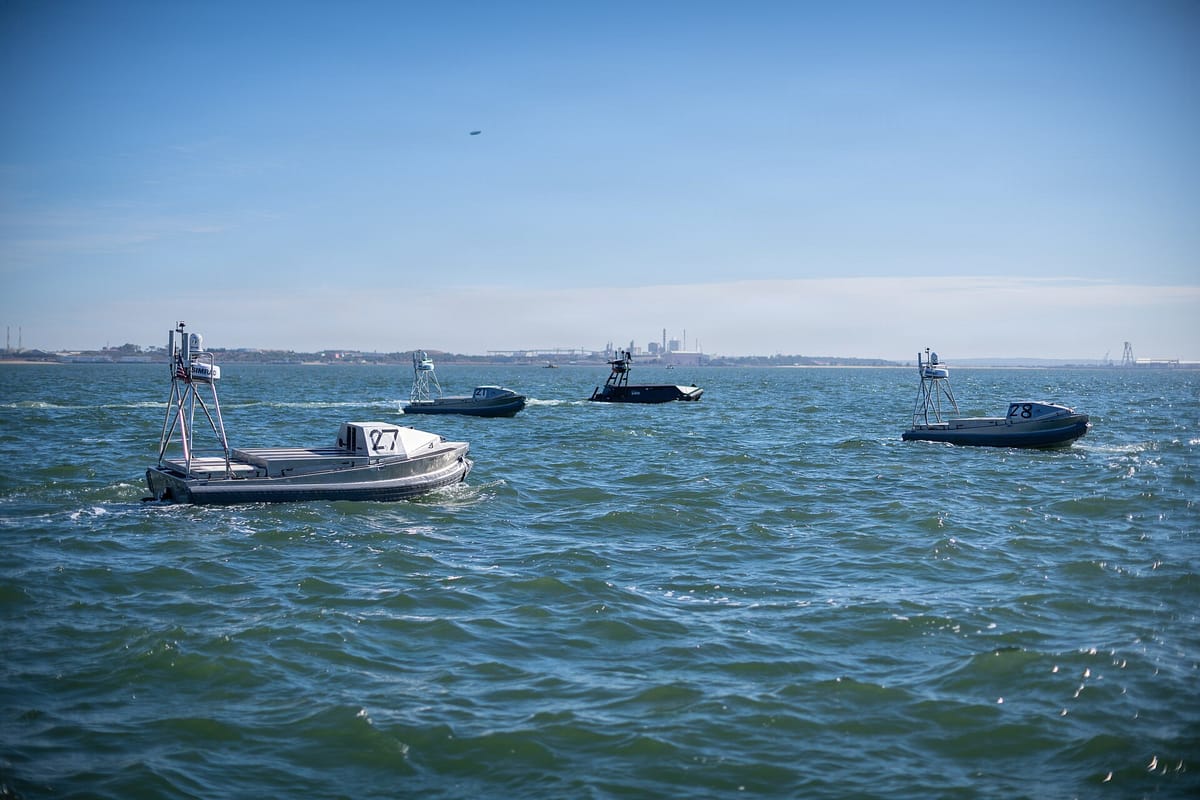
More than 300 unmanned craft, 14 ships and around 1,500 people from 36 navies begin four weeks of trials in the waters off Troia and Sesimbra on Monday. The Marinha Portuguesa (Portuguese Navy) calls REPMUS 2026 the largest exercise of its kind anywhere, and it runs until 25 September.
REPMUS stands for Robotic Experimentation and Prototyping with Maritime Unmanned Systems. This is the sixteenth edition, and Portugal has hosted every one of them. Alongside the 36 navies, the participant list includes more than 60 companies and research bodies, 13 universities, and five NATO organisations working on maritime operations and unmanned systems.
What is actually being tested
The exercise is not a demonstration of finished equipment, which is what separates it from a defence trade show. Systems built for surface, subsurface, aerial and land environments are put through conditions close to real operations, and the Navy's stated purpose is to test, evaluate and develop technologies that could shape the future of maritime security and defence.
The trials cover surveillance, information gathering and support to military missions. Unmanned vehicles have obvious wartime applications, but the Navy is explicit that they are not the only ones: the same craft are used for maritime surveillance, for protecting critical undersea infrastructure such as the transatlantic cables that come ashore in Portugal, and for search and rescue.
Where it happens, and how much water it takes
Operations run out of the Centro de Experimentação Operacional da Marinha (Navy Operational Experimentation Centre) at Troia, across other national exercise areas, and inside the Zona Livre Tecnológica Infante D. Henrique, a designated regulatory testbed for maritime technology. The area covered exceeds 400 square nautical miles, which the Navy puts at more than 1,370 square kilometres.
Organising alongside the Navy are the Faculdade de Engenharia da Universidade do Porto (Faculty of Engineering of the University of Porto, or FEUP), NATO's Centre for Maritime Research and Experimentation, the NATO Joint Capability Group Maritime Unmanned Systems, and the European Defence Agency. The FEUP involvement is long-standing and is one reason the exercise has stayed here: the university's underwater systems laboratory has been building autonomous marine vehicles since the 1990s.
For scale, the 2025 edition drew participants from 37 countries, 13 of them as observers, and tested roughly 270 unmanned surface, subsurface and aerial vehicles. This year's count of more than 300 systems is an increase on that.
A pattern rather than an isolated event
The exercise sits inside a broader Portuguese bet on uncrewed systems. In April the NRP Dom João II was floated in Romania as Europe's first purpose-built drone mothership for the Portuguese Navy. This month the Air Force bought Tekever AR5 drones to patrol Portugal's Atlantic waters, and in July Portugal joined three of the EU's five flagship defence projects, spanning drones and seabed security.
The spending side is moving at the same time. This month the state committed 21 million euros of NATO procurement services to rebuilding the Alfeite naval base, and earlier today we reported that neither the Defence nor the Finance Ministry will say what interest Portugal will pay on the 3.9 billion euro loan funding three new frigates. REPMUS is the cheap end of the same programme: a robot the size of a small boat is a rounding error against a frigate, and the exercise exists partly to work out which of the cheap options are worth buying.
What this means for expats
- Expect naval activity on the Sado through September: if you live in or are visiting Setúbal, Troia, Comporta or Sesimbra, unusual small craft and aircraft over the estuary are the exercise, not an incident. Local notices to mariners will mark restricted areas.
- Recreational drone rules get stricter near this: temporary flight restrictions can accompany military exercises, so check the geozone before you take off. Our guide to flying a drone in Portugal covers registration and the zones you cannot enter.
- Beaches and ferries are not affected: the exercise areas are offshore and in designated zones, and the Setúbal to Troia ferry runs normally.
- This is a hiring pipeline as much as a war game: 60 companies and 13 universities on the water for four weeks is where Portugal's marine robotics sector recruits, and the participant list is a map of who is active here.
The results feed into NATO and European Defence Agency capability work rather than into any Portuguese purchase order directly. The value to Portugal is being the place where it happens: sixteen consecutive editions have built a cluster of universities, firms and naval expertise that another country would find hard to assemble quickly, and harder still to move.