TAP's Half-Year Loss Widens 40 Percent to €99.2 Million on Fuel, the Day Before the Government Reads the Bid Report
TAP flew 4.2 percent more passengers and sold 4.4 percent more tickets in the first half of 2026, and still lost €99.2 million. Fuel costs rose 18.7 percent. Parpública hands the government its assessment of the Air France-KLM and Lufthansa bids on Tuesday.
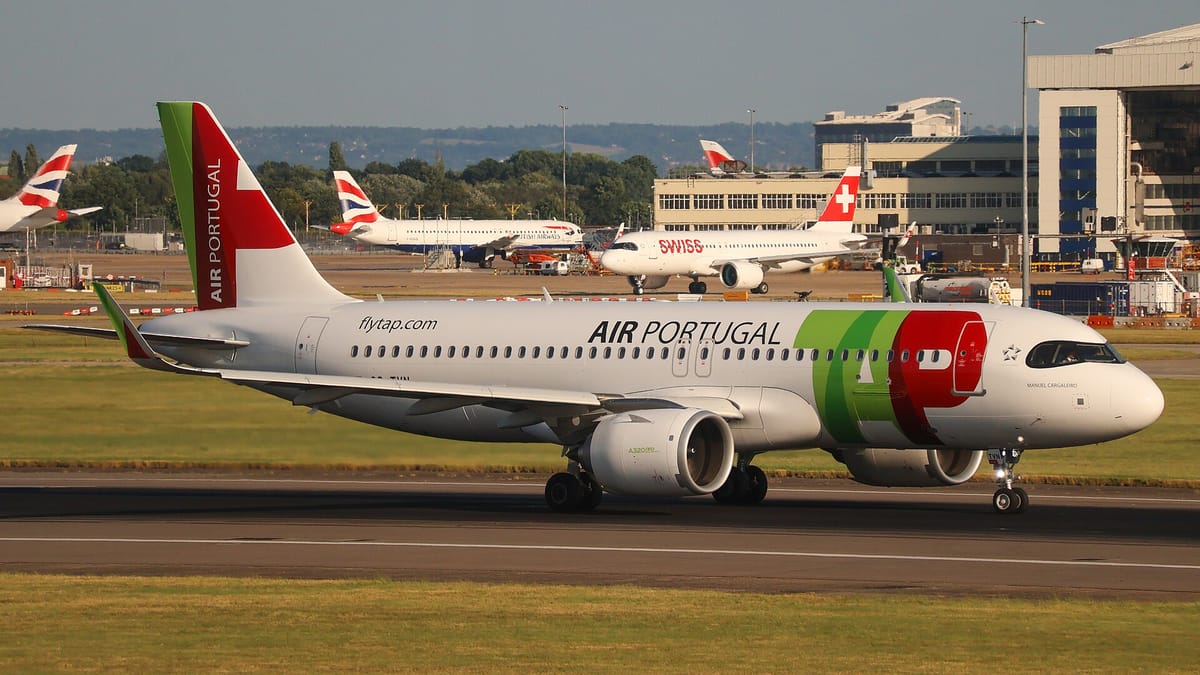
TAP reported a net loss of €99.2 million for the first half of 2026 on Monday, a 40 percent deterioration on the €71 million it lost over the same six months of 2025. The airline flew more passengers than a year ago, sold more tickets, and took more revenue through the door. Almost the entire swing came from the price of jet fuel.
The timing is what gives the number its weight. Parpública is due to hand the government its assessment of the binding bids from Air France-KLM and Lufthansa on Tuesday, one day after these accounts landed. The eleven criteria that frame that choice were set before anyone had seen a half-year loss of this size.
The numbers TAP published
- Net loss, first half 2026: €99.2 million, against €71 million in the first half of 2025.
- Second quarter alone: a loss of €59.3 million, against a profit of €37.5 million in the second quarter of 2025. That is a year-on-year swing of €96.8 million in three months.
- Fuel costs: up 18.7 percent across the half.
- Passengers: 8.2 million between January and June, up 4.2 percent, across 57,500 flights.
- Ticket revenue: €1,829.2 million, up 4.4 percent.
- Total operating revenue: €2,039.8 million, up 4.3 percent.
- Recurring EBITDA: positive €181.9 million. Recurring EBIT: negative €83.7 million.
- Cash and equivalents at 30 June: €1,222.1 million, after a €350 million senior notes issue during the half.
TAP had already reported a €40 million loss for the first quarter back in May, and warned at the time that the conflict in the Middle East would push its jet fuel bill up. The second quarter is where that warning arrived in full.
Why the revenue growth did not rescue the result
Second-quarter operating revenue was essentially flat year on year at €1,125.3 million, with ticket revenue steady at €1,018.9 million on broadly unchanged capacity. Unit revenue nudged up: PRASK, the passenger revenue earned per available seat-kilometre, reached 7.30 cents, a rise of 0.3 percent, and that figure absorbed a negative calendar effect from an early Easter in 2026.
Chief executive Luís Rodrigues put the mismatch plainly in the company's statement. The fuel price increase, he said, "made itself felt immediately in costs, while the mitigation measures on the revenue side tend to materialise more gradually, since a large part of the second-quarter revenue had already been sold when prices rose." An airline sells most of a summer quarter's seats months before it flies them. When the input cost jumps after the tickets are sold, there is no mechanism to reprice the flights already on the books.
That is also the most important thing the numbers say about the second half. The fares TAP is selling now are being priced with the higher fuel cost visible, not behind it.
What the EBITDA gap tells you
The distance between a positive recurring EBITDA of €181.9 million and a negative recurring EBIT of €83.7 million is depreciation and amortisation, and for an airline that is overwhelmingly the fleet. Read together, the two figures say that TAP's flying operation still generated substantial cash in the half, and that the cost of the aircraft it flies is what carries the result below zero. This is a fuel and capital-intensity story, not a collapse in demand: passengers, flights and ticket revenue all rose.
The fuel exposure itself is not new ground for Portuguese aviation. Supply has been rerouting for most of the year, with Galp shifting its jet fuel imports away from the Gulf, and the price of aviation kerosene has been the single most-watched input in the sector since the Hormuz disruption pushed it toward $211 a barrel.
The sale, and what a loss does to it
TAP also confirmed that it closed its Restructuring Plan during the half, a plan recognised by the European Commission, and launched a Strategic Plan running to 2035 built around long-haul route growth, complementary revenue streams and a digital programme it calls Horizon. Rodrigues framed the results as the start of "a new chapter."
For the two bidders, the character of the loss matters more than its size. A deficit caused by an external fuel shock, sitting on top of rising passenger numbers, positive unit revenue and €1.22 billion of cash, is a far easier thing to underwrite than one caused by customers going elsewhere. The demand side of these accounts is intact.
It is the political arithmetic that gets harder. Luís Montenegro has said the privatisation will recover the €3.2 billion the state put into the airline. A carrier posting a widening half-year loss in the week the government sits down to value nearly half of it is a weaker negotiating position than one posting a profit, whatever the cause. TAP's maintenance arm, which is chasing a share of Europe's rearmament spending, is one of the assets being weighed alongside the airline itself.
What This Means for You
- Fares this autumn and winter: Expect the fuel cost to show up in ticket prices rather than in the accounts from here. TAP says it will keep managing the impact through "active revenue management" and hedging, which in practice means the seats being sold now carry the higher input cost. If you are booking long-haul for the winter, booking earlier is the more defensible bet than waiting for a correction.
- Your routes are not at risk from this: Nothing in these numbers points to network cuts. Capacity was broadly stable, passenger numbers rose 4.2 percent, and the company singled out South America and Europe as its strongest markets. The 2026 to 2035 plan explicitly targets long-haul growth.
- There is no solvency question here: €1,222.1 million in cash at the end of June, reinforced by a €350 million bond issue, is a comfortable liquidity position. This is a profitability problem, not a survival one.
- If you hold Portuguese exposure: The state's stake is the point of interest, not the equity, which is not publicly traded. The outcome that matters for taxpayers is what the government concludes about price after Tuesday.
- The decision timetable is short: The Parpública report goes to the government on Tuesday, and a decision on who takes up to 49.99 percent of the airline has been signalled for September. A change of ownership does not alter your existing bookings, your Miles&Go balance or your passenger rights, all of which sit with the airline rather than its shareholders.
What to watch next
Two things will decide whether the first half was a bad quarter or the start of a bad year. The first is the jet fuel price, which TAP is now pricing into fares rather than absorbing, and which depends on a geopolitical situation nobody at the airline controls. The second is booking momentum, which the company described as resilient and supportive of rising unit revenue going into the second half.
The nearer test is Tuesday. The government receives Parpública's reading of two binding offers submitted on 29 July, for an airline that has since reported a materially worse half than the one those offers were framed against. Whether that changes the price, the conditions, or nothing at all is the first real signal of how much room Lisbon thinks it has.