Portuguese Building Sites Kept Working in June While the Euro Area's Slowed, Eurostat Data Show
Construction output rose 1.2% on the year in Portugal against a 0.7% fall in the euro area, where the construction of buildings dropped 6.5%. Spain recorded the EU's steepest annual decline at 8.5%.
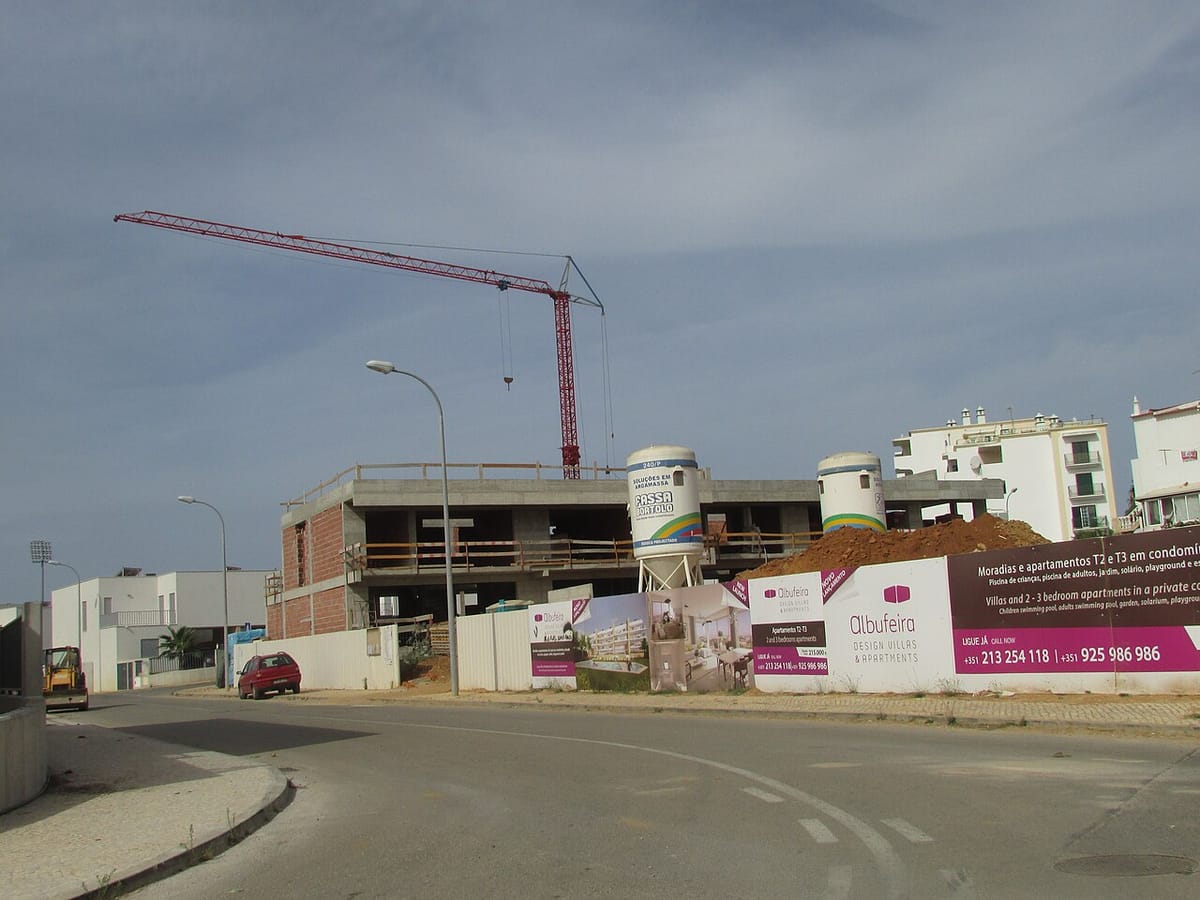
Portuguese building sites kept working through June while much of Europe's slowed. Eurostat data released on Thursday put construction output in Portugal 1.2% higher than a year earlier, against a 0.7% fall across the euro area and a marginal 0.2% rise in the European Union as a whole.
On the month, Portugal added 0.4% between May and June. The euro area lost 1.3% and the EU 1.0% over the same period, so the gap is not a rounding artefact: Portugal moved in the opposite direction on both the monthly and the annual reading.
What is dragging Europe down
The euro-area weakness is concentrated in one place. Construction of buildings, meaning housing and other structures, fell 6.5% year on year. The other two components held up: civil engineering rose 0.3% and specialised construction activities 0.2%. The EU-wide picture is the same shape, with buildings down 4.9% while civil engineering climbed 1.4% and specialised activities 0.5%.
That composition matters. Europe is still building roads, rails, grids and water infrastructure, much of it on public money and EU funds. What has stalled is the privately financed construction of buildings, which is the part most sensitive to borrowing costs and to how confident developers feel about selling what they put up.
On the month, every euro-area sub-sector fell: specialised construction activities 1.8%, civil engineering 1.4% and construction of buildings 0.9%.
Where Portugal sits
Portugal is in the upper half of the annual table but nowhere near the top. The largest year-on-year gains were in Slovenia (22.9%), Romania (18.4%) and Finland (12%). The steepest falls were in Spain (8.5%), Hungary (5%) and France (4.5%).
The Spanish number is the one worth pausing on. Iberia's two construction markets have tracked each other closely for years, and a nearly ten-point spread between them in a single month's reading is unusual. On the monthly comparison the biggest rises were in Romania (4.9%), Sweden (2.0%) and the Netherlands (1.0%), and the biggest drops in Slovakia (4.6%), Hungary (3.9%) and France (2.9%).
Portugal's own run has been positive but decelerating: 2.6% in January, 0.3% in February, 6.4% in March, 2.7% in April, 2.2% in May and 1.2% in June. The trend line points down even as it stays above zero.
What this means for you
- Buyers of new-build homes: activity holding up is not the same as supply arriving. Output measures work done, and the pipeline still runs years behind demand in Lisbon, Porto and the Algarve.
- Anyone renovating: a busy sector means contractors stay scarce and quotes stay firm. New-build costs rose 6.9% in the year to May, driven by labour rather than materials.
- Workers in the trade: construction pay led the 5.4% rise in company labour costs in the second quarter, and a sector still growing while Europe's contracts keeps that pressure on.
- Investors: the divergence from Spain is worth watching over the next two releases before treating it as a trend rather than a monthly wobble.
Portugal's advantage in June is real, but it is measured against a European construction sector in retreat. Growing 1.2% while your neighbours shrink says less about momentum than about who fell first.