Portugal Pays Brussels 41,250 Euros a Day for Unprotected Nature Sites, and Monday's Sado Estuary Decree Is Worth 750 of Them
Decreto-Lei n.º 189/2026 closes the designation of the Sado Estuary conservation area and takes effect today. It bans most building on rustic land around the bay, puts a 30-working-day ICNF clock on the rest, and carries fines reaching 200,000 euros for an individual.
Portugal has been paying the European Commission 41,250 euros a day since 5 March for failing to finish protecting 61 nature sites it was supposed to have protected years ago. On Monday the government published one more instalment of the repair job, and it takes effect today.
Decreto-Lei n.º 189/2026 (Decree-Law 189/2026), in the Diário da República (Official Gazette) of 21 September, closes the designation of the Zona Especial de Conservação do Estuário do Sado (Sado Estuary Special Area of Conservation). It is nine pages of conservation objectives and, more to the point for anyone who owns land between Setúbal, Alcácer do Sal, Palmela, Grândola and Vendas Novas, a new set of rules about what can be built, planted, dug, drained or driven across.
The fine that explains the timing
The decree does not bury its motive. Its preamble states that on 5 March 2026 the Court of Justice of the European Union, in case C-613/24, found Portugal in breach of Article 260(1) of the Treaty on the Functioning of the European Union and ordered a daily penalty payment.
According to the Court's own press release on the judgment, the sum is 10 million euros as a lump sum, plus 41,250 euros for every day until the 2019 judgment is fully complied with. That daily figure is not arbitrary: the Court set it at 55 sites still unprotected multiplied by 750 euros each, and wrote in a reduction of 750 euros a day for each site Portugal brings into compliance.
The original judgment dates from 5 September 2019, in case C-290/18. It found that Portugal had failed to designate 61 Sites of Community Importance as Special Areas of Conservation within the six years the Habitats Directive allows, and had failed to adopt the conservation measures that go with them. Portugal then passed Decreto Regulamentar n.º 1/2020, which named the sites. The Court's verdict on that in March was blunt: legislation that "merely designates" sites without specifying the habitat types and protected species on each of them "remains inadequate".
So the Sado decree is the second half of the exercise, the half the Court said was missing. Whether the Commission accepts it as enough to knock 750 euros off the daily bill is the Commission's call, not Lisbon's.
What the decree covers
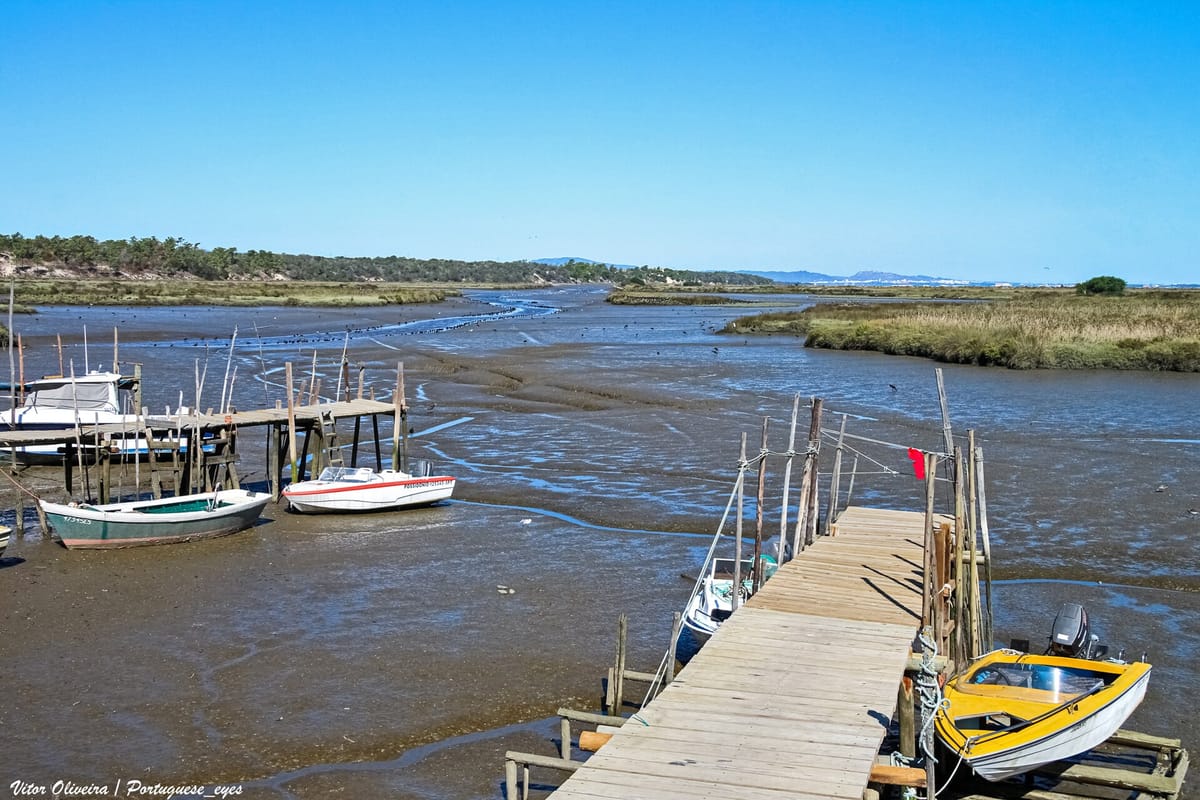
Three overlapping areas are in scope: the Sado Estuary Special Area of Conservation (site code PTCON0011), the Sado Estuary Special Protection Area for birds (PTZPE0011) and the smaller Açude da Murta Special Protection Area (PTZPE0012). The government consulted the national association of municipalities and the councils of Alcácer do Sal and Palmela, and put the question to Grândola, Setúbal and Vendas Novas.
Article 3 sets out what the protection is for, and the list is a reminder of how much sits in that bay. Estuarine habitats and saltmarsh. Mudflats and sandflats uncovered at low tide. Coastal lagoons. Cork oak and Iberian oak woodland. Dune systems from embryonic dunes to fixed grey dunes. And a long roll of birds: flamingo, spoonbill, avocet, little tern, osprey, purple heron, oystercatcher, black-tailed godwit.
It also names Tursiops truncatus, the bottlenose dolphin, whose small resident population in the Sado is among the very few estuarine dolphin groups in Europe. The decree's objective for it is to improve its conservation status, not merely hold the line.
Building on rustic land gets harder
Article 4 is the part with the widest reach. Municipal plans covering these areas must now carry rules prohibiting construction on solo rústico (rustic land), with a set of carve-outs that are worth reading closely, because they define the remaining room:
- Infrastructure supporting nature conservation, visitor use, recreation, sport, marine farming, commercial fishing, tourism activities, farming and forestry, and port operations.
- Reconstruction, demolition, alteration and conservation works on what already exists.
- Extensions to existing homes, provided the result does not exceed 200 square metres of total footprint and sealed surface.
- Extensions of a home or tourism building for tourism use, capped at a 500 square metre footprint, with no extra storeys, clustered against the existing building.
- A working farmer's own house on their holding, but only where there is no existing farm dwelling that could be used or rebuilt instead.
New quarries and mineral extraction sites are banned outright, as is enlarging the licensed area of existing ones.
Beyond the outright bans, a second tier of activity now needs a favourable opinion from the ICNF (Institute for Nature Conservation and Forests): building on rustic land that is not prohibited, extensions above 50 percent of the existing footprint or above 100 square metres, new roads and the widening or resurfacing of existing ones, coastal defence works, and changing the current use of rustic land where protected habitats occur.
Renewable energy installations on rustic land join that list, with three exceptions: sites inside rural settlements and dispersed-building areas already drawn on the municipal plan, installations mounted on existing licensed buildings or infrastructure, and self-consumption units small enough to count as works of minor urban relevance. Until municipal plans are actually revised to match, all building on rustic land in these areas needs the ICNF's opinion.
The clock on that opinion is 30 working days, and silence counts as approval. A refusal can be appealed to the minister responsible for the environment within 30 days.
Farming, water and the Vale do Sado irrigation scheme
Article 5 bans a further list of activities outright. Releasing untreated industrial or domestic wastewater. Introducing species on the national invasive list. Clear-felling or uprooting stands of the protected woodland habitats. Deep soil tillage, defined as deeper than 10 centimetres, where it would hit the root systems of cork oaks and holm oaks, measured across twice the crown spread with a minimum four-metre radius. Intensive marine aquaculture. And off-road motorised sport or recreation on rustic land and in the public water domain.
Conditioned on an ICNF opinion, among others: new permanent tree or shrub crops outside habitat areas, changes between farm and forest use over continuous areas above 0.5 hectares, converting salt pans to other uses, sediment management, water abstraction and drainage works, and new aquaculture installations. Notably, that last one covers renewing the licences of existing aquaculture operations, not just new ones.
The Aproveitamento Hidroagrícola do Vale do Sado, the Sado valley irrigation scheme, is carved out of several of these restrictions, which keeps the rice and irrigated arable land in the valley working under its existing management. Military installations and land under military easement are excluded from the decree entirely.
The fines
Breaches of the land-use rules in Article 4 are treated as planning offences. Breaches of Article 5 are environmental offences under the framework law, Lei n.º 50/2006, and the decree sorts them into bands.
The outright bans in Article 5(1), including the wastewater, invasive species, clear-felling, deep tillage and wetland provisions, are very serious offences. For an individual that means a fine of 10,000 to 100,000 euros for negligence and 20,000 to 200,000 euros where intent is found. For a company the top of the intentional band is 5 million euros. Doing a conditioned activity without the ICNF's opinion is generally a serious offence: 2,000 to 20,000 euros for an individual acting negligently, rising to 4,000 to 40,000 for intent.
Enforcement falls to the ICNF, the regional coordination commissions, the GNR, the PSP and the Maritime Police. The ICNF runs the proceedings and levies the fines, and can seize property as a precaution.
What is still missing
Article 13 leaves the most detailed layer to a later ordinance: a management plan, to be approved by the ministers for environment, spatial planning, agriculture, forests, sea, fisheries and infrastructure. That plan is what will actually name the habitat types and species the site is designated for, set conservation priorities and add active management measures. No date is attached to it.
That matters for the compliance question. The Court's complaint in March was precisely that Portugal had not specified habitats and species per site. The decree defers that specification to a plan that has not been published. The conservation measures and the sanctions regime are in force from today; the list they are meant to protect is not yet written down.
The decree was approved in Council of Ministers on 30 July, promulgated by President António José Seguro on 11 September and countersigned by Prime Minister Luís Montenegro on 14 September. It entered into force the day after publication, which is 22 September 2026.
It arrives in a month when Portugal's protected-area rules have been moving on several fronts at once. An order published on 18 September gave the environment agency twelve months to redraw the beach rules from Sesimbra to Odeceixe, a stretch that runs down the coast from the mouth of the Sado. The government has separately been redrawing the environment agencies themselves, with impact assessments centralising on the ICNF, the same body this decree hands a 30-working-day opinion queue. And the politics of protected status has been live since the environment minister ruled out declassifying the Sintra-Cascais Natural Park in August.
For landowners on the estuary, two practical points stand out. The deep-tillage rule around cork and holm oaks now carries an environmental fine on top of the separate national regime that already requires authorisation to fell those trees. And the 30-working-day ICNF clock, with silence counting as consent, is the single most useful deadline in the text: it is the difference between a stalled project and a permitted one.