An Order Published on Friday Hands Portugal's Environment Agency Twelve Months to Redraw the Beach Rules From Sesimbra to Odeceixe
Despacho n.º 11520/2026 reopens the Espichel-Odeceixe coastal programme four years after it was approved, after an inspection of 45 kilometres of Grândola coast between Troia and Melides. Sixteen bodies sit on the advisory committee; the beach concessionaires attend only when invited.
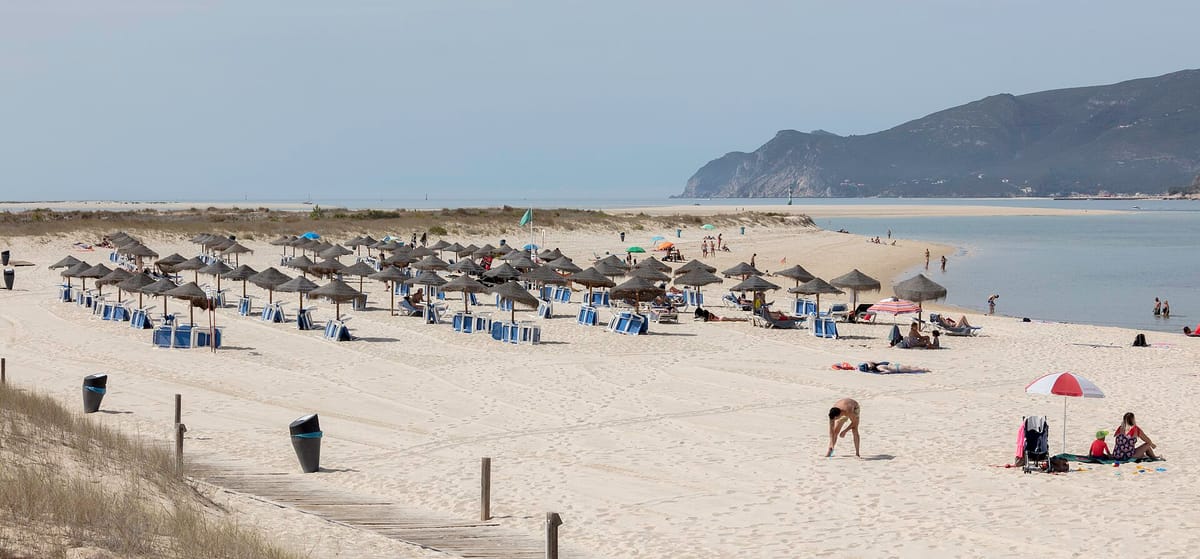
The Secretary of State for the Environment signed an order on 2 September that was published in the Diário da República (Official Gazette) on Friday, and it hands the Agência Portuguesa do Ambiente (Portuguese Environment Agency) twelve months to reopen the rulebook for roughly 220 kilometres of coast. Despacho n.º 11520/2026 orders the amendment of the Programa da Orla Costeira de Espichel-Odeceixe, the coastal programme that runs from Cabo Espichel in Sesimbra down to Odeceixe on the Algarve border.
The programme is only four years old. It was approved by Resolução do Conselho de Ministros n.º 87-A/2022 of 4 October, corrected two weeks later, and its management rules were published as Aviso n.º 23368/2022. Reopening a coastal programme this early is unusual, and the order is explicit about why.
Forty-five kilometres of Grândola coast started this
The trigger was an inspection the environment agency carried out in July 2025 on bathing access along the Grândola coastline, a stretch of about 45 kilometres between Troia and Melides. What the inspectors found there was enough to persuade the government that the classification of the beaches themselves, not just the enforcement around them, needs revisiting.
The order sets out the problem in the language of land-use planning: the classification of beaches has to be adjusted to the growth in demand, public access routes and car parks have to be organised, and the protection of sensitive ecological systems has to be reconciled with what the text calls the principle of free access and public enjoyment of beaches, and free access to the public water domain. A second objective is flatter and more revealing: to correct errors and inconsistencies in the rules that set out the principles and criteria for the use and management of beaches with bathing status.
That is a government saying, in the gazette, that the document it approved in 2022 does not work as written on the ground it was meant to govern.
Who gets a seat, and who only gets an invitation
The environment agency will run the amendment and must also put it through strategic environmental assessment, under Decreto-Lei n.º 232/2007. Both have to be finished within twelve months of publication, which sets the clock running from Friday.
The advisory committee named in the order has sixteen members. The environment agency chairs it. Alongside it sit the regional coordination commissions for the Alentejo and for Lisboa e Vale do Tejo, the Instituto da Conservação da Natureza e das Florestas (Institute for Nature Conservation and Forests), Turismo de Portugal, the Direção-Geral da Autoridade Marítima (Directorate-General of the Maritime Authority), the regional health delegations for both regions, the port authorities of Setúbal and Sesimbra and of Sines and the Algarve, and the six councils the coast passes through: Sesimbra, Setúbal, Grândola, Santiago do Cacém, Sines and Odemira.
One body is treated differently. The Federação Nacional dos Concessionários de Praia (National Federation of Beach Concessionaires), along with other associations whose purposes are relevant, may attend the committee's meetings only when the environment agency convenes them. Beach concessionaires are the commercial operators of the bars, restaurants and sunbed rows on the sand, and they are the interest most directly exposed if beach classifications move. They will be in the room, but as guests.
Nobody outside that list has a formal place yet. The strategic environmental assessment carries its own public consultation, and that is where residents, landowners and the campaigners who have spent two summers arguing about access on this coast will get their say. On present timings, that falls somewhere inside the next twelve months, which means the new rules will be drafted while the beaches they cover are closed for the winter.