Portugal Has Broken Its Ammonia Limit Every Year Since 2020, Its Air Pollution Programme Admits as It Takes Effect Today
The national air pollution programme, published on 10 November and in force today, says Portugal has missed its ammonia ceiling since 2020 because of a poultry boom, and will keep missing it after 2030. The wood-stove grant still has no amount, and there is no new money.
Portugal has been in breach of its legal limit on ammonia emissions every year since 2020, and expects to stay in breach beyond 2030. That admission sits in the Programa Nacional de Controlo da Poluição Atmosférica (National Air Pollution Control Programme, PNCPA), which the Council of Ministers approved on 8 October and which was published in the Diário da República (the official gazette) on Tuesday as Resolução do Conselho de Ministros n.º 217/2026 (Council of Ministers Resolution). It takes effect today, Wednesday 11 November.
The programme sets out how Portugal means to meet the EU's national emission ceilings for five pollutants. When it was approved, only a December 2025 draft was public, and our October report was based on it. The final 79-page text is now out. On home heating it keeps what the draft said; on farms it goes further than the October coverage did.
The ammonia problem
Under the 2018 decree that brought the EU directive into Portuguese law (Decreto-Lei n.º 84/2018), Portugal must cut ammonia emissions by 7 percent from 2005 levels in every year from 2020 to 2029, and by 15 percent from 2030. The programme says the cut actually achieved in recent years is only about 1 to 3 percent, about 1,000 to 2,000 tonnes, and that the country "has been in a situation of legal non-compliance since 2020".
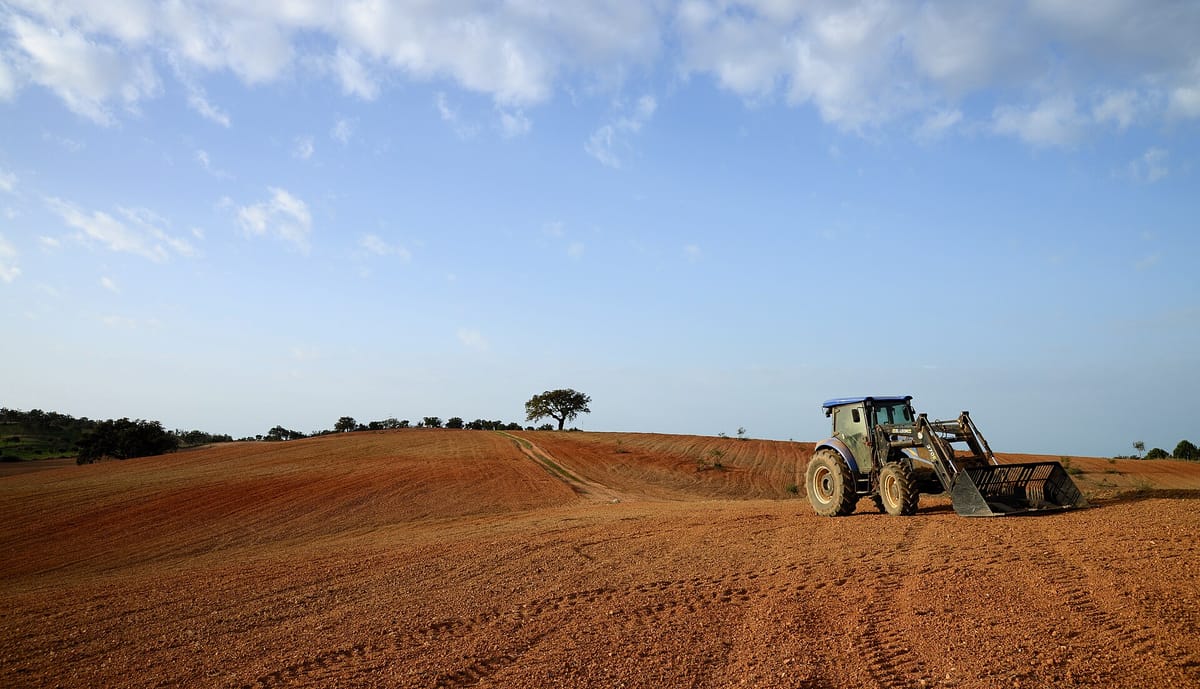
Its explanation is poultry. The breach was "mainly due to the high growth in the number of animals in the poultry sector from 2016", which only came to light in 2022, when the three-yearly farm statistics were updated. Agriculture and livestock produce more than 91 percent of mainland Portugal's ammonia, mostly from manure and slurry, nitrogen fertilisers and animal urine on pasture. In 2023, ammonia from livestock was 14 percent above its 2005 level, while emissions from fertiliser use were 3 percent lower. The programme's projections assume poultry production keeps growing until 2030, and it says the forecast breach "persists beyond 2030".
Ammonia matters away from the farm because, as the programme notes, it reacts in the air to form fine particles (ammonium nitrate), the same PM2.5 that does most harm to health.
What it asks of farms
Most of the extra farm measures are about finding out what is happening before regulating it:
- A survey of the big pig and poultry units. Producers whose installations come under the industrial emissions regime (PCIP) are to get a form in 2026 and 2027 asking which low-emission techniques and good practices they use, and APA and the agriculture services are to set a method for checking the yearly returns.
- Possible new licence conditions. Once the survey is in, the Agência Portuguesa do Ambiente (Portuguese Environment Agency, APA) is to judge, from 2027 to 2030, whether those installations need further measures written into their environmental licences.
- Better counting. New methods for estimating emissions from pigs, poultry and ruminants between 2026 and 2028, and updated 2030 projections in 2027.
- Advice and training for farmers on the national code of good practice for cutting ammonia, and a push from 2026 to shred pruning waste and work it into the soil instead of burning it.
Among the measures already in place, the programme lists the ban on burning stubble except for plant-health reasons. The law also requires that ammonia and particle rules spare small and very small farms excessive burdens, and the programme repeats that safeguard.
The other pollutants
The programme's table of commitments (cuts from 2005 levels) and where Portugal stood in 2023:
- Nitrogen oxides: 36 percent required to 2029 and 63 percent from 2030; Portugal was 55 percent down in 2023.
- Sulphur dioxide: 63 percent and 83 percent; Portugal was 84 percent down.
- Non-methane volatile organic compounds: 18 percent and 38 percent; Portugal was 26 percent down.
- Fine particles (PM2.5): 15 percent and 53 percent; Portugal was 24 percent down.
- Ammonia: 7 percent and 15 percent; Portugal was 2 percent down.
The text says the volatile compounds and PM2.5 targets are being met "very close" to the ceiling, and that on 2023 data Portugal is at risk of missing its 2030 commitments for nitrogen oxides, volatile compounds, PM2.5 and ammonia. For PM2.5 alone it puts the extra cut needed by 2030 at about 13,500 tonnes.
Home fires and city traffic
On heating, the final text keeps the draft's figures: wood burned in open fireplaces, stoves and inserts produced about 43 percent of mainland PM2.5 in 2023, about 18,000 tonnes. It also keeps the draft's two household measures: an awareness campaign by APA and the Direção-Geral da Saúde (Directorate-General of Health) in 2026, and the relaunch of a Fundo Ambiental (Environmental Fund) support line, running from 2026 to 2030, to replace open fireplaces, stoves and wood or coal boilers with cleaner heating such as heat pumps. There is still no amount, no eligibility rule and no opening date, so there is nothing to apply for yet.
In the cities, the programme says annual nitrogen dioxide levels are still above the 40 microgram limit in large urban areas, and that the new EU air quality directive lowers that limit to 20 micrograms from 1 January 2030. Among the measures already listed are low-emission zones in medium-sized and large cities by 2030, to be set up by the councils and the regional coordination and development commissions (CCDR). The measure names no cities.
No new money
The resolution itself says that spending on the programme's measures depends on the budgets the public bodies responsible already have, with no top-up from the Finance Ministry's provisional appropriation or other central reserves. APA, working with the Agência para o Clima (Climate Agency) and the agriculture ministry's planning office, must check progress every year and produce a final report with a proposed update by the end of the programme's third year.
What it means for health
The programme's modelling puts premature deaths linked to PM2.5 at 3,264 in its 2015 reference year, falling to about 1,916 in 2030 with the measures already in place. The additional measures would bring that to about 1,858, a further 3 percent. It is candid about why the gain is small: the modelled extra measures were the farm ammonia cuts, and they would lower average PM2.5 levels by less than 0.1 microgram, with little effect in the coastal cities, where farming is not the main source of the particles.
Readings from Portugal's air monitoring stations are published on APA's QualAr site, which is also the place to check during episodes such as last month's Saharan dust. The programme covers air pollutants, not greenhouse gases; Portugal's climate figures were in this week's EU progress report. Farmers' fertiliser costs, a separate issue, have been the subject of government support this year.