Porto's Mayor Gives the Metrobus Contractor Until December and Names It as the Reason the Works Are Late
Pedro Duarte told reporters on Friday that the builder of the second phase has missed its deadlines and has not met its obligations. Metro do Porto, which is the client, has not answered questions about the new date or about money beyond the recovery plan.
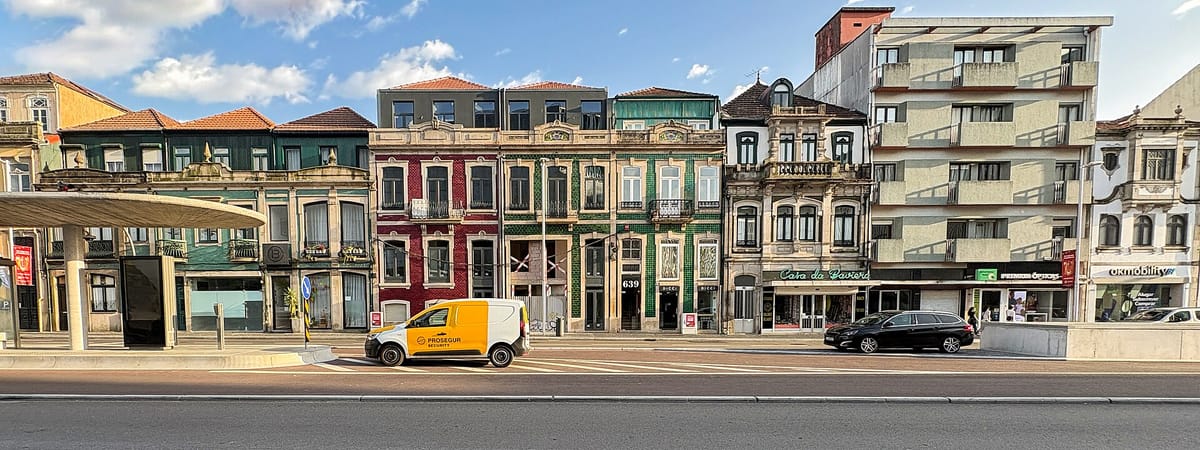
Porto's mayor spent Friday morning riding the number 22 tram. When he stepped off and met the reporters waiting for him, he said something mayors normally leave to lawyers: the company building the second phase of the city's metrobus has missed its deadlines, has not met its obligations, and now has until the end of December.
"It is important that this be said, and I have no problem saying it publicly: we have had serious problems with the contractor on this job. Not us, the Metro do Porto, we are not the client, the Metro is, over missed deadlines," Pedro Duarte told journalists.
He went further. "The contractor said to my face that it would finish the work by October. It probably will not. But the end of the year is the limit for us. So I hope that this time the word is kept, and by the end of the year we need that job closed."
Whose job it is, and who is building it
The distinction the mayor drew is not a technicality. The câmara municipal is not the contracting authority for the metrobus works; Metro do Porto is. The city's leverage is political rather than contractual, which is part of why a public deadline delivered to journalists on a Friday morning is the instrument being used.
The works were awarded to Alexandre Barbosa e Borges (ABB). Duarte, elected on the PSD, CDS-PP and Iniciativa Liberal coalition ticket, said the council has "made a big effort to give every condition to speed up what the timetable for the work is."
What is left to build is the stretch between the junction of Avenida da Boavista with Avenida Marechal Gomes da Costa and Praça Cidade do Salvador, the roundabout everyone in Porto calls the Anémona.
The dates keep moving, and nobody official will name the new one
Three different timelines are in circulation, and none of them come from the client.
- The contractor told the mayor it would be finished in October. He now expects that to slip.
- The mayor's own limit is 31 December, for the work to be closed.
- Luís Osório, president of Sociedade de Transportes Colectivos do Porto (STCP), the company that will actually run the service, told Público in an interview last week that the latest information he had was that operation of the second phase would begin in January. He added his own caveat: "Experience tells me that this may slip, but here it is purely speculative. At the moment we expect to start the second phase in January, whether in testing or in full."
Lusa put four questions to Metro do Porto this week: what the company's new official deadline for finishing the second phase is, when the service is expected to be running, when the hydrogen production and refuelling station will be ready, and whether funds from outside the Plano de Recuperação e Resiliência (Recovery and Resilience Plan, PRR) had to be found to finish the job, given that the PRR deadline has already been passed. No answer had arrived by Friday.
That last question is the substantive one. A works programme that outruns its European funding window has to be paid for from somewhere, and the somewhere is usually a municipal or company balance sheet.
A stop-start year on the Boavista
The second phase has been interrupted once already. In October last year, Metro do Porto's incoming administration ordered what it called a temporary technical stoppage, a month after the works had drawn objections both from candidates in the October 2025 municipal elections and from residents, particularly over the felling of trees along the avenue. Work restarted on 3 November 2025 on Avenida da Boavista, on the section between the Colégio do Rosário and Fonte da Moura.
The first phase is already carrying passengers. Porto's metrobus began paid service in April as Portugal's first hydrogen bus rapid transit line. When the second phase opens, the route will run from the Casa da Música to Praça do Império in about 12 minutes and on to the Anémona in about 17.
The money
Two figures define the project. The vehicles and the energy production system together cost 29.5 million euros. The civil works, the busway itself, cost about 76 million.
Neither number includes the operating subsidy that will follow, and neither is affected by a contractor overrunning its programme, at least not directly. What an overrun does affect is the moment the second figure starts producing anything, which is the point the mayor was making.
The wider picture in the north
The metrobus is one of several transport files landing on Porto's desk at once. The city has now issued more than 100,000 free transport cards against a model that assumed 59,381 users, a demand problem rather than a construction one. Metro do Porto re-tendered its operating contract at 690 million euros in July as four new lines joined the network. And the model itself is spreading: Coimbra has redrawn 26 bus lines around a metrobus that starts serving Praça da República on 10 September, while the government has revived an 80 million euro plan to link Guimarães and Braga by 2030 on the same principle.
Porto's is the one that has to finish first, and on Friday its mayor put a date on it in public and named the party he holds responsible. Metro do Porto and the contractor have not answered. Update: on 6 October 2026, a test train ran the whole of the Pink Line for the first time with passenger service expected by the end of March 2027.