Coimbra Redraws 26 Bus Lines for a Metrobus That Starts Serving Praça da República on 10 September
The city executive approved the package on Monday by six votes to five. Twenty-six SMTUC lines change route on 10 September, through-traffic is squeezed out of Rua da Sofia, and SMTUC expects about 14 percent of daily passengers to be affected.
Coimbra's municipal executive voted on Monday to rewrite the routes of 26 city bus lines, timed to the day the metrobus starts carrying passengers to Praça da República and the Coimbra-B railway station. The changes take effect on 10 September, and the Serviços Municipalizados de Transportes Urbanos de Coimbra (SMTUC, the municipal urban transport service) estimates that about 14 percent of its daily passengers will find their journey altered.
The vote split the chamber cleanly. Five councillors from the governing Avançar Coimbra coalition (PS, Livre and PAN), plus the chamber's former Chega councillor, voted in favour. The five councillors of Juntos Somos Coimbra (PSD, CDS-PP, IL, Nós Cidadãos!, PPM, MPT and Volt) voted against, arguing that the city had not been consulted and predicting congestion once the restrictions bite.
What actually changes on 10 September
Two things happen at once, which is why the package is larger than a normal timetable revision.
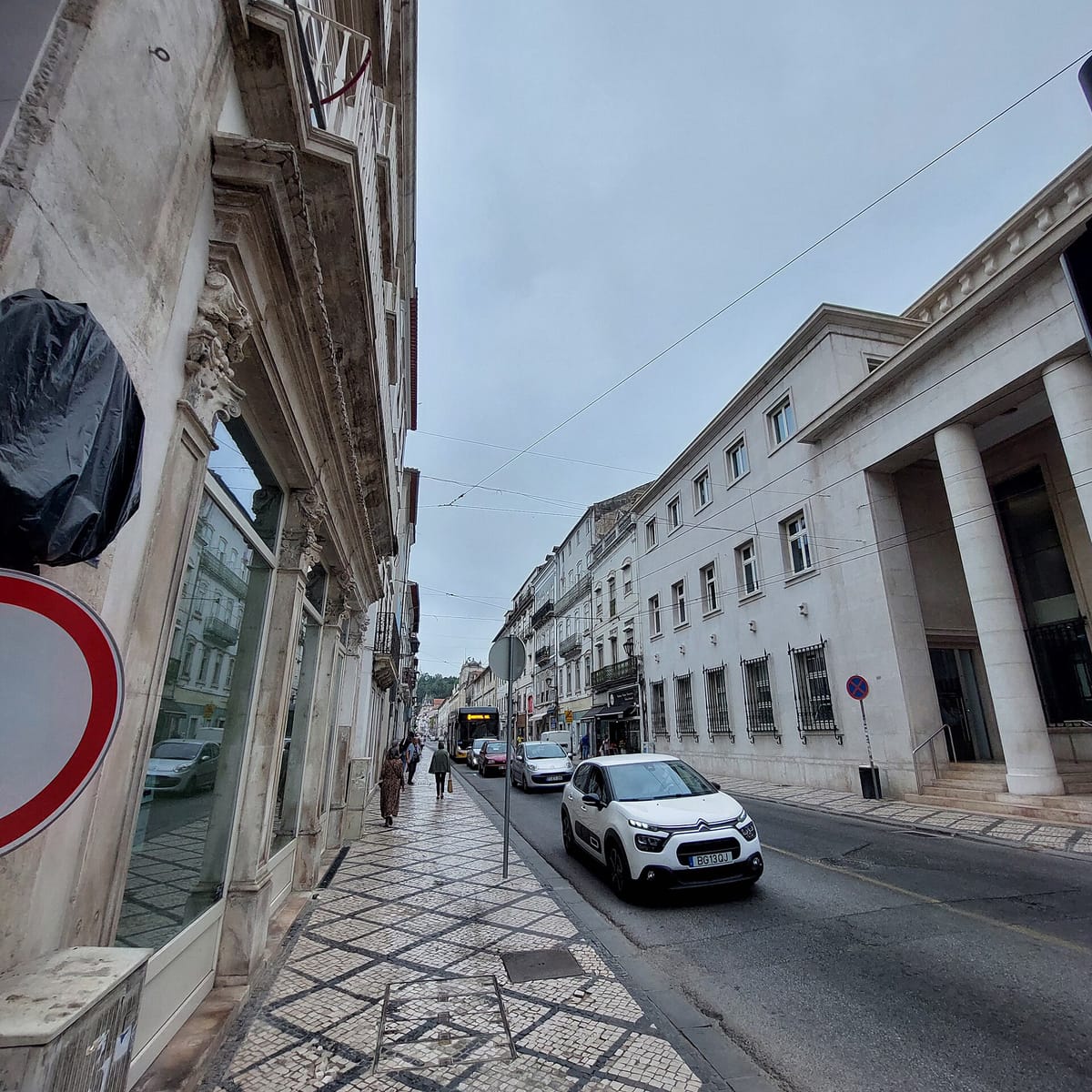
The first is the traffic plan for the Baixa, Coimbra's low-lying commercial centre. The proposal reorganises circulation along the main axes: the via Central, Rua da Sofia, Rua Olímpio Nicolau Rui Fernandes and Rua de Saragoça. Through-traffic on Rua da Sofia and Olímpio Nicolau Rui Fernandes is cut back sharply and pushed instead onto Rua de Aveiro, Rua de Saragoça, Rua Guerra Junqueiro and the city's inner and outer ring roads. André Remédio, technical director of Engimind, the firm hired to model the reorganisation, set out that transfer of traffic to the executive.
The second is the bus network itself. Twenty-six SMTUC lines change route: the 4, 5, 5T, 6, 6F, 11, 16G, 19, 19A, 19T, 19R, 24, 25, 25T, 27, 27F, 28, 28F, 29, 30, 30A, 30T, 30F, 36F, 42V and 103.
Luís Neto, the SMTUC board member who presented the proposal, described the governing principle as the removal of duplication. Where a bus line would now shadow the metrobus along its dedicated lane, the line is cut back and passengers change vehicles instead. Three points become interchanges: Arnado, Praça da República and Estádio/Solum. Four lines will terminate at Praça da República, where the connection is direct. Lines terminating at Arnado leave passengers a five-minute walk along Rua da Sofia to the metrobus stop beside the city hall. At Solum and the stadium, the transfer is a three-minute walk.
SMTUC expects more than 3,800 daily journeys to become combined bus-and-metrobus trips, and about 530 passengers a day to abandon the municipal buses entirely and make the whole journey on the metrobus. Because many lines get shorter, Neto told the executive, the service window widens and frequencies rise on several routes. He also framed that as a reliability fix: SMTUC has spent 2026 short of drivers, with its regularity index falling, and shorter routes make the printed timetable easier to actually keep.
The objection: redundancy is not always waste
Ana Bastos, the opposition councillor who held the mobility portfolio in the previous mandate, made the sharpest argument against. She said the package amounts to "a profound transformation of how the city works, without the people and traders directly involved having been heard", and called for a broad public discussion first.
Her substantive point was about resilience. Overlapping routes, she argued, are not simply accounting waste; they give a network "greater robustness, resilience and flexibility", offering alternatives when something fails. "We cannot look at the network exclusively through an accounting logic, eliminating everything that, on a simplified analysis, looks duplicated," she said. She also warned that the executive should not move to "a solution of strong restriction" while the metrobus still does not cover most of the urban area, the bus network is mid-reorganisation, and there is no structured ring of peripheral car parks to receive drivers turned away from the centre. And she flagged one specific bottleneck: with the Baixa axes restricted, access between the Portagem and the University of Coimbra falls back on the Ladeira do Seminário, a residential street, and Rua de Aveiro, which is already congested.
Mayor Ana Abrunhosa answered that the guiding principle is intermodality, and that a network full of redundancies is one that confuses passengers. She said there had been repeated meetings with traders and residents, that access is guaranteed for residents and businesses on streets moving to restricted circulation such as Rua da Sofia, and that the changes will be monitored and corrected if they fail. On the politics of the car, she was direct: this is not "an attack on the automobile" but a defence of "mobility in safety, with life lived in the city". Peripheral car parks and tighter parking enforcement inside the city are the next steps, she said. Councillor Ricardo Lino, of the governing coalition, said the changes were technically grounded and would make reaching the Baixa faster and more comfortable.
SMTUC, Metro Mondego and the city council are preparing a joint information campaign to explain, as Neto put it, the alternative "case by case, so that nobody is left without a service".
How the metrobus got here
The metrobus is the surface component of the Sistema de Mobilidade do Mondego: articulated buses running in a dedicated lane, closer to a light rail line in operation than to an ordinary bus route. In July, Metro Mondego president Leonel Serra said service to Coimbra-B and Praça da República was expected "at the end of August, beginning of September, if nothing goes wrong in the meantime". The extension towards the city's hospitals is targeted for the first quarter of 2027, and further links to Condeixa, Cantanhede, Mealhada and the university depend on feasibility studies and funding that do not yet exist.
Coimbra has had a difficult year with the system around it. In July, a ransomware attack on Metro Mondego may have copied pass-holders' identity, address and tax data. Earlier this month the council also joined the Portuguese cities backing away from shared e-scooters, and it is preparing to double its tourist tax to two euros a night. Elsewhere in the country the same technology is at different stages: Porto's metrobus began paid service in April, and the government has revived an €80 million plan to link Guimarães and Braga by 2030.
What This Means for Expats
- Check your line before 10 September. If you live in Coimbra and use any of the 26 numbered lines above, your route, and possibly your terminus, changes overnight. The SMTUC app and the joint information campaign are the places to confirm the new alignment; do not assume your stop survives.
- Budget an extra transfer, not extra time. The design deliberately swaps one-seat rides for interchanges of three to five minutes on foot. On paper the higher frequencies should cancel that out. In the first weeks, they may not, so build slack into anything time-critical.
- Driving into the Baixa gets harder on purpose. Through-traffic on Rua da Sofia and Rua Olímpio Nicolau Rui Fernandes is being squeezed out, and the mayor has signalled tighter parking enforcement to follow. Residents and traders on those streets keep access, but visitors should plan to arrive by transport or park further out.
- Watch the Portagem to university corridor. If you commute to the university by car, the opposition's warning about the Ladeira do Seminário and Rua de Aveiro is the practical one to test in the first week of the new plan.
- Peripheral parking is a promise, not a facility. The park-and-ride ring that would make this network work does not exist yet. Until it does, the metrobus and the redrawn bus lines are carrying the whole burden of the change.
The council says it will monitor the plan and correct it where necessary, which is the right posture for a change this large. The test arrives quickly: 10 September falls in the week Coimbra's students start returning, and a university city's transport network is judged not on the modelling but on the first Monday morning when everyone tries to use it at once.