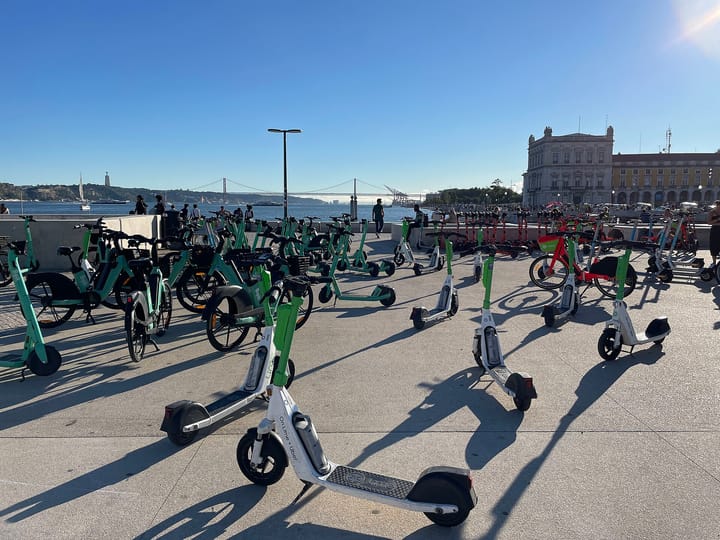
Coimbra Joins the Portuguese Cities Backing Away From Shared E-Scooters, While the National Rulebook Still Calls Them Bicycles
Braga has banned them, Espinho has ended its scheme and Lisbon faces a referendum push. Coimbra's mayor says the city lacks the safety conditions. Meanwhile the Codigo da Estrada still classifies e-scooters as velocipedes and helmets remain optional.
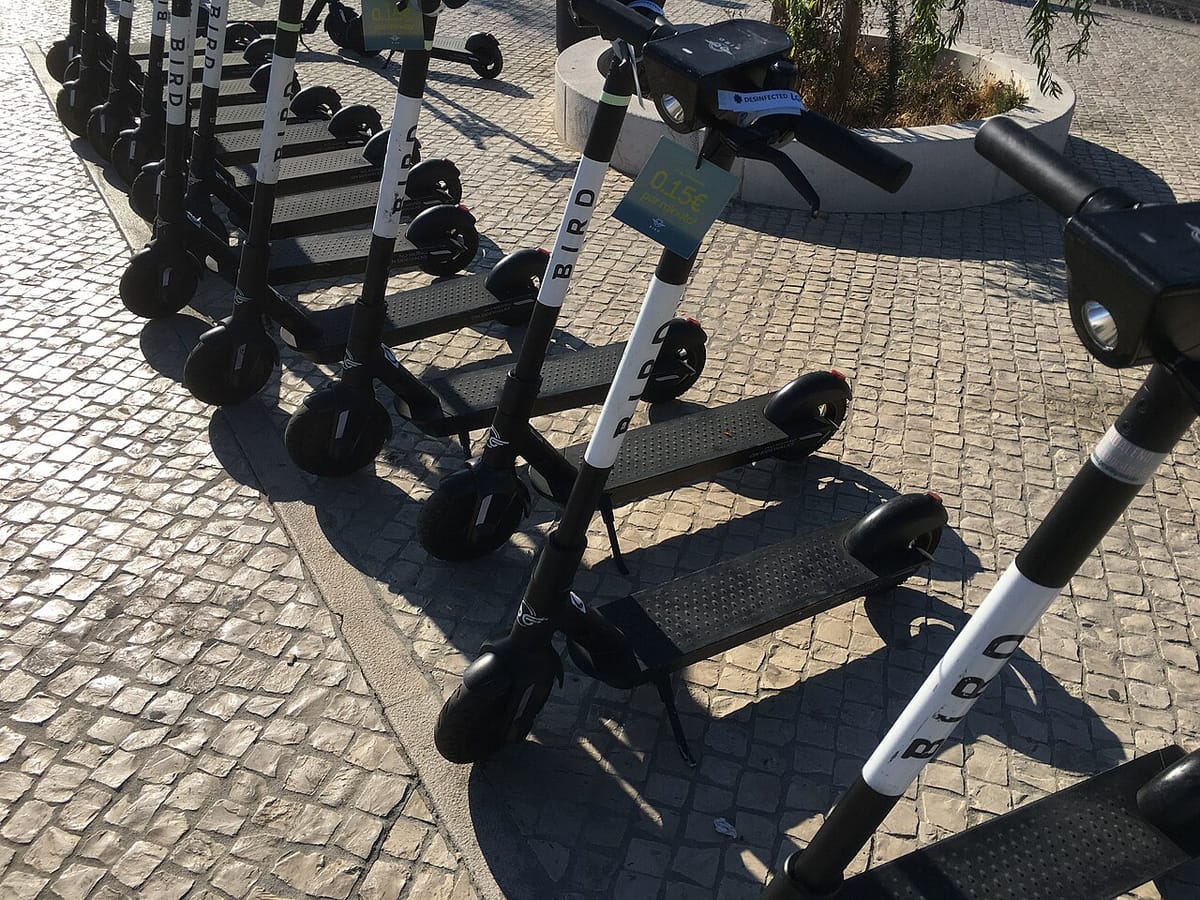
Coimbra has become the latest Portuguese city where shared electric scooters are being argued out of existence. A public petition is circulating that asks for dockless rental scooters to be pulled from the streets and allowed back only under tighter rules, and the mayor, Ana Abrunhosa, has said that as things stand the city does not have the safety conditions to host them. Keeping them, she argues, would require substantial investment that is hard to justify right now.
The complaint is familiar: machines left across pavements, sometimes toppled and blocking the way, and accidents caused by scooters abandoned wherever the last rider stepped off. Abrunhosa's position is not that micromobility should end, but that the city has to be prepared for it first.
A pattern rather than an incident
Coimbra is the fourth municipality to reach this point in under three months. In late June, Braga's mayor João Rodrigues moved to terminate the council's contracts with scooter operators, after a public petition launched on 14 June cleared 1,000 signatures. "We cannot ignore the countless accident cases with scooters," he said, citing daily reports. The council went on to prohibit shared scooters outright, giving operators 60 days to remove their equipment and pointing to more than 40 recorded accidents in the year.
Espinho ended its shared bicycle and scooter programme in late July, after the operator's contract lapsed in March, saying it wanted to give the public realm back to pedestrians. In Lisbon, the Automóvel Club de Portugal (Portuguese Automobile Club) has proposed putting the future of shared scooters to a municipal referendum.
The operators have pushed back hardest there. Bolt, Lime and Byrd argue that the proposal attaches a real problem to the wrong solution, and that shared fleets are in fact the most tightly governed vehicles on the street: they carry municipal authorisations, insurance, speed caps, mandatory parking bays and geofencing. Remove them, the companies say, and what remains is the entirely unregulated privately owned scooter. Their counter-proposal is more enforcement, more parking infrastructure, wider slow-speed geofenced zones and a negotiated cap on fleet size.
The rulebook underneath has not moved
What makes this a municipal fight is that the national framework has stayed still. Portugal's Código da Estrada (Highway Code) still classifies electric scooters as velocípedes, meaning bicycles. Helmets are recommended, not required. Riders are capped at 25 km/h, must use lights and reflectors at night, and are barred from pavements.
Two things have shifted at the edges. The PSD has tabled a bill that would make helmets and reflective gear compulsory, with fines of 30 to 150 euros, and it is still awaiting a parliamentary decision. Separately, Decreto-Lei 26/2025, which transposed the revised EU motor insurance directive, moved the more powerful machines out of the bicycle category altogether: models capable of exceeding 25 km/h are treated as motor vehicles and need compulsory third-party cover. Owners who have never checked their model's specification may be uninsured without knowing it.
Spain, meanwhile, tightens up from 1 October: a minimum age of 15, compulsory helmets with 200 euro fines, a ban on verges and interurban roads, lights at night and reflective clothing for delivery riders. Portugal's own Highway Code revision is being drafted, but scooters are not its headline.
The casualty picture is mixed, which is part of why the national debate has drifted. In the first four months of 2025 the PSP logged 623 accidents involving cyclists and scooter riders in its own patrol area, 479 of them with casualties and 16 with serious injuries, but none fatal. Across 2024 the same force recorded 1,658 injury accidents, four deaths, 72 serious and 1,677 minor injuries. The worst year for deaths was 2021, at ten.
Enforcement, when it lands, can be startling. On 18 August at around 3:40am, officers watching the 25 de Abril Bridge cameras spotted a 24-year-old riding an electric scooter the wrong way across the deck towards Almada. He tested at roughly 2.25 g/l of blood alcohol, well past the 1.2 g/l threshold at which drink-driving becomes a crime, and faces suspicion of dangerous driving as well.
What this means for foreign residents
- Check whether your city still has a fleet. Braga and Espinho have gone, Coimbra is contested and Lisbon is under pressure. If you rely on shared scooters for a commute leg, have a fallback.
- Your private scooter may legally require insurance. If it can exceed 25 km/h, Decreto-Lei 26/2025 treats it as a motor vehicle. Read the manual before you ride it again.
- Riding drunk on a scooter is a crime, not a fine. The same 1.2 g/l criminal threshold that applies to cars applies here.
- Helmets are coming. The PSD bill is pending and Spain moves first in October. Buying one now costs less than the fine will.
Portugal is running the debate backwards: town halls are deciding whether shared scooters exist at all, while Parliament has yet to settle what a scooter legally is. Until the Highway Code is rewritten, the map of where you can ride one will keep being drawn council by council, and a road safety record that has barely improved in a decade will keep supplying the argument.
Feature image: CAPTAIN RAJU, Wikimedia Commons, CC BY-SA 4.0. Update: on 30 September 2026 parliament backed compulsory helmets for e-scooter and e-bike riders at first reading; the bills now go to committee before a final vote. Update: on 15 October 2026 Lisbon's mayor proposed suspending the city's shared e-scooter system with a council vote due on 21 October.