Lisbon's Burnay Palace Restoration Slips to 2030, With the Same 15.76 Million Euros Spread Over Five Years Instead of Four
A Council of Ministers resolution pushes spending on the future headquarters of Museus e Monumentos de Portugal to 2030, citing a building in worse shape than first diagnosed. The design competition for the main works only got under way this year.
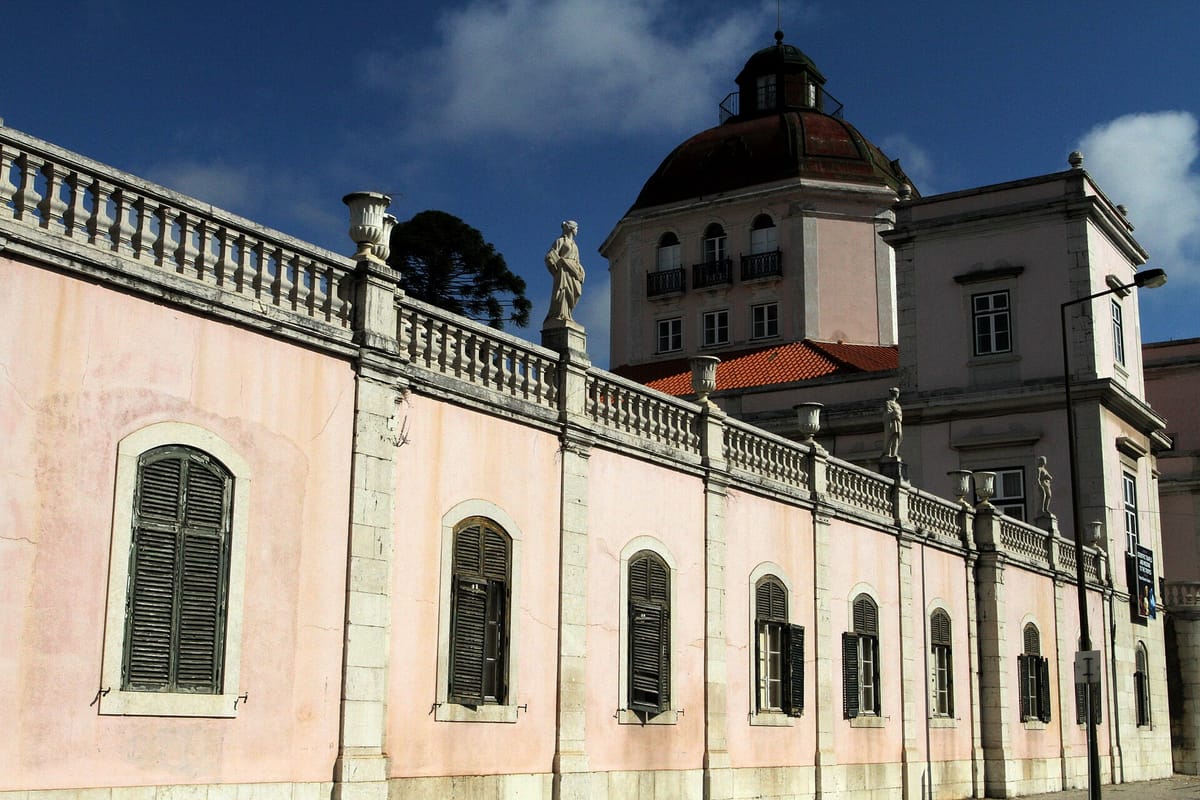
The restoration of the Palácio Burnay, the pink palace on Lisbon's Rua da Junqueira that is meant to become the headquarters of the State's museums and monuments company, will take three years longer to pay for than planned. A Council of Ministers resolution published in the Diário da República (the official gazette) on Thursday, 15 October, spreads its 15.76 million euro budget from 2026 to 2030. The original plan, approved in January 2024, had the money almost entirely spent by the end of 2026.
The total does not change. What changes is the timetable, and the Government's own explanation for it is that the building turned out to be in worse shape than its first diagnosis showed.
The old schedule and the new one
Resolução do Conselho de Ministros n.º 15/2024 (Council of Ministers resolution), approved on 4 January 2024 under the previous government, allowed Museus e Monumentos de Portugal, E.P.E. (MMP, the public company that runs the national museums, monuments and palaces) to commit up to 15,763,900 euros to rehabilitate the palace and its gardens. It capped spending in each year as follows:
- 2024: 2,870,000 euros
- 2025: 4,731,500 euros
- 2026: 8,112,400 euros
- 2027: 50,000 euros
The new Resolução do Conselho de Ministros n.º 200/2026, approved on 8 October and signed by Prime Minister Luís Montenegro, revokes the 2024 and 2025 lines and replaces the rest with five years of spending:
- 2026: 2,870,000 euros
- 2027: 6,311,200 euros
- 2028: 3,197,500 euros
- 2029: 2,538,900 euros
- 2030: 846,300 euros
The new lines add up to the same 15,763,900 euros. The heaviest year moves from 2026 to 2027, and about 6.58 million euros, more than 40 percent of the budget, now falls in 2028 or later.
Why it slipped
The resolution gives three reasons. Carrying out the project, it says, "revealed relevant technical and operational constraints, associated with the state of conservation of the building, with the initial absence of safety conditions and basic infrastructure, and with the need to reformulate the preliminary technical diagnosis". Those circumstances, it adds, forced an adjustment of the original timetable, and the new split is meant to suit "the nature and complexity of the intervention".
It does not say how much of the money was spent in 2024 and 2025, or when the works should finish. The business news site ECO reports that the new headquarters will only be ready in 2030; MMP is currently based at the Palácio da Ajuda.
What has been done so far
The public procurement portal, base.gov.pt, shows how slowly the work has moved. In 2024 and 2025, the contracts that name the palace were mostly preparatory: cleaning and clearing the building, sealing its outer openings, repairing doors and gates, installing intrusion alarms, mapping the electrical and telecoms network, a seismic vulnerability report on two reinforced concrete buildings in the complex, geotechnical surveys, and studies for the water systems and the outdoor spaces. A full architectural survey of the palace was only commissioned in November 2025, for 39,900 euros.
Together with a 175,149.20 euro contract signed on 31 December 2025 for temporary electrical installations in the palace's working spaces, the contracts naming the palace up to the end of 2025 come to about 527,000 euros, not counting furniture bought jointly for the palace and other sites.
Three contracts in 2026 point to the shape of what comes next:
- In May, MMP paid the Ordem dos Arquitectos (the architects' professional body) 9,200 euros for technical advice on a public design competition for the palace's requalification project. The main architectural project, in other words, was still to be chosen this year.
- In August, after a public tender, it signed a 647,903 euro contract with In Situ, a conservation company, to restore the palace's central tower and entrance hall over 200 days. The contract was published on the portal on 14 October.
- On 2 October, it hired a firm to supervise those works for 17,316 euros, also over 200 days.
The building
The Palácio Burnay is classified as an imóvel de interesse público (a property of public interest) under Decreto n.º 28/82 of 26 February 1982, with a special protection zone set in 1996, according to the 2024 resolution. It belonged to the finance ministry's estate until it was handed to the culture ministry so that MMP could make it its head office.
It last housed the Instituto Superior de Ciências Sociais e Políticas (ISCSP, the University of Lisbon's school of social and political sciences), and has decayed since the school left. When the Government announced the project in January 2024, it described the palace as a building of great value that was heavily damaged by neglect, according to the culture ministry's own announcement. The 2024 resolution called the investment "urgent", to guarantee the building's "solidity, safety and salubrity", and also covers its gardens and annexes. The resolution presents the restored palace as a "space for cultural enjoyment" as well as an office, but no plan for public access has been published.
Under the 2024 resolution, the money comes from the finance ministry's budget programme, not the culture budget. ECO lists the palace among the largest culture investments in the draft 2027 State Budget.
Outside the recovery plan
The Burnay project is paid for from the State Budget, not from the EU's Recovery and Resilience Plan, whose culture works faced a hard deadline at the end of August. By then the public institute Património Cultural (Cultural Heritage) had to show that the main works at 84 museums, monuments, palaces and theatres were finished, as we reported at the time. No such external deadline binds the Burnay works, and the resolution leaves the year of completion unstated.