
No Portuguese Law Requires a Child Alarm in the Car: What the Highway Code Demands When Children Ride, and What It Leaves Out
Since March 2020, Italy has fined drivers who carry an under-four without an alarm that stops the child being forgotten in the car. Portugal has no such rule. Here is what the Highway Code and Penal Code do say, and what to do if you see a child alone in a car.
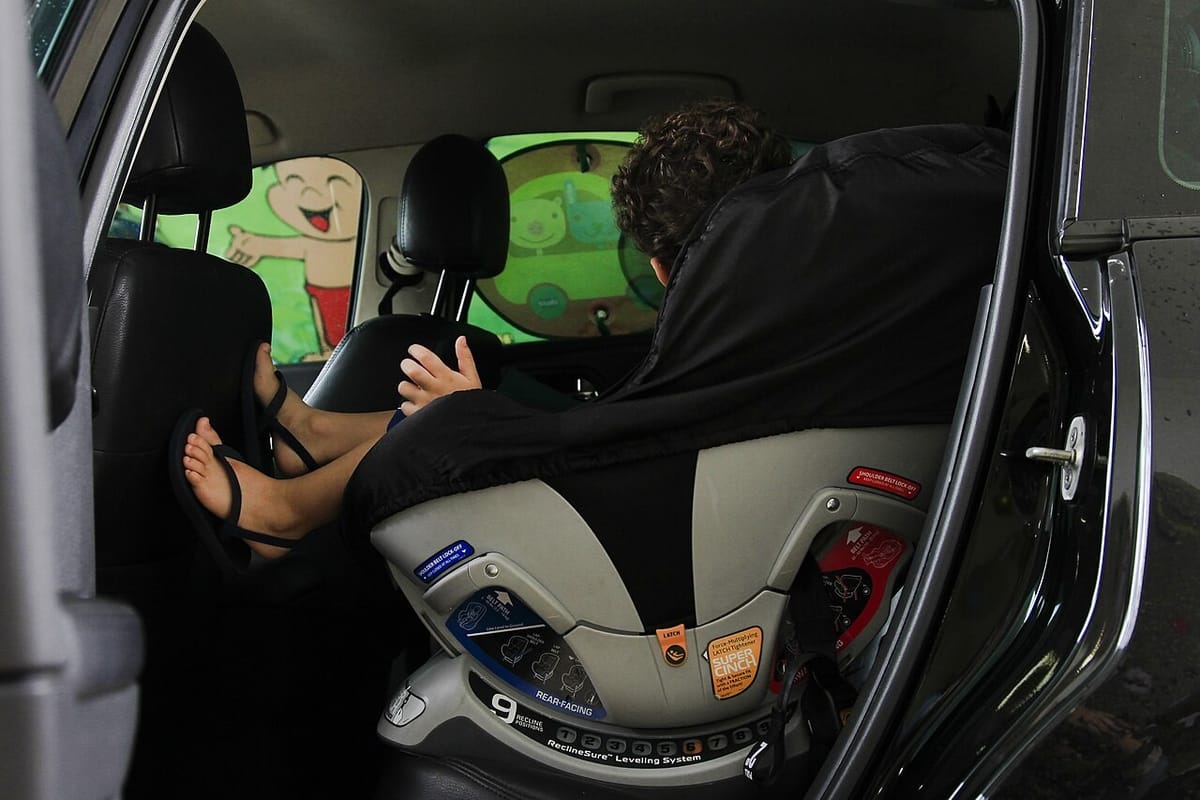
On 10 October, SIC Notícias reported that several children in Portugal have died after being forgotten in cars, and that "dispositivos anti-abandono" (anti-abandonment devices: alarms that warn a driver a child is still in the seat) are not compulsory here. With IPMA (the national weather institute) expecting an October heatwave next week, with highs above 30 °C possible, this is what Portuguese law does and does not require.
What the Highway Code requires
The rules sit in Article 55 of the Código da Estrada (Highway Code), unchanged since 2020. The consolidated text in the Diário da República (the official gazette) says:
- Who needs a seat: children under 12 and shorter than 135 cm, in a car with seat belts, "devem ser seguras por sistema de retenção homologado e adaptado ao seu tamanho e peso" (must be secured by an approved restraint system suited to their size and weight).
- Where they sit: in the back. A child under 3 may travel in front in a rear-facing seat, but only with the passenger airbag switched off; a child of 3 or over may sit in front if the car has no rear seat or no rear belts.
- No seat belts: children under 3 may not travel in such a car at all.
- Exceptions: buses, taxis, TVDE ride-hailing cars and patient transport may carry children without a child seat, but not in front.
Article 55(6) sets a "coima de (euro) 120 a (euro) 600 por cada criança transportada indevidamente" (fine of 120 to 600 euros for each child carried improperly). Article 145 makes carrying minors without the mandatory safety equipment a "grave" (serious) offence, which under Articles 147 and 148 can bring a driving ban of one month to one year and the loss of two licence points (our points-system guide explains the balance).
What it does not require
We found no Portuguese rule requiring a device that warns a driver a child has been left behind. Neither Article 55 nor the rest of the consolidated Highway Code mentions children left in parked vehicles or child-presence alarms.
The same goes for Lei n.º 13/2006 (the Collective Transport of Children Law), which governs organised runs to schools and creches and was last amended in March 2026. Its Article 14 requires a fire extinguisher and a first-aid kit, not a presence sensor. Article 8 requires an adult escort, the "vigilante", alongside the driver, but the escort "só é dispensada se o transporte for realizado em automóvel ligeiro de passageiros" (is only waived if the transport is in a light passenger car).
Parliament's open-data registers of bills and resolutions (updated to 9 October) and petitions (to 22 September) in the current legislature hold no initiative on anti-abandonment devices.
How Italy did it
Italy's Law no. 117 of 1 October 2018 amended Article 172 of its Highway Code: the driver of a car, van or lorry registered in Italy, or registered abroad and driven by an Italian resident, "ha l'obbligo di utilizzare apposito dispositivo di allarme volto a prevenire l'abbandono del bambino" (must use an alarm device designed to prevent the child being left behind) whenever carrying a child under four in a child seat.
Italy's Ministry of Infrastructure and Transport says the technical decree took effect on 7 November 2019 and fines began on 6 March 2020. Its FAQ, last updated in December 2022, puts the fine at 83 to 333 euros plus five licence points. The devices must switch on automatically.
The EU position
Regulation (EU) 2019/2144, the General Safety Regulation, made a set of safety systems compulsory in new vehicles. The European Commission's summary of them (speed assistance, drowsiness warnings, emergency braking and others) includes nothing that detects a child left in a car.
The criminal law
Article 138 of the Código Penal (Penal Code), "Exposição ou abandono" (exposure or abandonment), punishes anyone who endangers another person's life by leaving them where they cannot defend themselves, or by abandoning someone they had a duty to look after, with one to five years in prison; two to five if the offender is a parent; and three to ten if the victim dies. Article 137, negligent homicide, carries up to three years or a fine, or up to five years for gross negligence. Which applies in a given case is for prosecutors and the courts.
The Portuguese cases
Observador reported that a two-year-old died in Lisbon in May 2021 after about seven hours in a car; that a one-year-old died in September 2023 in a car parked at the NOVA University science campus in Monte da Caparica; and that on 23 July 2026 an 18-month-old girl died after being left in a creche vehicle in Almada, a case the Polícia Judiciária (criminal investigation police) took over. The Ministério Público (public prosecutor) opened inquiries in the 2021 and 2023 deaths.
Why a closed car is dangerous
The DGS (Directorate-General of Health) is blunt: "Nunca deixar crianças, doentes ou pessoas idosas dentro de veículos expostos ao sol" (never leave children, sick people or older people in vehicles exposed to the sun). The US National Highway Traffic Safety Administration says a car's interior can warm by almost 20 °F (about 11 °C) in the first ten minutes, and that an outside temperature in the mid-60s °F (about 18 °C) can push it above 110 °F (about 43 °C).
If you see a child alone in a car
- Call 112 at once, the number INEM (the National Medical Emergency Institute) gives for any emergency, and follow the operator's instructions.
- We found no PSP, GNR or INEM guidance on whether a bystander may break a window, so ask the 112 operator.
- For your own family, check the back seat every time you leave the car.
A wider rewrite of the Highway Code is being prepared, as we reported in August; nothing published so far says whether it will cover children left in cars.


