Scrapping a Car in Portugal in 2026: A Practical Guide to the Certificate of Destruction, the Free Drop-Off and Its Two Exceptions, and Why the Date Decides Your Road Tax
An old car in Portugal is legal waste, and only a licensed dismantler's certificate of destruction ends your responsibility for it. When the drop-off is free, the papers to bring, the fines for abandoning a car and the IUC dates that change in 2027 and 2028.
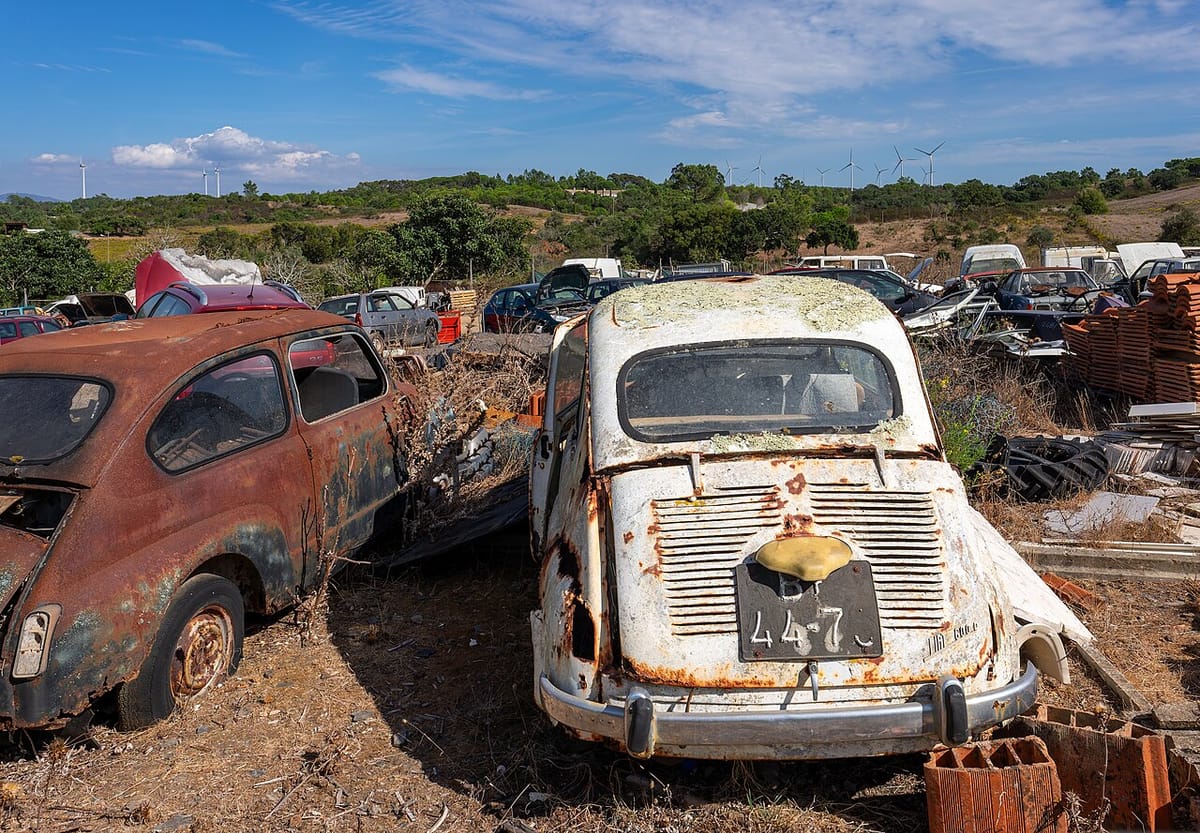
Sooner or later every car in Portugal reaches the point where it is not worth repairing. What happens next is tightly regulated. An end-of-life vehicle is legally waste, and the law says who may take it, what paperwork goes with it and when the state stops treating you as its owner. Get it right and the process is usually free and takes one visit. Get it wrong, by selling the carcass to someone unlicensed or leaving it on a verge, and you can go on owing road tax for a car that no longer exists, and face an environmental fine that starts at 2,000 euros.
This guide covers private cars and light vehicles on the mainland. It is built on Decreto-Lei n.º 152-D/2017 (Decree-Law 152-D/2017, the unified regime for specific waste streams, whose Section VI deals with end-of-life vehicles), the Código da Estrada (Road Code), the Código do Imposto Único de Circulação (Road Tax Code) and the procedures published by the Instituto da Mobilidade e dos Transportes (IMT, the Institute for Mobility and Transport) and the Agência Portuguesa do Ambiente (APA, the Portuguese Environment Agency).
The key terms
- Veículo em fim de vida (VFV): an end-of-life vehicle. The IMT describes it as a vehicle that can no longer circulate because of an accident, breakdown, poor condition or another reason, has reached the end of its useful life and has become waste.
- Abate: scrapping. In everyday Portuguese, "entregar o carro para abate".
- Centro de receção / operador de desmantelamento: a collection centre, or a licensed dismantler. Only a licensed dismantler can issue the certificate that ends your responsibility.
- Certificado de destruição: the certificate of destruction. It proves you handed the vehicle to a licensed operator and is what allows the IMT to cancel the registration.
- Cancelamento da matrícula: cancellation of the registration, which withdraws the vehicle's authorisation to be on the public road.
Step 1: find a licensed operator
Article 84 of Decree-Law 152-D/2017 makes the owner or holder of an end-of-life vehicle responsible for taking it to a treatment centre that operates under the law's licensing rules. Article 81(2) extends the same duty to dealers and traders who end up holding one.
The APA publishes the list of licensed dismantlers that can issue certificates of destruction. It also points owners to its public waste-licensing register, SILOGR, where searching for the European waste code 16 01 04* ("veículos em fim de vida") lists the companies licensed to take them. Since 1 January 2018, the APA says, the only valid certificates of destruction are those issued on its single electronic platform. They carry the APA logo and a barcode.
This is the most important check in the whole process. A scrapyard that buys your car for cash without issuing an APA certificate has not scrapped it in the eyes of the law, and the registration stays in your name.
Step 2: hand over the car and the paperwork
Under Article 85(2), when you deliver the vehicle you must:
- hand over the certificado de matrícula (the registration certificate), or, for older cars, the livrete and the título de registo de propriedade (the vehicle identification document and the title of ownership); and
- request cancellation of the registration on the official form. The operator provides the form, on paper or digitally, and the law also allows it to be submitted digitally through the Portal Único de Serviços. The APA and the IMT identify it as the IMT's Modelo 9.
According to the APA, the operator checks the make, model, registration and chassis number against the documents, and checks the owner's details against a personal identity document. Bring your Cartão de Cidadão or residence card.
If you do not have the documents. Article 86 exempts a holder who should not have them in their possession from handing them over, provided they prove the documents were sent to the IMT. If your documents are simply lost, ask the operator or the IMT what they will accept before you go.
You can drive it there. If you drive the car to the collection centre or dismantler yourself, the APA says it is not yet legally waste, so the waste-transport rules and the electronic waste guide (e-GAR) do not apply. If it cannot be driven, moving it is waste transport. A private owner does not need to register on the APA's system for this: the receiving operator issues the e-GAR.
Step 3: the certificate, and the automatic cancellation
The dismantler identifies the car, checks the documents and issues the certificate of destruction on the APA platform (Article 85(4) and (6)). Within five working days of receiving the car, it must send the original certificate to you and a copy, with the documents, to the IMT (Article 85(7)).
Article 85(8) provides that registrations of end-of-life vehicles are cancelled automatically and in real time, through a computer link between the APA's certificate platform and the IMT's registration platform. The IMT charges no fee for cancelling the registration of an end-of-life vehicle.
Keep the original certificate. The APA describes it as the proof that you delivered the car to a licensed centre and have no further responsibility for it. The law sets a retention period of at least five years for certificates (Article 85(11)), but the original you hold is what you will need if a tax or registration problem appears later. If you have the certificate and the registration still has not been cancelled, the APA advises contacting the IMT directly, because the IMT is the body that cancels registrations.
A cancellation for destruction is final. Article 119(10) of the Road Code bars restoring a registration, or issuing a new one, where the earlier cancellation was based on the vehicle's destruction.
Is it free?
Usually, yes. Article 84(6) says that delivering an end-of-life vehicle to a treatment centre designated by the vehicle producers, within their collective or individual scheme, costs the owner nothing, even if the car has a negative or zero market value. The APA's guidance applies the same rule to collection centres and dismantlers designated by the producers or by the licensed management body that runs the collective scheme for cars.
There are two exceptions, set out by the APA in its guidance on the law. The drop-off is not free of charge if:
- the car was originally fitted with an engine, transmission shafts, gearbox, catalytic converters, electronic control units and bodywork, and any of these is missing; or
- waste has been added to the car, for example if it has been used to store rubbish.
The practical lesson is simple. Do not strip the engine or the catalytic converter to sell before you scrap the car, and empty it first. Whether the operator pays you anything for the car is not something these rules set.
Road tax: why the date matters
Article 4(3) of the Road Tax Code says the Imposto Único de Circulação (IUC, the annual road tax) is due until the registration is cancelled because the vehicle has been scrapped under the law. Until that cancellation, you are still the taxpayer, whether or not the car moves. Three regimes apply in turn:
- In 2026, the tax period for cars still starts on the date of registration and on each anniversary of it (Article 4(2) in its current wording). If the car is scrapped and the registration cancelled before its next anniversary, the next year's tax does not arise.
- In 2027, the rules change. Decreto-Lei n.º 161/2026 moves the IUC to the calendar year from 1 January 2027, with a single annual assessment covering every vehicle registered on 1 January. For this transition year only, Article 6(2) of that decree lets you ask for the 2027 assessment to be annulled if a car's registration is cancelled during 2027 before its registration anniversary.
- From 2028, the assessment covers all vehicles registered on 1 January, and the tax is due in full for each year (Article 4(1)). A car still registered on New Year's Day carries that year's IUC, even if it is scrapped in February.
So a car you plan to scrap is best dealt with before its registration anniversary in 2026 or 2027, and before 1 January from 2028 onwards. Our guide to the IUC and the annual inspection covers how the tax is calculated, and our report on the new IUC payment calendar explains the 2027 and 2028 payment dates.
After an accident: a total loss
The Road Code treats a vehicle as inutilizado (written off) when it has suffered damage that permanently prevents it from circulating or seriously affects its safety. Article 119(1) requires the registration of a written-off or end-of-life vehicle to be cancelled, and Article 84(3) of Decree-Law 152-D/2017 gives the owner 30 days from the date the vehicle was written off to send it to a waste-treatment operator, at the owner's expense. Where a written-off vehicle is the insurer's responsibility, Article 84(5) puts the cost on the insurer, also within 30 days.
Where a car is declared a total loss after an accident, Article 83(7) requires the insurer to tell the owner that a certificate of destruction is needed to cancel the registration, who is responsible for presenting it, and that only a licensed operator can issue it. Insurers that handle the destruction themselves are exempt from producing the vehicle documents, provided they prove they sent them to the IMT (Article 86). Our guide on what to do after a car accident covers the insurance side.
The alternatives, and what they are not
The IMT's cancellation page lists other grounds for cancelling a registration, each on the same Modelo 9 and each with a fee of 10 euros:
- Kept off the public road. A car used only for motor sport or on private land not open to traffic can have its registration cancelled temporarily. The IMT says this lasts for up to five years, and before the period ends you must ask for the registration to be restored or cancelled permanently, or face a fine. You need a declaration of what the vehicle is being used for.
- Missing. A car whose whereabouts have been unknown for more than six months, with a police report of its disappearance and a police declaration that it has not been found.
- Exported. A car exported to another EU country or outside the EU, with proof it left Portugal or a copy of its new registration. There is no fee when you present a copy of the new registration certificate issued in another EU country.
- Sold but never transferred. If you sold the car more than a year ago, the buyer never registered it, and you filed a request for the vehicle's seizure more than six months ago, you can ask for the registration to be cancelled (Road Code Article 119(12)).
None of these is a way to park a dead car indefinitely. Where the car is written off or has been exported, Article 119(4) gives the owner 30 days to request cancellation, with a fine of 60 to 300 euros for missing the deadline (Article 119(13)).
Scrapping in another EU country. Article 85(10) accepts certificates of destruction issued in other EU member states if they contain all the information the law requires. The APA says you then send the IMT a copy of the certificate, a completed Modelo 9 and the vehicle documents yourself.
What happens if you just abandon it
A car left in the same place on the public road or in a free car park for 30 days without interruption, or for more than 48 hours when it shows obvious signs of abandonment or cannot move safely under its own power, counts as improperly parked under Article 163 of the Road Code and can be removed (Article 164). The registered holder is then notified to collect it within 45 days, or 30 days if it is so deteriorated that selling it would not cover the costs. If it is not claimed, it is considered abandoned and passes to the state or the local authority (Article 165). Article 84(4) of Decree-Law 152-D/2017 has the municipal or police authorities send an abandoned vehicle to a waste operator, with the costs charged to the owner.
Failing to send an end-of-life vehicle to a licensed centre, and failing to request cancellation of its registration as Article 85 requires, are both classed as serious environmental offences under Article 90(2) of the decree-law. Under the Lei-Quadro das Contraordenações Ambientais (the framework law on environmental offences, Lei n.º 50/2006), a serious offence by an individual carries a fine of 2,000 to 20,000 euros for negligence and 4,000 to 40,000 euros where it is intentional. For companies the ranges are 12,000 to 72,000 and 36,000 to 216,000 euros.
Buying used parts from a scrapped car
If you buy second-hand parts, Article 81(6) and (7) require the seller to give you, at the time of sale, a document proving the parts come from a licensed dismantler and an itemised invoice. Online sellers must display the dismantler's name and licence number for each part. Selling used parts from end-of-life vehicles without this is prohibited by Article 87(9)(e). Our report on the new EU rules on scrapped cars covers the changes coming at European level.
Checklist
- Confirm the operator is on the APA's list of licensed dismantlers.
- Do not remove the engine, gearbox, catalytic converter, electronic units or bodywork, and clear out any rubbish.
- Take the registration certificate (or livrete and title of ownership) and your identity document.
- Fill in and sign the Modelo 9 cancellation request at the operator, or submit it online.
- Collect the original certificate of destruction, with the APA logo and barcode, and keep it.
- Check a few days later that the registration shows as cancelled; contact the IMT if it does not.
- Time it before the registration anniversary in 2026 or 2027, and before 1 January from 2028.
What this means for you
- The certificate is the whole point. Without an APA-platform certificate of destruction, the car is still yours for tax and registration purposes, however it left your hands.
- Keep the car intact. Delivery is normally free, but not if key components are missing or the car has been used for rubbish.
- Watch the calendar. The switch to a calendar-year IUC makes 1 January the date that decides whether you owe a full year's tax from 2028, and 2027 has its own annulment rule tied to the registration anniversary.
- Do not abandon it. The costs of removal come back to you, and failing to send an end-of-life vehicle to a licensed centre is a serious environmental offence.
- If you live in the Azores or Madeira, check the procedure with the regional authorities; this guide is written for the mainland.
Sources
This guide is written from official Portuguese and EU sources.
- Procuradoria-Geral Regional de Lisboa, Decreto-Lei n.º 152-D/2017, de 11 de dezembro, consolidated text, Section VI (veículos em fim de vida), Articles 81, 83, 84, 85, 86, 87 and 90 (Portuguese only)
- Agência Portuguesa do Ambiente, Perguntas Frequentes, Veículos em Fim de Vida (VFV), version 2.0, September 2019, questions 13 to 21, 39 and 40 (PDF, Portuguese only)
- Instituto da Mobilidade e dos Transportes, Cancelamento da Matrícula (grounds, documents, Modelo 9 and fees) (Portuguese only)
- Procuradoria-Geral Regional de Lisboa, Código da Estrada (Decreto-Lei n.º 114/94), consolidated text, Articles 119, 163, 164 and 165 (Portuguese only)
- Autoridade Tributária e Aduaneira, Código do Imposto Único de Circulação, Article 4 (incidência temporal), current and previous wording (Portuguese only)
- Diário da República, Decreto-Lei n.º 161/2026, de 4 de agosto, amending the Código do IUC, Articles 2 (new Articles 4, 16 and 17) and 6 (transitional rules for 2027) (PDF, Portuguese only)
- Procuradoria-Geral Regional de Lisboa, Lei n.º 50/2006, de 29 de agosto, Lei-Quadro das Contraordenações Ambientais, consolidated text, Article 22 (fine bands) (Portuguese only)