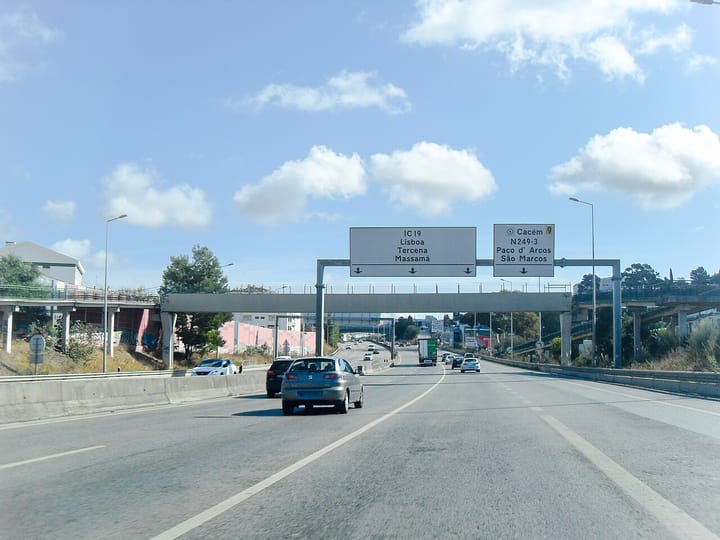
Annual Road Tax (IUC) and Vehicle Inspection (IPO) in Portugal in 2026 — A Practical Guide to the Brackets, the 37.47€ Light-Vehicle Tariff, the 2026 Recall-Fail Rule, the 2027 April Reform, and the 250-1,250€ Fine Bracket
Owning a car in Portugal in 2026 means two recurring lines: IUC (annual road tax) and IPO (centro-de-inspeções inspection), both tied to the matrícula registration month. This guide walks the 2026 brackets, the 37.47€ light-vehicle tariff, the new recall-fail rule and the 2027 April reform.

Owning a car in Portugal in 2026 means tracking two recurring lines that arrive every year on the same calendar: IUC (Imposto Único de Circulação), the annual road tax, and IPO (Inspeção Periódica Obrigatória), the vehicle inspection. Both are tied to the vehicle's matrícula registration month, both are administered through different state agencies (Autoridade Tributária for the tax, Instituto da Mobilidade e dos Transportes for the inspection), and both come with surcharge-and-fine architecture that is unforgiving if the calendar slips. For foreign residents, the friction points are the same every year — Portal das Finanças notifications missed because ViaCTT was not set up, IPO certificates lost because the digital channel was not enabled, an imported vehicle's first Portuguese-calendar IUC arriving sooner than expected — and they are easy to pre-empt once the architecture is on the table.
This is the 2026 walk-through: how each tax and check works, what the brackets and fees actually are, where the calendar is shifting (the IUC moves to a unified April deadline starting in 2027), how the Centro de Inspeções booking flow runs, what changes in 2026 for vehicles with active manufacturer recalls, and how a foreign resident running a single car typically lands inside a €100–€340-a-year combined annual budget for the recurring vehicle obligations.
IUC — The Annual Road Tax
IUC is the annual circulation tax payable to the Autoridade Tributária e Aduaneira (AT) on every motor vehicle registered with a Portuguese matrícula. The legal framework is the Código do IUC, originally enacted as Lei 22-A/2007 and updated through annual State Budget laws; the 2026 brackets sit inside the OE 2026 (Lei 82/2025) text. The tax has six categories — Category A (light passenger vehicles registered before 1 July 2007), Category B (light passenger vehicles registered from 1 July 2007), Category C (light commercial up to 12t), Category D (heavy commercial above 12t), Category E (motorcycles, mopeds and tricycles) and Categories F/G (boats and aircraft). The category structure decides which calculation grid applies; within each grid the determinants are fuel type, cylinder capacity, age and (for Category B and onwards) CO2 emissions.
How the IUC Bill Is Calculated
For a Category B light passenger car — the bracket most foreign residents will encounter — the bill is the sum of two components: the cilindrada (cylinder capacity) line and the CO2 line, with both progressively scaled. The cylinder line runs from a base around €30 for vehicles under 1,250cc to €120-plus for vehicles above 2,500cc; the CO2 line runs from near-zero for sub-120 g/km vehicles to €300-plus for vehicles above 195 g/km on the WLTP cycle. Diesel vehicles carry an additional NOx-related agravamento (5%) on top, reflecting the air-quality differential. A typical 2017-vintage 1.6-litre petrol hatchback will land around €70–€90 a year; a 2020 2.0-litre diesel SUV closer to €280–€350; a sub-120 g/km plug-in hybrid below €60. Battery-electric vehicles (BEVs) are exempt from the CO2 line and pay only the cylinder-equivalent base, which keeps a typical Tesla Model Y or Renault Megane E-Tech under €30 a year.
Category A vehicles (pre-July-2007 registration) follow a simpler grid built only on cylinder capacity and fuel type, without the CO2 line. The architecture intentionally keeps older-vehicle bills low — a 1.4-litre petrol from the early 2000s typically lands around €30–€50 a year — so the AT does not penalise legacy fleet while pulling its emissions signal through the Category B grid.
The 2026 Payment Calendar (Last Year of the Registration-Month System)
2026 remains under the historical registration-month rule: IUC must be paid by the last day of the calendar month in which the vehicle was first registered. A car first registered on 14 May 2018 is therefore due by 31 May every year; a car registered on 3 January 2022 is due by 31 January every year. This is the rule that will change in 2027 — see below. Payment is settled through a Documento Único de Cobrança (DUC) that AT issues automatically at the start of each vehicle's reference month. The DUC reference number can be paid through Multibanco ATMs, homebanking, MB WAY, the Portal das Finanças payment portal, CTT post-office counters or AT service counters at any Loja de Finanças.
Installment Options Above €100
The 2026 IUC code allows installment payment for higher bills:
- Bills up to €100: single payment by the registration-month deadline.
- Bills between €100 and €500: two installments — April and October.
- Bills above €500: three installments — April, July and October.
Most foreign-resident single-car households fall in the €60-€300 band and pay in a single tranche; SUV-and-large-vehicle households in the €500-plus band can split into thirds without surcharge. Choosing the installment route is done at the Portal das Finanças during the first reference window — the system holds the schedule for all subsequent installments automatically.
Penalties for Missing the Deadline
The IUC late-payment regime layers two costs. The first is a surcharge of 15-50% on the unpaid amount, with a minimum of €25 for individuals (€50 for legal persons), applied progressively the longer the delay runs. The second is the AT's juros compensatórios (compensatory interest) on the principal, currently at the legal commercial rate. A missed €120 IUC bill picked up at the 60-day mark therefore typically settles at €145–€155 with surcharge plus modest interest; the same bill picked up at the 12-month mark and pushed into execução fiscal (forced execution) lands much higher because the AT adds collection costs. Voluntary regularisation within the window after the first reminder reduces the surcharge to the floor.
The 2027 April Reform
The 2026 OE text confirms that the IUC payment calendar shifts to a unified April deadline starting 1 January 2027. From 2027, every Portuguese vehicle owner pays IUC by the end of April for the full calendar year, regardless of when the vehicle was originally registered. The transitional rule prevents double-payment for vehicles whose 2026 registration-month payment ran late and crossed into 2027; the AT will issue net DUCs for any overlap. The change simplifies the AT collection cycle and aligns Portuguese IUC with the IMI-style spring-payment window that taxpayers already understand.
Exemptions Worth Knowing
The 2026 IUC code exempts: full battery-electric vehicles from the CO2 line (cylinder-equivalent base only); classic vehicles over 30 years registered as veículos de interesse histórico; vehicles owned by people with permanent disability of 60% or above (subject to AT certification); diplomatic vehicles; and specific public-service categories. Hybrid and plug-in hybrid vehicles do not enjoy a full exemption but pay reduced CO2-line rates relative to combustion-engine equivalents.
IPO — The Vehicle Inspection
IPO is the technical inspection administered through the Instituto da Mobilidade e dos Transportes (IMT) and conducted at licensed centros de inspeções operating under contract with the IMT. The legal framework is Decreto-Lei 144/2017, the IPO base regulation, with periodic ministerial-portaria updates on prices and procedure. The network of licensed inspection centres across the country numbers around 250 sites, operated by groups including Controlauto, Inspecções Técnicas SGS, Manutenção e Inspecção Automóvel and the IMT-direct sites. Any licensed centre can inspect any vehicle — there is no geographic constraint.
Frequency by Vehicle Age
For light passenger vehicles, the IPO calendar is age-based:
- 0-4 years from first registration: exempt — no IPO required.
- 4-8 years: every two years.
- 8 years onwards: annually.
Heavy vehicles, taxis, driving-school vehicles and vehicles in passenger transport (TVDE included) follow a stricter calendar — annual IPO from the first year, with semi-annual checks for some commercial categories. Motorcycles above 250cc follow the light-passenger schedule; mopeds and motorcycles below 250cc are exempt. The inspection window opens three months before the matrícula day-and-month and closes on that exact day-and-month — booking inside that window does not shift the cycle, so a vehicle inspected three months early next year still resets to its original registration-month anchor.
2026 IPO Tariff
The 2026 ministerial portaria sets the IPO tariff at:
- Light vehicles (passenger cars, M1): €37.47 (VAT included), up €0.83 from 2025.
- Heavy vehicles: €56.08 (VAT included).
- Motorcycles, tricycles and quadricycles: €18.87 (VAT included).
- Re-inspection (Type B, after a failed first attempt): €9.40 (VAT included).
The tariff is national and identical across all licensed centres — there is no price competition between Controlauto, SGS or the IMT-direct sites. Booking is done online through each operator's portal or by walk-in; the operator-portal route normally guarantees a same-day or next-day slot in metropolitan areas and a one-week wait in interior districts at peak season.
What the Inspection Actually Checks
The IPO runs through more than 100 checkpoints organised across braking system (brake balance, ABS warning lamp, brake-fluid level), steering and suspension (free play, shock-absorber response, ball-joint integrity), lighting (headlamp aim, indicator function, brake-light strength), tyres (tread depth ≥1.6mm, structural integrity, matched-pair wear), electrical and electronic systems (battery, OBD-II diagnostic for post-2001 vehicles, ABS and ESP self-test), chassis and body (corrosion, structural integrity, mountings), and emissions (CO/HC for petrol, opacity for diesel, with electric vehicles skipping this stage but adding a battery-management-system and high-voltage-circuit verification). The full list lives in Annex II of DL 144/2017.
The 2026 Recall-Fail Rule
The most material 2026 change is procedural: from 1 January 2026, a vehicle subject to an active manufacturer recall that has not yet been repaired automatically fails the IPO. The recall data is pulled from the IMT national recall registry, which the IMT now interfaces directly with the centro-de-inspeções terminals. Owners can check the status of any active recall on their vehicle through the IMT portal at imt.pt or the gov.pt vehicle-services aggregator using the matrícula and the vehicle's chassis number. The fix is to take the vehicle to an authorised dealer to complete the recall repair (always free of charge to the owner) and then return to the centro de inspeções within the 30-day window for a Type B re-inspection at €9.40.
Defect Classification and Re-Inspection
The IPO classifies defects in three tiers:
- Type 1 (minor): the vehicle passes; an annotation is made; five or more concurrent Type 1 defects upgrade the file to a Type 2 fail.
- Type 2 (serious): the vehicle fails; owner has 30 days to repair and return for re-inspection at €9.40 at the same centro. A second consecutive failure shrinks the re-inspection window to 15 days.
- Type 3 (critical / dangerous): the vehicle is immobilised on-site — the owner cannot drive it out of the centre. A tow truck or trailer collection is required; recovery costs are on the owner.
If the 30-day re-inspection window lapses without a return visit, the file closes and the next IPO is treated as a fresh first inspection at the full €37.47 tariff (not the €9.40 re-inspection rate).
Penalties for Driving Without a Valid IPO
Driving a vehicle outside its IPO validity attracts a fine in the €250–€1,250 bracket under the Código da Estrada, applied on roadside enforcement by the GNR or PSP, with the higher end of the band reserved for repeat offenders or for vehicles whose lapse is more than 90 days past expiry. The vehicle's documents may also be retained until the IPO is regularised. Insurance overlays add a separate risk: most Portuguese motor insurers will reduce or refuse third-party-liability cover for an at-fault accident if the vehicle's IPO is more than 30 days lapsed, on the grounds that the vehicle's roadworthiness has not been verified inside the regulatory window.
What to Bring to the Centro de Inspeções
Documentary requirements for a 2026 IPO appointment are straightforward:
- The Documento Único Automóvel (DUA) — the single-document successor to the old livrete and título de registo de propriedade — kept either physically or via the digital chave-móvel route through the gov.pt vehicle wallet.
- The driver's licence of the person presenting the vehicle.
- The previous IPO certificate (digital since 2021 — the centro can pull it from the IMT system using the matrícula but having the printout speeds the check-in).
- The current IUC payment proof (or evidence of valid IUC exemption) — the centro will not initiate the IPO if the IUC is in arrears.
- The valid motor insurance certificate (a windscreen sticker is no longer required after the 2014 reform but the certificate is still demanded at check-in).
The IPO certificate itself has been digital since 2021 — a paper-printed validade-até stamp on the windscreen is still issued for visual verification but the legal document lives in the IMT system, accessible to roadside enforcement and to the next centro at the next renewal.
Foreign-Resident Friction Points
The Imported-Vehicle Calendar Reset
A vehicle imported from another EU country and matriculated in Portugal under the change-of-residence ISV-exemption regime carries a fresh Portuguese registration date — the day the matrícula was issued — that resets the IUC and IPO calendars. A vehicle that was due for IPO under its German or French calendar before the move may not be due again in Portugal for up to four years, depending on its age class on import; conversely, IUC begins immediately on the Portuguese registration month going forward. Always cross-check the new Portuguese registration date in the DUA against any prior calendars from the country of origin to avoid double-payment or missed-deadline gaps.
The Portal das Finanças Notification Channel
Default IUC reminders are issued through ViaCTT, the AT's digital mailbox, with a fallback paper letter to the registered address. Foreign residents who have not enabled ViaCTT or who have an incorrect address on file routinely miss the reminder and fall into the surcharge bracket without realising the bill was issued. The fix takes ten minutes: log into Portal das Finanças → 'Os Seus Serviços' → 'A Sua Caixa' → activate ViaCTT, then under 'O Seu Cadastro' confirm the morada fiscal and add a Portuguese-format mobile number for the SMS-on-issue notification.
The DUA Replacement and Digital Wallet
If the vehicle was registered before 2018 the older paper livrete-plus-título format may still be in the glove box. The DUA can be requested at any IMT counter or via the gov.pt vehicle-services portal using the matrícula and Cartão de Cidadão / Chave Móvel Digital. The digital DUA accessible via the mobile wallet (gov.pt app or each operator's app) is now sufficient evidence for any roadside check or centro de inspeções appointment — printing is optional from 2024 onwards.
Multibanco DUC Payment Mechanics
The AT-issued DUC for IUC carries an entity-and-reference pair specific to the AT (entidade 10880 in most cases). The Multibanco 'Pagamentos ao Estado' option asks for the entity, the reference and the amount — all three are on the DUC. The receipt printed from the ATM is the legal proof of payment and should be retained until the next year's DUC supersedes it.
Disability and Classic-Car Mechanics
Drivers with permanent disability of 60% or above can apply for IUC exemption directly through Portal das Finanças by uploading the Atestado Médico de Incapacidade Multiusos. The exemption applies to one vehicle per qualifying person and renews automatically each year while the disability classification holds. Classic-vehicle status (over 30 years and registered with the IMT as veículo de interesse histórico) reduces the IUC bill to a flat low cap — typically €30 — but does not remove the IPO obligation, which continues annually for any classic vehicle in regular road use.
Combined Annual Budget
For a single-car foreign-resident household running a vehicle aged 8 years or more, the combined annual recurring obligation lands as follows:
- IUC — typically €60-€300 for a Category B passenger car, depending on cylinder capacity and CO2 grade.
- IPO — €37.47, annual once the vehicle is past 8 years.
- Combined recurring — €100-€340/year.
For a 4-to-8-year-old vehicle the combined drops to €60-€320/year (IPO biennial, so amortised at €18.74 per year). For a 0-to-4-year-old vehicle, only IUC applies — typically €60-€300 depending on the bracket. Add fuel, insurance, the matrícula-renewal mechanics if the vehicle changes ownership and the periodic seguro automóvel premium for the full annual ownership cost.
The 2026 Calendar in Practice
For a vehicle registered in May, the 2026 IUC is due by 31 May 2026; the AT will have issued the DUC during the first week of the month, with the ViaCTT notification or paper letter following. The IPO, if due in May, can be booked at any centro from 1 February (the start of the three-month early window) through 31 May. From 2027 onwards, the IUC half of this calendar collapses into a single April deadline for all vehicles regardless of registration month; the IPO calendar continues to track the registration day-and-month under the existing DL 144/2017 framework. The transition year — 2026 to 2027 — is administratively neutral for any vehicle whose 2026 IUC is paid on time; AT-side reconciliation handles any overlap automatically.