Portugal's Car Plants Built a Fifth Fewer Vehicles in July, and a Single Factory Explains Almost All of It
ACAP counted 21,373 vehicles built in Portugal in July, down 19.4% on the year. Volkswagen Autoeuropa's 27.8% drop at Palmela accounts for 89% of the fall. Of the 14,669 passenger cars built that month, six were battery-electric.
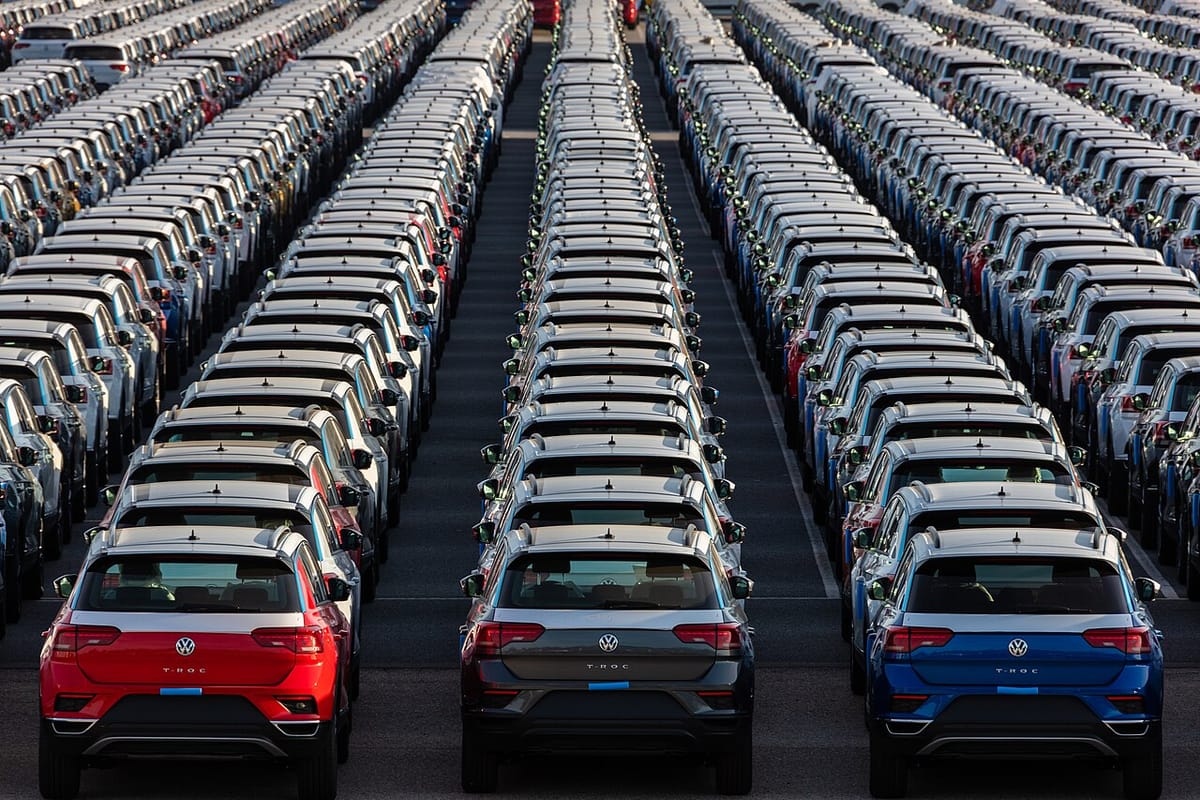
Portugal's vehicle factories turned out 21,373 units in July, 19.4% fewer than in the same month a year earlier. The figures come from ACAP (the Portuguese Automobile Association) through its Auto Informa statistics service, published on Thursday. Almost the whole of the fall traces back to a single plant.
Volkswagen Autoeuropa at Palmela built 11,850 cars in July, against 16,418 in July 2025, a drop of 27.8%. That shortfall of 4,568 vehicles accounts for 89% of the 5,141-unit decline in national output. Every other plant either held its ground or grew: Stellantis Mangualde produced 9,247 vehicles, marginally ahead of last July's 9,217, and Toyota Caetano's Ovar line built 276 vans, up 38.7%.
One factory, two thirds of the country's output
The concentration is the point. Across the first seven months of 2026, Autoeuropa accounted for 135,465 of the 197,430 vehicles built in Portugal, or 68.6% of the total. Stellantis Mangualde took another 29.0%. When Palmela slows for a model changeover, the national statistic slows with it, which is exactly what happened when the plant paused earlier this month for its electric-vehicle overhaul.
Year to date, output is down a far gentler 3.4%. Passenger cars are off 1.8% at 155,946 units and light commercial vehicles are down 7.4% at 40,202. July, in other words, looks worse than the year does.
A reporting change sits inside the heavy-vehicle numbers
ACAP's July table records zero heavy vehicles produced, against 349 a year earlier. That reading needs a caveat, and ACAP supplies it in a footnote: Mitsubishi Fuso Trucks Europe, which builds at Tramagal, has stopped disclosing data by model and for the export market. The year-to-date heavy total is 1,282 units, down 38.2%. Treat the monthly zero as a gap in the series rather than proof that nothing left Tramagal in July.
A separate ACAP table covers vehicles assembled rather than manufactured here, and there CaetanoBus put together 177 heavy vehicles across the year, up 21.2%, of which 58 are battery-electric and 16 run on hydrogen.
Portugal builds cars for other people
Exports took 97.9% of everything built here, 193,205 units in the year to July, with Europe absorbing 93.1% of that. Germany is comfortably the largest customer at 43,349 vehicles, followed by France, Italy, Turkey and Spain, each between 20,000 and 24,000. The domestic market took 4,225 vehicles, 2.1% of production. Portuguese buyers are close to irrelevant to Portuguese car plants, which is why national output tracks German and French demand rather than anything happening in Lisbon.
The electric gap
Here is the figure that deserves more attention than the headline percentage. Of the 14,669 passenger cars built in Portugal in July, six were battery-electric. Across the whole year to July, 14 out of 155,946. The country's car plants run on petrol and diesel.
Light commercials tell a different story: 863 of the 6,704 vans built in July were electric, 12.9%. Stellantis Mangualde is doing the electrifying; Palmela, for now, is not, though Volkswagen has confirmed that new electric models will be built there. Until that line starts, a country where roughly half of new car sales are electrified builds almost no electric cars.
What this means for foreign residents
- Setúbal jobs, not national ones. Autoeuropa's swings hit the Setúbal peninsula hardest. If you live on the south bank, a 27.8% month at Palmela reaches local shift patterns, agency contracts and supplier towns long before it reaches a national statistic.
- Watch the trade balance, not the plant. Vehicles are one of Portugal's largest goods exports, and the external surplus halved in the first half partly because the goods deficit widened. A weak second half at Palmela would show up there.
- Foreign ownership runs deep here. Every plant named above is foreign-owned, which is the pattern we covered earlier today: 3% of companies, 46% of exports.
August and September will tell whether July was a changeover pause or the start of something duller. The line at Palmela is mid-transition, ACAP's Fuso series has a hole in it, and the year-to-date figure remains only modestly negative. One bad month in a plant-concentrated industry is not a trend. Two would be. On the Portuguese industrial-investment tape, our report on SRAM breaking ground on a third Coimbra factory, a 57.5 million euro project carrying 527 contracted jobs and 16.9 million euros of state support, due to open in the middle of 2028 sets the latest reference.