Portugal's 2021 Floating-Solar Auction Has All but Collapsed, and EDP's Exit From the Alqueva Leaves Only One Plant Standing
Four years after Portugal auctioned its reservoirs for floating solar, five of six plants have failed and EDP has abandoned the biggest — the Grande Lago on the Alqueva. Wildlife rules and thin economics explain a stalled bet.
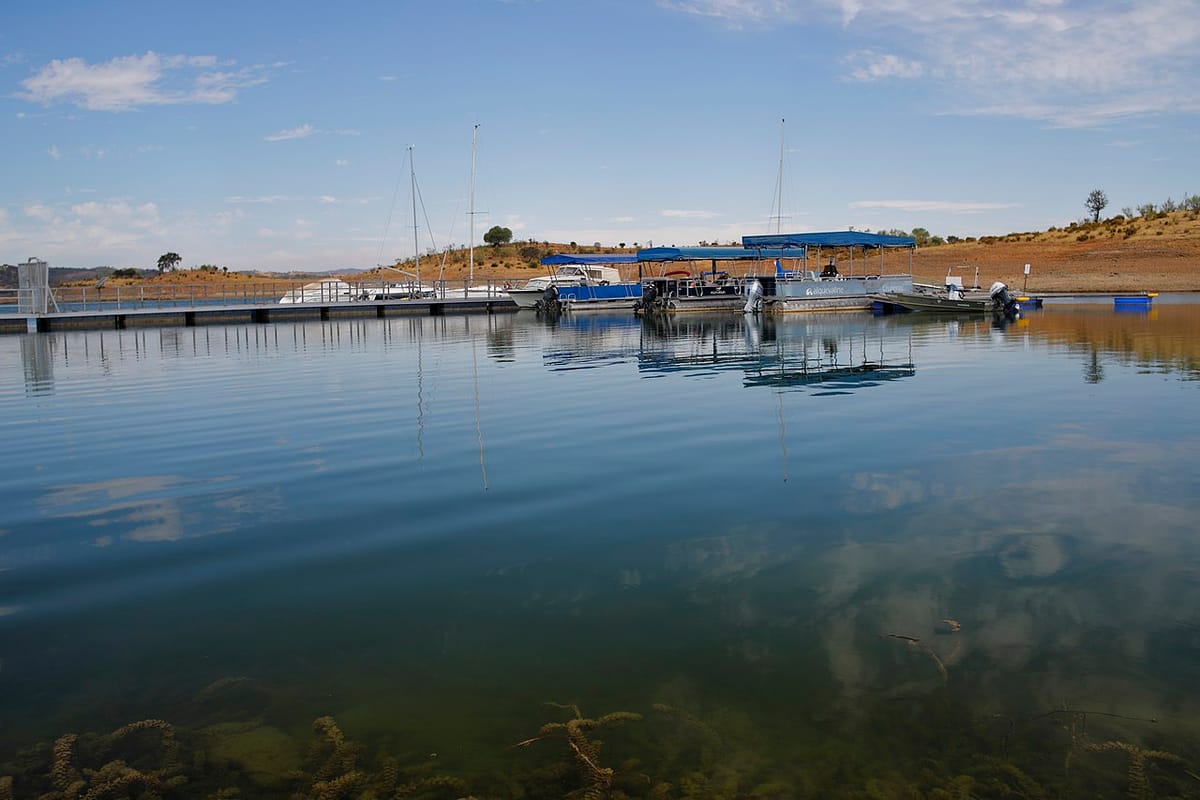
When the government of António Costa auctioned off the surfaces of Portugal's reservoirs for floating solar in 2021, the pitch was that the country was ready to graduate from pilot projects to industrial scale. Four years on, that promise has almost entirely sunk. Of the six plants awarded, none is yet generating, and only one has secured the environmental green light it needs to be built. The latest to fall was the most ambitious of them all.
EDP Renewables (EDP Renováveis) confirmed this month that it is abandoning the Grande Lago project on the Alqueva reservoir, the largest lot in the 2021 tender. As we reported when the withdrawal first surfaced, the plant would have injected 70 MW into the grid through the Alqueva substation, pairing floating panels across 82 hectares of water — roughly 0.33% of the vast Alentejo lake — with two onshore wind clusters. The investment was put at €169 million. EDP had won it with an aggressive bid that promised negative prices of €4.12 per megawatt-hour on the solar component for the first 15 years, a figure hailed at the time as the lowest electricity tariff in the world and worth an estimated €114 million to consumers.
What killed it, according to detailed reporting by Observador on the final decision, was a collision between wildlife protection and the clock. The environmental impact study, filed with the Portuguese Environment Agency (Agência Portuguesa do Ambiente, APA) in late 2024, was declared non-conforming. A late redesign of a 30-kilovolt power-line corridor — introduced to steer clear of black vulture (abutre preto) nests — relied on colony monitoring that only began in June 2025 and never covered a full annual cycle. Regulators said that left "relevant uncertainties" about the birds and refused EDP's request to extend the deadline to September 2026. In July, the agency rejected the file outright and closed the procedure.
EDP has made clear it will not move the panels onshore to salvage the project, and it is candid that economics played a part: the cost of building renewables has climbed while wholesale prices sag during the sunny, windy hours when generation peaks. That squeeze is the same one bearing down on projects across the sector.
The Grande Lago is not an isolated casualty. Two Finerge plants inside the Peneda-Gerês National Park were blocked by the nature-conservation institute (Instituto da Conservação da Natureza e das Florestas, ICNF); a Voltalia scheme at the Cabril dam collapsed under fierce local opposition; and a further Finerge project is still stuck at the conformity stage. Only Endesa's plant at Alto Rabagão, cleared last November, has passed environmental review. The pattern echoes the fire-and-land objections that led Sabugal to reject two renewable-acceleration zones last month.
The irony is that floating solar works in Portugal: EDP itself has run a small 5 MW platform on the Alqueva since 2022. What has proved elusive is scale. With the state now offering developers extra time and the option to shift capacity from water to land, ministers are betting the technology can still be rescued — even as the reservoirs stay empty and the grid leans ever harder on the renewables it already has. On where the national emissions line actually went, our reading of the 2026 EDGAR release, which puts Portugal's emissions up 1.6 percent in 2025 against a falling European total, with gas-fired power and industrial burning carrying 72 percent of the rise sets the latest reference.