EDP Abandons Its Giant Floating Solar Project on the Alqueva Reservoir
EDP has scrapped the 154 MW 'Great Lake Hybrid Plant' once billed as the world's largest floating solar facility, citing weaker economics since its 2022 award and the environment agency's rejection of the wind connection over vulture habitats. A smaller Alqueva pilot remains.
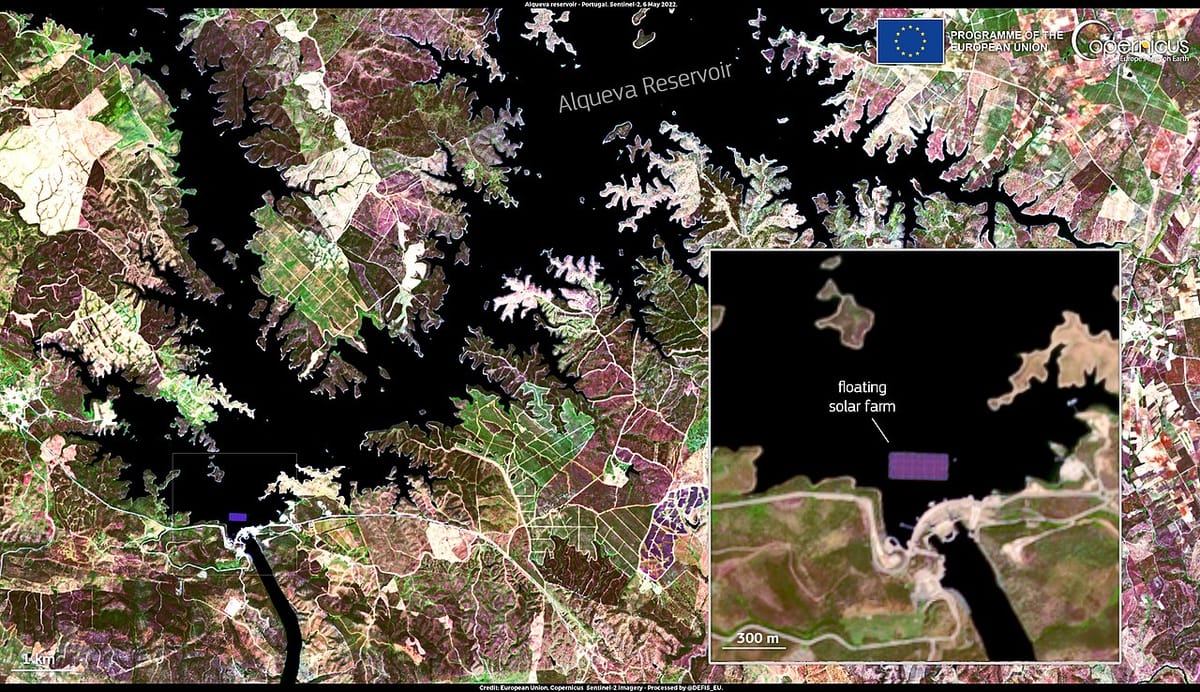
EDP has walked away from what was meant to be one of the most eye-catching pieces of Portugal's renewable-energy story: a giant floating solar and wind complex on the Alqueva reservoir, in the Alentejo, that the company had once promised would be the largest floating solar facility in the world. On 6 August the utility confirmed that the project — branded the Great Lake Hybrid Plant (Central Híbrida do Grande Lago) — will not go ahead, saying that "after a detailed analysis, EDP considers that the conditions are not in place to proceed."
Two forces killed it. The first is money. The plant was awarded back in 2022, and in the years since the economics have turned against it: the cost of equipment and installation has climbed while wholesale prices for renewable electricity have fallen, eroding the returns that once justified an investment of roughly 170 million euros. The second is the environment. The Portuguese Environment Agency (Agência Portuguesa do Ambiente, or APA) rejected the project's environmental-impact study after some two years of back-and-forth, with the sticking point being the power line needed to connect the wind element, which regulators judged a threat to local vulture habitats.
On paper the scheme was ambitious. It was designed as a hybrid plant of around 154 megawatts, pairing some 70 megawatts of floating solar panels with the hybridisation of 70 megawatts of wind capacity, plus a slice of extra solar over-equipment. It would have spread across a large stretch of the Alqueva's surface — Europe's biggest artificial lake — and had originally been expected to be generating power by 2025.
Alqueva already hosts a smaller, working example of the idea. In 2022 EDP switched on a pilot floating-solar array there of roughly five megawatts, built from about 12,000 panels covering some four hectares, which at the time was billed as Europe's largest floating solar plant on a reservoir. That pilot remains; it is the far larger follow-on that has now been shelved.
The cancellation lands at an awkward moment, because in most respects Portugal's solar push has never looked stronger. In July, solar became the single largest source of the country's electricity for the first time ever, supplying close to a fifth of national consumption over the month and helping renewables cover more than half of demand. Against that backdrop, the loss of a flagship project underlines how the constraints on the energy transition are shifting — away from whether the sun and wind can deliver, and towards grid connections, planning permissions, environmental trade-offs and the cold arithmetic of falling power prices.
It also reflects a growing tension in the Alentejo, where a wave of solar proposals on and around the reservoir has drawn objections from municipalities worried about tourism and from environmental groups warning that the cumulative impact of many plants has been poorly assessed. For EDP, retreating from the Grande Lago avoids a drawn-out fight it had decided was no longer worth winning. For Portugal, it is a reminder that even a country racing ahead on clean power will not build every project it announces — and that the reservoir once pitched as the site of a world record will, for now, keep its surface largely to itself. On where the national emissions line actually went, our reading of the 2026 EDGAR release, which puts Portugal's emissions up 1.6 percent in 2025 against a falling European total, with gas-fired power and industrial burning carrying 72 percent of the rise sets the latest reference.