Portugal Gains Its First Master of Wine as a Dão Producer Joins a Worldwide Roll of 427
Tiago Macena, a partner and winemaker at Código Wines in the Dão, is among seven new Masters of Wine announced on Thursday and the first based in Portugal. His research paper examined Encruzado, the Dão white grown almost nowhere else.
Portugal has produced a Master of Wine for the first time. The Institute of Masters of Wine announced on Thursday that seven candidates had passed all three stages of its examination, and among them was Tiago Macena, a partner and winemaker at Código Wines in the Dão. He is the first Master of Wine based in Portugal in the qualification's history.
The other six are Alice Archer and Owain Hughes of the United Kingdom, Weiran Liu of China, Gabriella Macari of the United States, Jake Skakun of Canada and Sue Tolson of Hungary, who becomes her country's first as well. Added to four announced in February, the 2026 intake reaches eleven, the largest cohort since 2021, when thirteen qualified. There are now 427 active Masters of Wine across 31 countries.
Why this took so long
Portugal is one of the world's ten largest wine producers and has been making wine on an industrial scale since the eighteenth century, so a first MW in 2026 looks late. The explanation is mostly structural. The Institute is a British body, its examinations are conducted in English, and its centre of gravity has historically been the trade rather than production: buyers, merchants, journalists and educators, concentrated in London and increasingly in the United States and Australia. Winemakers in producing countries have never been its natural constituency.
The exam itself is also unusually punishing. Candidates face three blind tastings of twelve wines each, in which they must identify grape variety, origin, winemaking method, quality, style and commercial positioning; five theory papers spanning viticulture, vinification, the handling of wine, the wine business and contemporary issues; and finally an original research paper. Most candidates take several years. Macena first sat the exam in 2017 and passed the practical component in 2023, with the last stage still ahead of him.
His research paper was on Encruzado in the Dão, a study of how Portugal's most respected white variety is produced and where it might go next. It is a fitting subject: Encruzado is grown almost nowhere else, is capable of ageing in a way few Iberian whites manage, and remains largely unknown outside the trade.
The winemaker
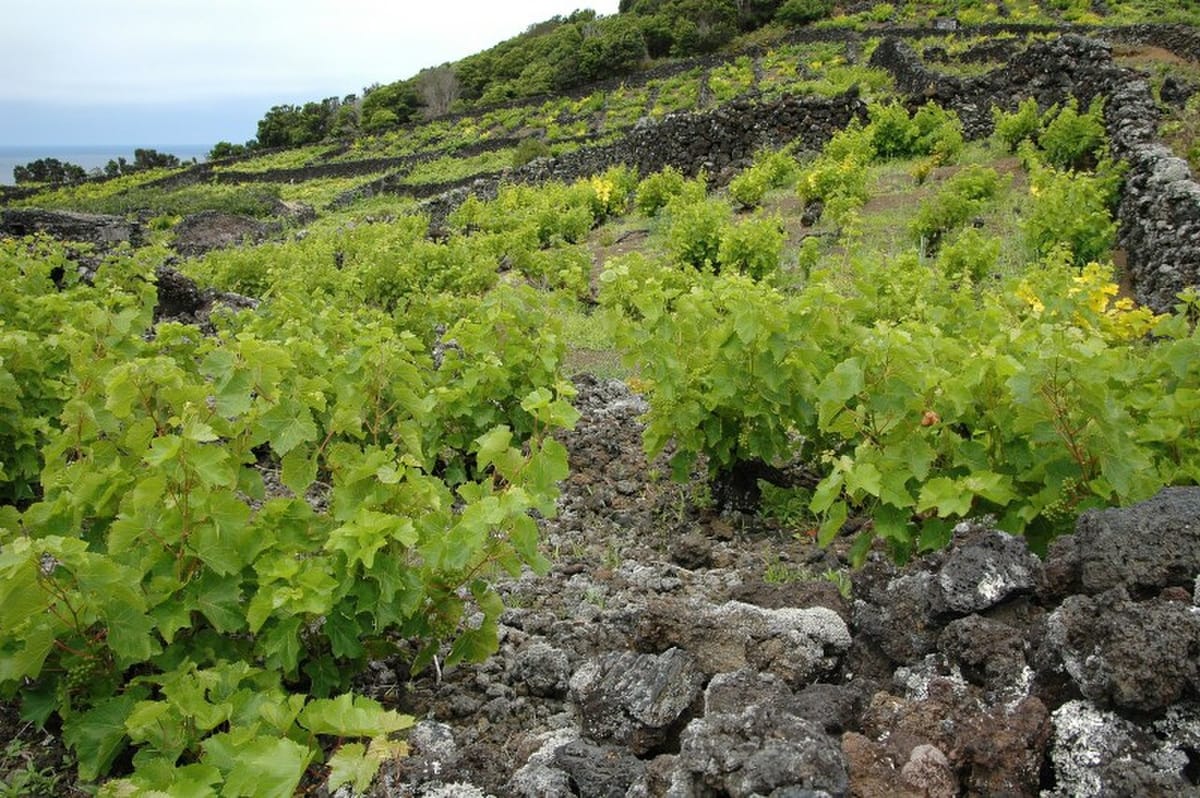
Macena read agronomic engineering at the Instituto Superior de Agronomia of the University of Lisbon and took a postgraduate qualification in wine business. Alongside Código Wines in the Dão, he consults for producers in the Alentejo and on Pico in the Azores, where vines grow inside walled enclosures of black basalt on a UNESCO-listed landscape. His stated focus is native Portuguese grape varieties and the preservation of old vineyards, which places him squarely in the movement that has spent the past two decades arguing that Portugal's competitive advantage is its 250-odd indigenous varieties rather than any attempt to match international styles.
ViniPortugal, the national wine promotion body, has supported his candidacy for years. Its chairman Frederico Falcão said in 2023, when Macena cleared the practical stage, that the organisation had "always believed that this day would come" and had made a point of backing him throughout.
Roderick Smith, chair of the Institute of Masters of Wine, described the qualification as "one of the most significant achievements in the wine world".
What it is worth
An MW is not a licence to make better wine, and nobody in the trade pretends otherwise. What it does is confer access and credibility in the export markets where Portuguese producers have had the hardest time getting a hearing. Masters of Wine sit on buying panels, judge competitions, write the reference books and advise the retail chains that decide which bottles reach a supermarket shelf in London, New York or Singapore. Having one who works in the Dão and consults in the Alentejo and the Azores is a different proposition for those regions than having an advocate in a tasting room three thousand kilometres away.
The timing helps. Portuguese wine exports have been pushing toward the €1 billion mark while simultaneously losing ground in the United States under tariffs, and the industry is looking hard for new routes to market. It also arrives in a year of real strain at home: the Douro is enduring its worst crisis in decades even as the national harvest is forecast to grow 12%, a combination of too much wine and too little demand that no qualification can fix.
What this means for foreign residents
- The Dão deserves more of your attention than it gets. It sits between Viseu and the Serra da Estrela, roughly two hours from Porto and three from Lisbon, and produces some of the best-value serious wine in the country. Encruzado for whites, Touriga Nacional and Jaen for reds.
- Cellar-door visits are straightforward. Dão producers are smaller and less geared to coach tourism than the Douro or the Alentejo, which usually means booking ahead by email but also means talking to the person who made the wine rather than a guide.
- Wine education is available locally. The WSET qualifications that most MW candidates pass through on the way are taught in Lisbon and Porto, in English, and the early levels are approachable for anyone with an interest rather than a career plan.
- Expect to see the label. The letters MW carry weight on a back label and in a tasting note. Producers Macena consults for in the Alentejo and Pico will use it, and it is a reasonable shorthand for technical seriousness when you are choosing between unfamiliar bottles.
- National Wine Day is now fixed in the calendar. Portugal gave wine its own national day last month, and regional celebrations around the harvest run through September and October across the Dão, Douro and Alentejo.
Whether one qualification changes anything for Portuguese wine as a whole is doubtful. What it does mark is the point at which a country with an enormous and genuinely distinctive wine culture finally has a voice inside the institution that shapes how the rest of the world buys it. That the voice belongs to somebody working with old vines and native varieties in the Dão, rather than a trade specialist in a capital city, is the more interesting part.