Portugal's Fifth IRS Cut Is Worth 12 Euros a Year on a 1,000 Euro Salary and 344 on a Household of Eight Thousand, and Parliament Has Yet to Vote It
The Council of Ministers approved cuts of 0.3 to 0.5 points across the first six brackets on Thursday, plus a pension supplement, a fuel-sector package and a national rail pass. The IRS piece went through as a bill, which means the Assembleia da República has to pass it first.
Luís Montenegro spoke to the country from São Bento on Thursday evening, without taking questions, to announce a package the Conselho de Ministros (Council of Ministers) had approved that afternoon. Most of it he had already announced, in Parliament, nine days earlier. What Thursday added was the detail: the size of the cut bracket by bracket, the bands of the pension supplement, and the legislative form each measure takes, which turns out to be the part that decides when any of it actually arrives.
The headline is the fifth reduction in IRS, the personal income tax, of this government's time in office. Rates fall across the first six brackets, the change applies to income earned in 2026, and the Ministério das Finanças (Ministry of Finance) says it reaches more than 2.9 million households. Because the tax is progressive, a rate cut in the lower brackets also reduces the bill of everyone above them, so in practice every taxpayer is touched by some amount.
The amount is the thing worth reading closely.
What it is worth, on the Ministry's own simulations
The Finance Ministry published a set of worked examples alongside the announcement. They assume fourteen payments a year (twelve salaries plus the holiday and Christmas allowances) and a resident on the mainland, and they are annual figures rather than a forecast of the November payslip, because the new withholding tables that will govern the last two months of the year have not been published yet.
A single taxpayer with no dependants on a gross salary of 1,000 euros a month saves 12.10 euros across the whole year. The same taxpayer on 2,000 euros saves 100.44 euros. A couple with two dependants, one earning 2,500 euros and the other 1,500, saves 200.88 euros between them. A couple earning 5,000 and 3,000 saves 343.66 euros.
Pensioners get the same treatment, since pensions are taxed as income: a retiree with no dependants on 1,000 euros a month gains 12.10 euros over the year, one on 2,000 euros gains 100.44 euros, and one on 3,500 euros gains 171.50 euros.
That spread is not an accident of presentation. It is what a rate cut concentrated in the middle brackets does. A euro a month at the bottom of the scale and roughly 29 euros a month at the top of the examples is the shape of the measure, and it is the reason the government describes it as support for the middle class rather than as a cost-of-living measure for the lowest earners.
The rates
The Finance Ministry described the change as a reduction of 0.3 percentage points in the first bracket, 0.5 points in the second through fifth, and 0.3 points in the sixth. The three highest brackets are untouched. The bracket thresholds themselves do not move: only the rates change. The separate legal mechanism that indexes the thresholds every year is expected to run as usual in January, which is what keeps the scale roughly neutral against the pay rises agreed in the Concertação Social (Social Concertation) framework.
On that description, the first bracket falls from 12.50 to 12.20 percent, the second from 15.70 to 15.20, the fourth from 24.10 to 23.60, the fifth from 31.10 to 30.60 and the sixth from 34.90 to 34.60. The third bracket is the one figure the published accounts do not settle cleanly: on a 0.5 point cut it lands at 20.70 percent, while at least one table circulating on Thursday night prints 20.20. The decree text will resolve it, and readers working out their own position should wait for it rather than for the arithmetic.
The part that still needs a vote
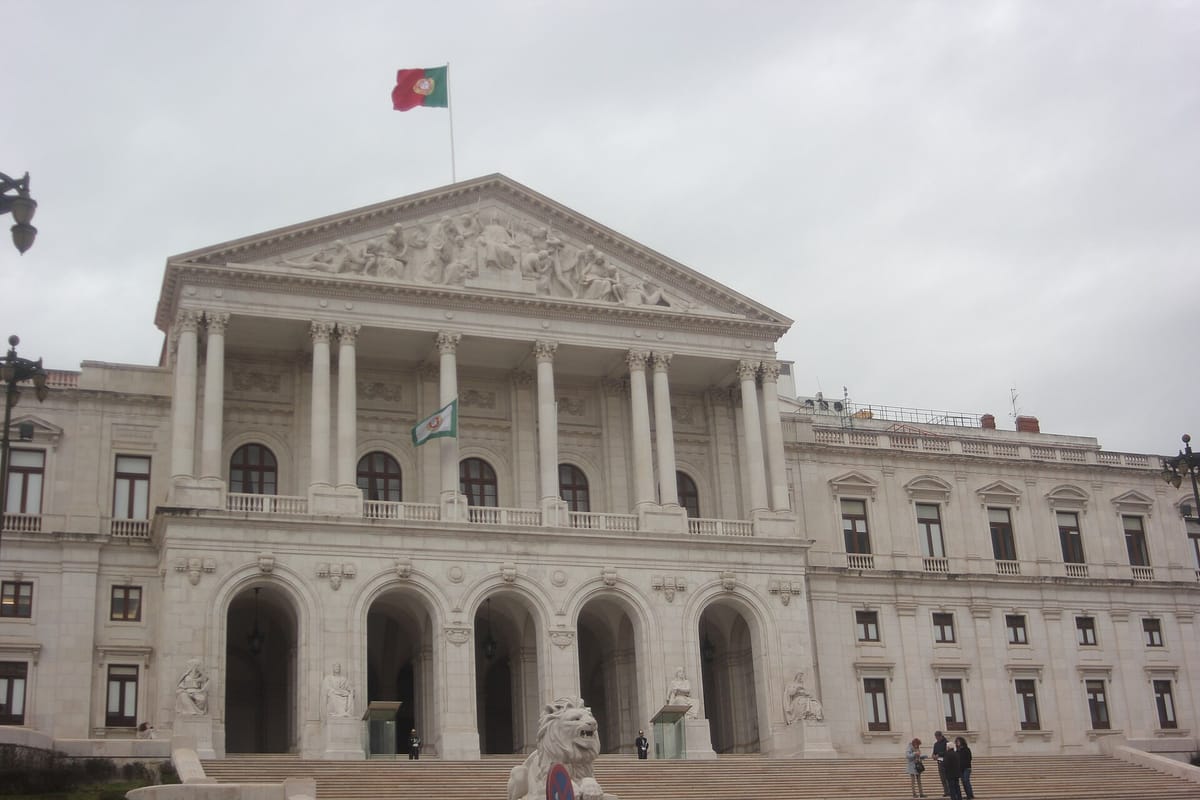
Here is the detail that Thursday's ceremony did not dwell on. According to the government's own communiqué, the IRS measure was approved as a proposta de lei authorising the government to reduce the rates. So was the extension of the fuel-tax discount. A proposta de lei is a bill: it goes to the Assembleia da República (Assembly of the Republic) and has to be passed there before it becomes law.
The other measures did not take that route. The pension supplement, the fuel-sector support and the Passe Verde extension were all approved as decree-laws, which the government can enact on its own authority.
So the promise that net pay rises in November, retroactive to January, rests on a parliamentary timetable rather than on a signature. This is a minority government, and the same parties that will vote on this bill have their own bills on the cost of living already queued: two VAT bills reach the floor on 24 September, neither of which can take effect before January.
The pension supplement, and a number that has now moved twice
The extraordinary pension supplement is the third in three consecutive years. It pays 200 euros to pensioners on 537.13 euros a month or less, 150 euros to those above that and up to 1,074.26 euros, and 100 euros to those above that and up to the ceiling. It is paid automatically, in a single instalment, with the December pension, and it reaches roughly two million people at a cost of about 400 million euros.
The bands are multiples of the Indexante dos Apoios Sociais (Social Support Index), fixed for 2026 at 537.13 euros. The ceiling is three times that figure. When the prime minister first announced the supplement on 8 September he gave the ceiling as 1,611.13 euros, which is 26 cents short of three times the index, and we noted at the time that the Council of Ministers text would presumably settle it. It has: the communiqué published on Thursday night says 1,611.39 euros, the arithmetically correct figure. The prime minister used the older number again in his address.
Fuel, and the discount that is about to get bigger
Three of the measures concern fuel. The temporary reduction in the Imposto sobre os Produtos Petrolíferos (Tax on Petroleum Products), the ISP, is extended to 31 December 2026, which the government values at about 1,300 million euros of foregone tax to the end of the year. A separate decree-law re-establishes direct support for the sectors most exposed to pump prices: freight and passenger transport, taxis, private social solidarity institutions and volunteer fire brigades. That scheme last ran to the end of June. It sits on top of the 10 cents a litre approved last week for coloured and agricultural diesel.
Montenegro put the total discounts currently in force at about 23 cents a litre and said the figure will probably rise to 25 cents next week, when diesel is expected to go up about ten cents and petrol about eight. "The State earns zero euros from the rise in fuel prices," he said, which is the claim the ISP mechanism exists to make good on.
He also declined to go further, invoking the troika years to refuse what he called an auction of scattered measures. The government's arithmetic is that its intervention, counting measures already in force, returns about 2,300 million euros to taxpayers.
And one measure that is simply a bigger map
The last item is the Passe Ferroviário Verde, the 20 euro national rail pass. The decree-law extends it to the urban services of Lisbon and Porto, including the Fertagus line, which removes the need to buy a second ticket for the suburban leg of a journey. "For just 20 euros a month you can travel on all, absolutely all, of the country's rail lines, with the exception of the Alfa Pendular," Montenegro said.
The start date is the open question. The Infrastructure Ministry announced in August that the extension would begin during European Mobility Week, which runs from 16 to 22 September. On Wednesday the same ministry told RTP Antena 1 that the extension "is being operationalised" and that there is still no information on when it starts.
What this does to the accounts
The IRS cut and the pension supplement cost about 400 million euros each. They are being paid out of this year's execution, which had already narrowed to a 282 million euro surplus by July after a large clear-out of overdue hospital bills. They also arrive on top of relief the tax was going to deliver anyway: two routine indexations will cost the state 401 million euros next year before anyone touches a rate.
There is also the familiar tail on any mid-year change to withholding. Taking less tax at source in the closing weeks of a year front-loads the money into two pay packets and leaves a thinner refund the following spring, or a bill instead of a cheque. Tax specialists have made that point in each of the past two years. The bastonária of the Ordem dos Contabilistas Certificados (Order of Certified Accountants) told ECO that taxpayers have got used to managing it.
If you want to know where your own income sits in the scale before any of this changes, our guide to Portuguese income tax sets out the brackets and how withholding works.