Mirandese, Portugal's Only Other Official Language, Now Has a Six-Pillar Strategic Plan, 500,000 Euros a Year and a 2029 Deadline
The mission structure set up for the language presented its plan on Thursday. Behind it sits a 2025 resolution with fourteen competences, a teacher pool, a certification system nobody has built yet, and an instruction to report on whether the number of speakers moves.
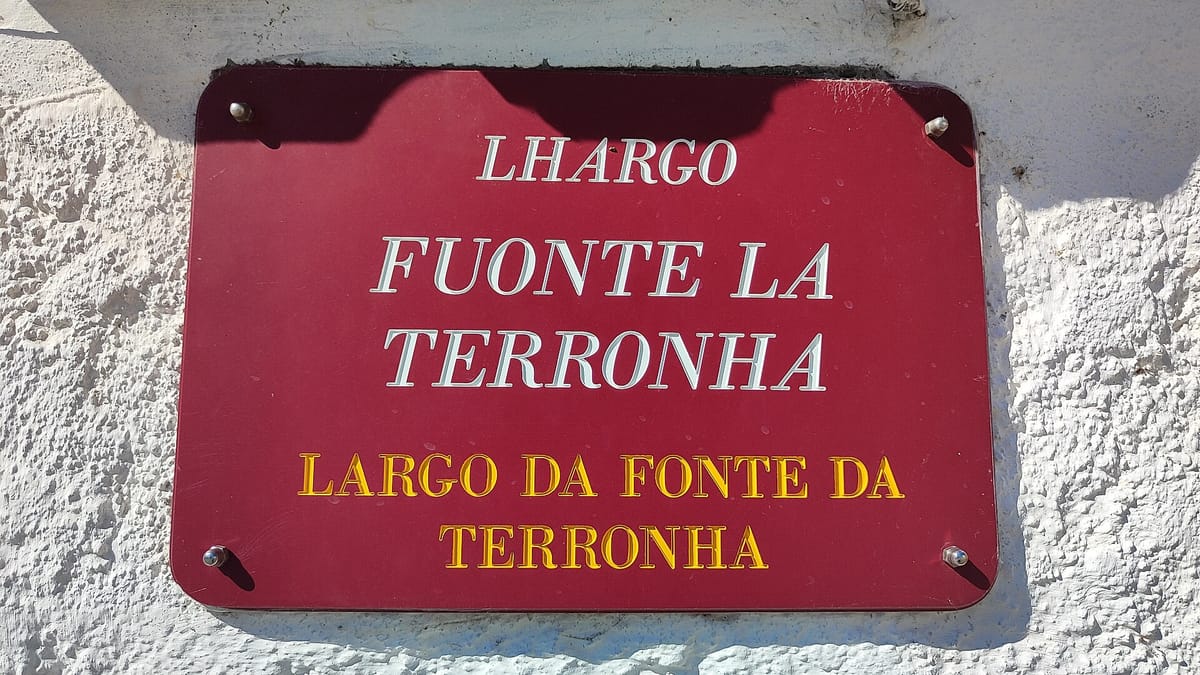
Portugal has two official languages. The second one is spoken in a corner of the Bragança district along the Spanish border, has been recognised in law since 1999, and on Thursday it acquired something it had never had before: a strategic plan with a structure, a budget and a deadline attached to it.
The Estrutura de Missão para a Promoção da Língua Mirandesa (Mission Structure for the Promotion of the Mirandese Language) presented its strategic plan on Thursday. Its commissioner, Alfredo Cameirão, told the Lusa news agency that the plan rests on six pillars and is built for the next four years, which is the life the government has given the body itself.
The six pillars
The first is a linguistic commitment: making room for the lhéngua, as Mirandese calls itself, inside institutions, public services and the territory it belongs to. The second is what Cameirão described as a living laboratory, building capacity through research, training, linguistic resources and technological investigation.
The third is the one that decides whether any of the rest matters. It is described as putting the language in motion: creating speakers, strengthening teaching, restoring transmission between generations and getting Mirandese used day to day, with teacher training and classroom materials behind it.
The fourth turns to culture, with the aim of establishing Mirandese as a language of contemporary artistic and cultural creation rather than a heritage object. The fifth looks outward, through national and international cooperation and a European profile for the language. The sixth is what the plan calls the economy of the language: getting Mirandese used in economic activity, in tourism and in the development of the territory.
Where the structure came from
The mission structure was created by Resolução do Conselho de Ministros n.º 66/2025, published on 18 March 2025. Its preamble takes the language to be, in the words of Article 2 of Lei n.º 7/99, part of the cultural and linguistic heritage of Portugal, and reads the state's duty to preserve it out of Article 9 of the Constitution.
The resolution did not appear from nowhere. A working group set up by Despacho n.º 1294/2024 had produced a strategic plan of its own and concluded that a fast, effective mission structure was needed to carry public policy through. The 2025 State Budget then provided for money to create and run a body to promote the language.
The resolution gives the structure a commissioner and two subcommissioners, appointed by the minister responsible for culture and ranked for pay and duties as senior public managers of the first and second grades. It provides a technical team of up to three senior technicians, one technical assistant and one operational assistant, all seconded. Administrative and logistical support comes from the Gabinete de Estratégia, Planeamento e Avaliação Culturais (Office for Cultural Strategy, Planning and Evaluation), the GEPAC.
The money is capped: the budget charges are borne by the Finance Ministry's chapter 60, transferred to the GEPAC, up to a maximum of 500,000 euros a year. And there is an end date written into the text. The structure dissolves on 31 December 2029 unless a later resolution expressly extends it.
What it is actually required to do
The resolution lists fourteen competences, and they read less like a declaration than like a work order. The structure has to create and coordinate a pool of Mirandese teachers, working with higher education institutions and teacher training centres on their qualification and certification. It has to develop teaching programmes for the language at different school levels, with the Education Ministry and the schools of the Terra de Miranda. It has to build a system for certifying language competence in Mirandese and get it approved by the Education Ministry and officially recognised.
Beyond the classroom, it is required to support translation and publishing of literary and scientific works, and audiovisual production, in Mirandese; to create a travelling exhibition on Mirandese history, culture and language and keep it circulating around the country; to encourage bilingual materials in public spaces and citizen services, covering administrative documents, signage and institutional communication; and to build partnerships for the language in digital contexts, including linguistic tools and online learning resources.
The last competence is the one that will eventually say whether the rest worked. The structure has to monitor indicators of the language's vitality, produce periodic reports on its sociolinguistic situation, and propose measures to revitalise it.
Who sits around it
An advisory council was created alongside the structure, with one representative each from the GEPAC, the Direção-Geral da Educação (Directorate-General for Education), Camões, the Institute for Cooperation and Language, the Câmara Municipal de Miranda do Douro, the Associaçon de la Lhéngua i Cultura Mirandesa, the Faculty of Letters at the University of Coimbra, the Faculty of Letters at the University of Porto, the Instituto Politécnico de Bragança and the Agrupamento de Escolas de Miranda do Douro. Service on the council is unpaid.
Cameirão's account to Lusa describes a somewhat wider council than the founding resolution does, including the University of Trás-os-Montes e Alto Douro, the Frauga association for the integrated development of Picote and the Academia de Letras de Trás-os-Montes. The resolution allows the composition to be read as a floor rather than a ceiling, and the extra names are not in it.
The structure works out of the Casa dos Magistrados on Rua do Convento in Miranda do Douro, a building owned by the municipality that was refurbished to house it.
Why any of this is urgent
Lei n.º 7/99 of 29 January is a short law, and it did something unusual: it recognised the right to use a minority language rather than declaring a second national one, and it has never carried much machinery. For twenty-seven years, teaching Mirandese has depended largely on a handful of schools in Miranda do Douro and on the Associaçon that has campaigned for it.
What is new here is not recognition. It is the apparatus: a named commissioner, a teacher pool, a certification system, a budget line and a date by which somebody has to report on whether the number of speakers moved. Whether 500,000 euros a year is the right size for that job is a separate question, and the vitality reports the resolution demands are the instrument that will answer it.
The Terra de Miranda is a thin-populated corner of the northeast, and most of the national news that reaches it concerns what it is losing: shepherds waiting two years for wolf compensation, or a central bank counter opening one day a week because it is the only one in Trás-os-Montes. A four-year plan for the language is a different kind of item, and it belongs to the same argument about whether the interior gets institutions or only visits.
Portugal has been building a formal inventory of its intangible heritage in parallel, a process that runs through public consultation and, in some cases, toward UNESCO. A living language is a harder object than a festival or a craft. It cannot be inventoried into survival; it has to be spoken. That is what the third pillar is for.