Porto's Metro Gets a Study to Run South Along the Vouga Line to Feira, São João da Madeira and Oliveira de Azeméis, and the Old Salgueiros Ground Is Earmarked for Housing
The Infrastructure Minister announced a study of a metro link south from Gaia on the Vouga line corridor, as Porto and IP signed deals on the VCI, two outer ring roads and the Circunvalação. The lorry ban's first figures, and housing plans for the Salgueiros site.
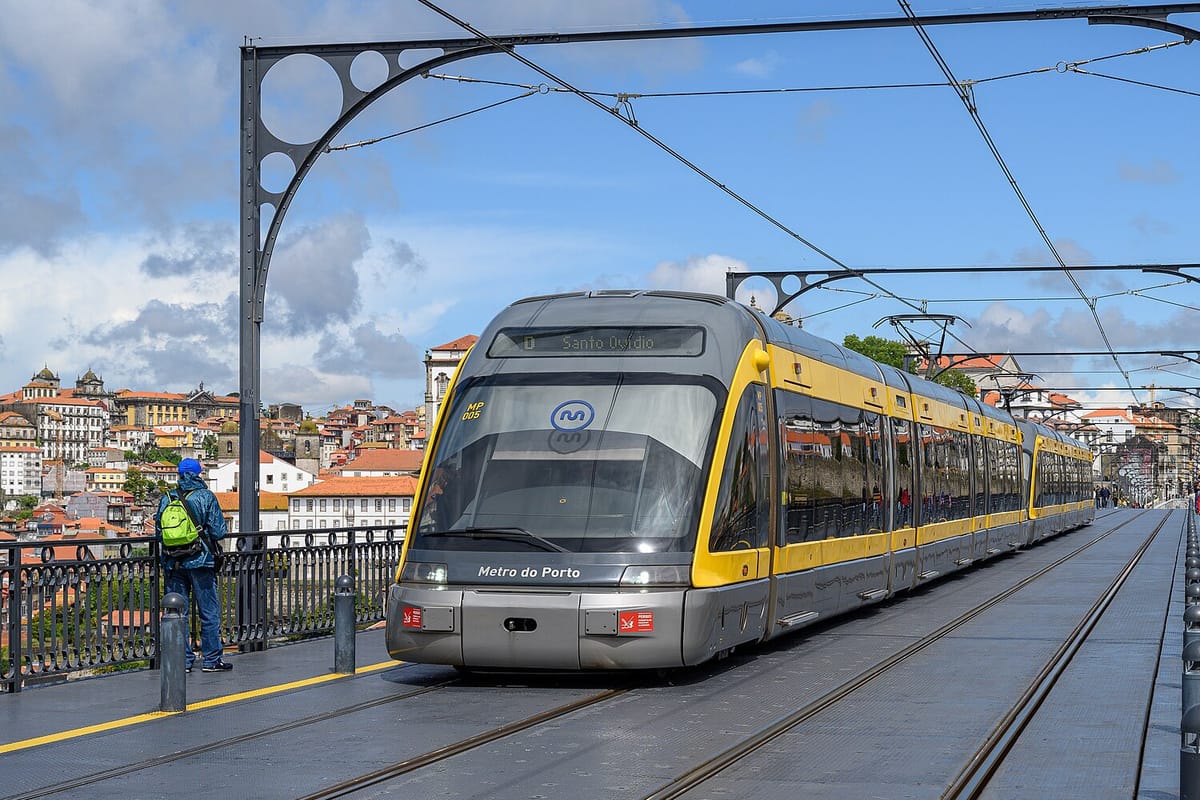
The Government will study taking the Metro do Porto south to the councils at the southern edge of the Porto metropolitan area, using the corridor of the Linha do Vouga (Vouga line), a narrow-gauge railway that runs from Espinho inland to Sernada do Vouga. The Infrastructure and Housing Minister, Miguel Pinto Luz, announced it on Wednesday 4 November at Porto City Hall, where the council and Infraestruturas de Portugal (IP), the state rail and road manager, signed a set of mobility agreements.
The Área Metropolitana do Porto (AMP, Porto Metropolitan Area) says the study, "which should start soon", will assess extending the metro network to São João da Madeira, Oliveira de Azeméis, Santa Maria da Feira and Vale de Cambra. According to Lusa, via ECO, the minister described a link from Santo Ovídio in Vila Nova de Gaia to Espinho, São João da Madeira, Santa Maria da Feira and Oliveira de Azeméis, and said he had instructed the Metro do Porto to plan it. Bringing some 400,000 residents into the network would be "absolutely transformative", he said.
"Sometimes we forget that there is a Porto Metropolitan Area to the south," Pinto Luz said. No budget, route or timetable was given. For people in these towns, nothing changes yet: this is a study, not a project.
Two new ring roads, studied to take pressure off the VCI
The council and IP signed an agreement to study two outer ring roads, the Via Circular Externa Nascente and Poente (eastern and western outer ring roads). The aim, in a first phase, is to see how they could "complement or replace some functions" of the Via de Cintura Interna (VCI, Porto's inner ring road), said the mayor, Pedro Duarte, according to the council's release. The study will use transport models covering the whole metropolitan area. The AMP says the outer road could cross parts of Vila Nova de Gaia, Gondomar, Valongo, Porto and Maia.
The council takes on more of the VCI's daily running
A separate management agreement splits responsibilities on the VCI between the council and IP. It covers towing and the pound for removed vehicles, traffic enforcement and emergency crossings, landscaping of the green areas at the junctions, and street lighting, the council says in a second release. Duarte said it allows "concrete improvements" but is not yet "a structural solution".
Pinto Luz gave a first count of the ban on heavy goods lorries on the VCI, which has applied on weekdays from 07:00 to 21:00 since 15 September, with lorries sent instead to the toll-free A41/CREP outer ring. He spoke of about 30 percent fewer lorries on the VCI, 60 percent fewer crossing the Arrábida bridge and about 3,500 fewer lorries a day over the Douro bridges. Incidents on the road were down 7 percent, he said, and the capacity to clear them within the first hour was up 11 percent.
Circunvalação, the Ramal da Alfândega and two new light rail studies
- Circunvalação: an agreement on the redesign of the EN 12, the Estrada da Circunvalação (ring avenue) that runs along much of Porto's boundary with its neighbours, which the council wants to treat as "a shared space" rather than "a line that separates". Duarte named Asprela and the northern entrance to the city as priorities.
- Ramal da Alfândega: a cooperation protocol on the old Alfândega rail branch between kilometre 0.491 and kilometre 3.559, which the council wants to use for a fast public transport link between the historic centre and Campanhã.
- Light rail: the council and the Metro do Porto signed an agreement for preliminary studies of a surface light rail service on the Campo Alegre corridor and the Casa da Música to Roberto Frias corridor.
Salgueiros land offered for housing
The minister also said he had told the Metro do Porto's board, which owns the site of the old Salgueiros football stadium in Paranhos, to start talks with the council on putting the land "at the service of housing", Lusa reported via ECO. "Details? Only after that process starts," he said. The Metro do Porto began demolishing what was left of the Estádio Vidal Pinheiro on 7 September. The housing use is an intention for now, with no number of homes, type of rent or date announced.
Porto's council voted this week to tie seven tourism projects to affordable rentals.