A Week Into Porto's Lorry Ban on the VCI, the Council Counts Traffic and the Hauliers Count Kilometres
Twenty-seven tickets in the first three days, detours of up to 57 kilometres on some runs, and a mobility councillor who says he is measuring the policy by accidents that do not happen.
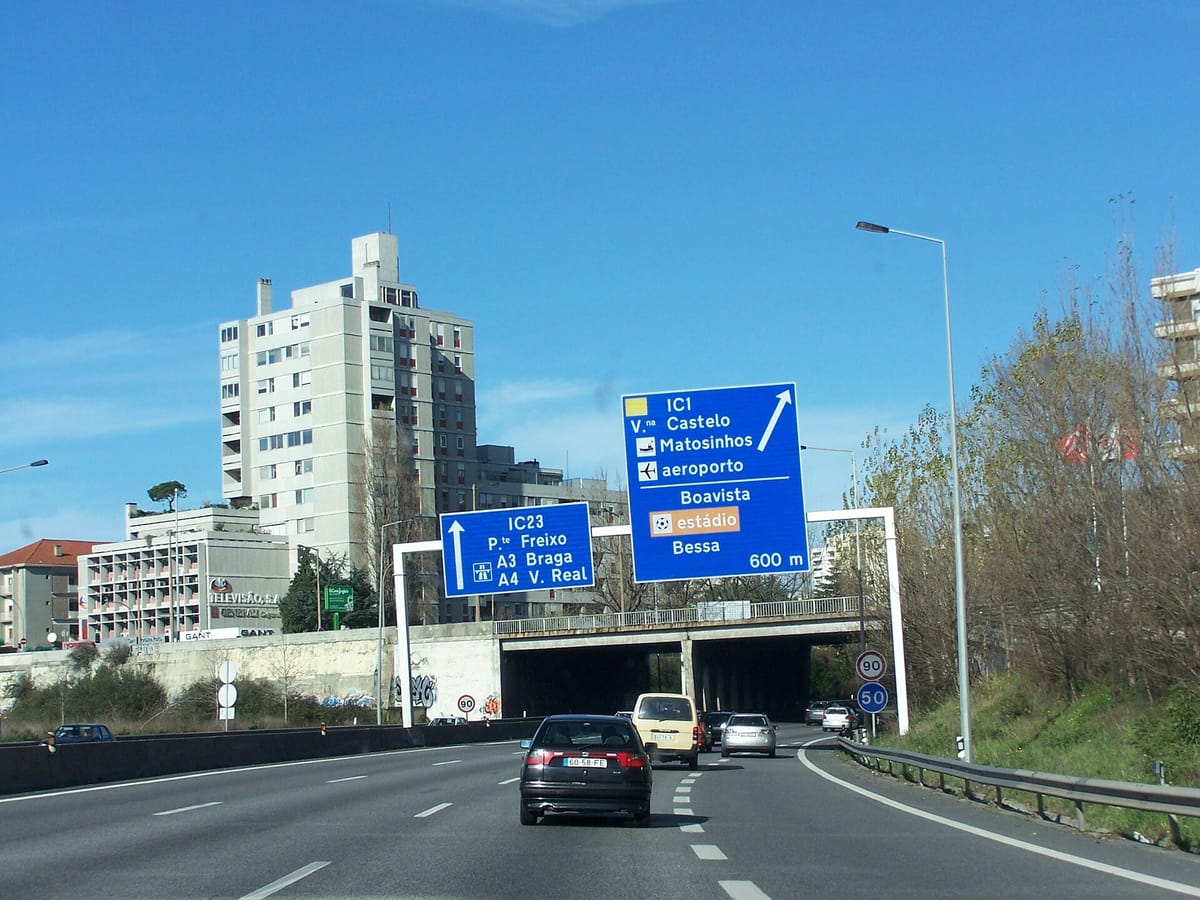
Heavy goods vehicles have been barred from Porto's inner ring road since Tuesday 15 September. Four days in, the city's mobility councillor was calling the early data promising while the haulage industry was calling it a bill. Both are describing the same 20 kilometres of road.
The ban applies to the Via de Cintura Interna between seven in the morning and nine at night on weekdays, across the stretches signed as A1/IC1, A20/IC23, A28/IC1 and A44/IC23, which together link Porto and Vila Nova de Gaia. It catches vehicles over 3,500 kilograms gross weight with three or more axles and a height of at least 1.1 metres at the vertical of the first axle. Traffic that would have used the VCI is pushed out to the Circular Regional Externa do Porto, the A41.
Four days of enforcement
The PSP's metropolitan command recorded 27 infractions in the first three days of the new regime, all of them lorries without authorisation to be on the VCI during the closed hours. The exception exists for trucks whose journey starts or ends in the councils of Porto or Gaia for loading or unloading, and it is not automatic: the haulier has to register the number plate in advance on a digital platform run by the two councils, which the police can then read.
Hugo Beirão, the mobility councillor in Pedro Duarte's executive in Porto, said he expects the infraction count to fall to zero as operators learn the rules, and that he is not measuring the policy by infractions at all. "I measure the advantage of the measure by the traffic, by the average speed of traffic and by the accidents that do not happen on the VCI," he told ECO. He framed the restriction as a road safety process and predicted the criticism from hauliers would stop being a topic within days.
What the detour costs
The logistics operator Luís Simões has counted detours of up to 57 additional kilometres on some runs. Its country manager, Tiago Garcia, said the extra distance feeds directly into fuel and vehicle utilisation costs. Luís Torres, chief executive of the Torrestir group, was blunter: every additional kilometre is fuel, driver time and wear, and it will surface in transport prices and then in consumer prices further down the supply chain.
Torres also disputed the proportionality. Heavy vehicles account for around 15 percent of total VCI traffic, by the sector's own reference figures, which in his reading makes them an odd target for a structural congestion problem. Lorries are not being taken off the road, he argued; they are simply being sent a longer way round.
Beirão's answer is that hauliers gain predictability in exchange for distance, and that they have the compensation of a toll exemption on the A41 approved by Parliament. He also rejected the idea that supply into the two cities changes at all: deliveries and collections inside Porto and Gaia are unaffected, and what moves is the north to south through-traffic.
What this means for you
- If you drive the VCI, expect the change to be gradual. The councillor explicitly refused to declare a result in the first week, and traffic counts taken in mid-September are not a settled picture.
- If you run or hire a van or lorry, check the weight and axle test. The ban is not simply "heavy goods". It is over 3,500 kilograms gross, three or more axles, and 1.1 metres of height at the first axle. Many two-axle delivery vehicles fall outside it.
- Register the plate before the journey, not at the roadside. The loading and unloading exception only works if the vehicle is already on the councils' plate register that the PSP checks.
- Budget for the A41 in time, not money. The toll exemption removes the charge, but the detour still adds kilometres and minutes on every affected run.
The VCI ban sits alongside the 2.4 million euro cycle route Porto tendered this week as the second attempt in seven days to change what uses the city's roads. The measure that will be judged first is the one with 27 tickets already written against it.