Markets, Business & Tech Briefing: A Total Stoppage at Sines, Madeira's Power Warning, PSI Up 13% in 2026
📋 In This Edition
- Every Shift Out at Sines, and Madeira Starts Counting Days
- Tech: The Layer Portugal Does Not Own, and the Talent It Loses Because of It
- Gold, Bitcoin and a US Debt Pile That Passed $40 Trillion
- Where Lisbon Actually Stands: August, the Year, and the Curve
- The Week Ahead
Every Shift Out at Sines, and Madeira Starts Counting Days
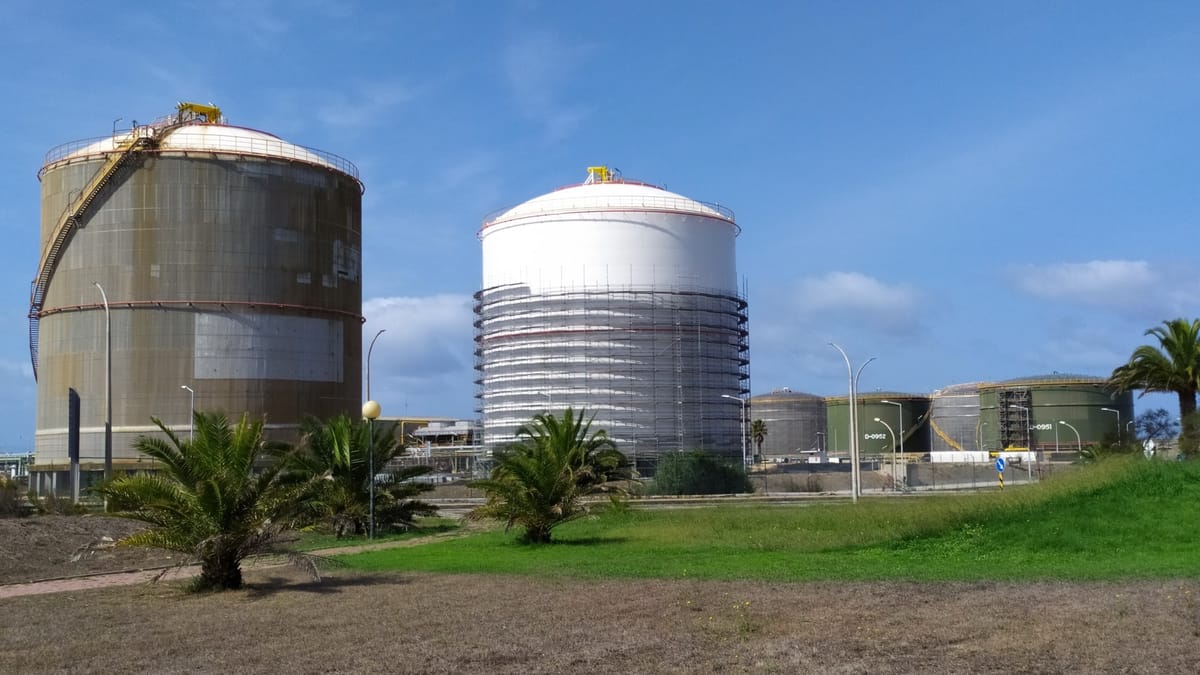
Euronext Lisbon is shut for the weekend, so the day's business news came from a jetty rather than a trading screen. At midnight on Saturday the workers who run the liquefied natural gas terminal at Sines walked out, and by mid-morning the union running the stoppage was claiming the maximum result. "A adesão é de 100%, não há qualquer cisterna a ser abastecida," Rogério Silva of Fiequimetal told the news agency Lusa: adherence is total, and not a single road tanker is being loaded. The first shift held, and so did the second, which clocked on at 09:00.
The strike was called by SITE Sul and Fiequimetal and runs until Tuesday, 25 August. We set out the grievance when the stoppage was announced: the workers want a route to early retirement that recognises the wear of continuous shift work, on terms comparable to those written into the ACT 2000 collective agreement, and they want equal pay for people doing identical jobs. Most of them have already done about twenty years on rotating rosters. The dispute dates to 2012. REN, which owns the terminal through REN Atlântico, did not respond to Lusa's request for comment.
What makes a three-day walkout at one industrial site worth the lead is arithmetic rather than drama. Sines is Portugal's only LNG import terminal, and in 2024 it accounted for 98% of everything the national gas system took in, across 53 ship operations, with Nigeria supplying 52% and the United States 40%. There is no second door. A minimum-services agreement was signed at the labour authority DGERT on 17 August, and both sides say it is being honoured: normal weekend volumes are still going into the transport network. What has stopped is the loading of road tankers, which is how gas reaches the customers who sit off the pipeline grid.
The most concrete consequence has already been filed in writing, and it comes from 900 kilometres out in the Atlantic. José Manuel Rodrigues, Madeira's regional secretary for the economy, has written to Maria da Graça Carvalho, the Minister for the Environment and Energy, asking her to guarantee essential minimum services for the three days of the strike. Madeira's Vitória power station, CTV3, burns gas shipped from Sines and represents roughly 35% of the region's thermal generating capacity. Rodrigues framed the request in terms of territorial continuity, which is the language an island government uses when it wants Lisbon to remember that an interruption on the mainland is not an inconvenience there but a supply problem.
For investors the read is narrow but real. REN is a regulated network business whose earnings are set by tariff rather than by three days of tanker loadings, so the stoppage will not show up in the accounts. It arrives, though, at a moment when the company is unusually exposed politically: the state has just paid a 17% premium to buy back 13.7% of it, and the Tribunal de Contas (Court of Auditors) has yet to sign off. A government that has spent €380 million to sit on one side of the table now has a visible interest in what the other side is asking for. Add a distributor already warning that capped investment would raise bills, and the summer's gas file is getting crowded.
Tech: The Layer Portugal Does Not Own, and the Talent It Loses Because of It
The weekend's most useful technology interview was not about a product launch. Rui Gonçalves, who leads technology consulting at KPMG Portugal and sits on the firm's global artificial intelligence council, spent it explaining, to Lusa, why digital sovereignty is not one thing. "A soberania tem várias camadas," he said: it has the chips, it has the computing capacity, it has the models, it has the data, it has the applications, and it has the talent. Portugal, on his reading, is short at both ends of that list and comfortable in the middle.
On chips and frontier compute he is blunt: Europe will hardly manage to be sovereign there any time soon. He is only slightly warmer on models, noting that France's Mistral, founded in 2023, is neither widely diffused nor positioned the way Anthropic is. The part worth Portuguese attention is the last layer. "Continuamos a formar talento de classe mundial, e muito do nosso talento sai de Portugal por causa do acesso ao primeiro layer de soberania," he said: the country keeps producing world-class engineers, and many of them leave precisely because the interesting work sits where the chips and the frontier models are.
His warning about the standard Portuguese answer is the sharpest thing in the interview. Selling cheaper hands to foreign buyers, the nearshoring model that has quietly become a large chunk of the domestic technology sector, is not sovereignty; it is dependency with an invoice attached. He points at India, where the big software services firms are losing business as artificial intelligence automates exactly the work they undercut everyone else to win. KPMG's own counter, he says, is to run delivery hubs from Lisbon that plug into global projects rather than into other people's cost lines, with the design authority for the firm's global AI operation sitting with the Portuguese team.
The state is edging toward the same conclusion from a different direction. The Council of Ministers approved a National Sovereign Cloud Plan on 14 May, which classifies public data and processes by how critical they are and applies security rules accordingly; ARTE and the CNCS, the national cybersecurity centre, are to set the qualification methodology, and every public body must have classified its processes by 30 June 2027. The scenario the plan is written against is the unglamorous one Gonçalves keeps returning to: waking up to find that a service you do not own has become unavailable. Portugal has been building the physical side of this answer for a while, from the University of Lisbon's €20 million bet on two data centres to the €2 billion Azambuja scheme the local council refused to fast-track. The harder half is the people, and 30,000 applications for a €750 training cheque are not, on their own, a retention policy.
Gold, Bitcoin and a US Debt Pile That Passed $40 Trillion
The week's most violent price action happened a long way from Lisbon, and it is the reason the euro has felt so firm. Bitcoin ended Friday above $77,000, a gain of more than 20% across the five sessions, after having sunk below $60,000 in late June from a January peak near $95,000. Gold recovered to $4,661 an ounce, having slipped to roughly $4,000 in June and touched more than $5,300 in January. Both moves have the same author: investors selling dollars.
The trigger was fiscal. United States federal debt passed $40 trillion on Wednesday, five months after it crossed $39 trillion, and the Treasury said it would at least double the volume of its long-dated debt buybacks. That second announcement was meant to steady the bond market and instead read to a lot of people as a promise of more money, which is how you get simultaneous bids for the two assets that exist to sit outside a currency. More than $4 billion of short positions were liquidated by Friday, which is what turns a move into a stampede.
None of this is a Portuguese story, and it is worth being clear that it is not an argument for buying anything. It matters here for two ordinary reasons. A weaker dollar makes the imported energy bill cheaper, which is the good half. It also makes Portuguese exports and the country's dollar-earning tourism trade a little dearer at the margin, which is the other half. And a world that has decided to worry about the credibility of sovereign balance sheets is a world that eventually reprices long-dated debt everywhere, including the far end of Portugal's own curve.
Where Lisbon Actually Stands: August, the Year, and the Curve
The PSI (Portuguese Stock Index) closed on Friday, 21 August, at 9,354.78 points, its highest finish in four months and about 1.7% below the 52-week peak of 9,516.43. The daily numbers we covered yesterday; the more informative frame is the longer one. Lisbon started August at 9,116.04, so the month has delivered 2.62% with a week of trading still to run. Measured from the 8,263.65 at which the index closed 2025, the year to date is worth 13.2%.
That second figure deserves a moment, because it is the one most likely to be misread. Thirteen percent in under eight months is a strong year by any normal standard. It is also less than half of what the same index did in 2025, when it rose 29.5% and had its best year since 2009. A market that has re-rated that hard, that quickly, and that is now trading within touching distance of its 52-week high, is a market with a thinner margin for disappointment than the headline momentum suggests. Breadth has been improving rather than narrowing, which is the encouraging part; the leadership has rotated from energy to consumer and industrial names, which is the healthy version of a rally.
In the bond market Portugal's 10-year Obrigações do Tesouro (Treasury bonds) finished the week yielding about 3.62%, against a German 10-year Bund at roughly 3.25%, itself close to its highest since March 2011. That leaves the spread at about 36 basis points, near its narrowest ever, and it remains the clearest market verdict on a run of budget surpluses. The comfort is confined to the front of the curve. The 20-year has drifted to around 4.15% in the secondary market, above Spain's equivalent and well above the 3.875% Lisbon paid on its May syndication, which is the local expression of the global repricing of long-dated debt that Friday's dollar selling only encourages. The euro ended the week near $1.168, its firmest against the dollar since June.
The Week Ahead
Lisbon reopens on Monday, 24 August, with no domestic data of consequence and earnings season finished, so the tape will take its cue from abroad. Three things are worth watching at home. The first is Sines: whether the stoppage runs its full course to Tuesday, whether the Environment and Energy Ministry answers Madeira's letter, and whether REN says anything at all, having so far said nothing. The second is the long end of the curve, where a 20-year yield trading through Spain's is either an anomaly that corrects or a number that quietly becomes the cost base of the 2027 budget. The third is the pump: the widened ISP rebate takes effect on Monday, softening but not cancelling an expected rise of about 3.5 cents a litre on diesel. For Monday itself, expect a quiet, marginally softer open: Lisbon has spent two weeks earning a four-month high and is more likely to sit on it than to sprint at 9,500.