Half the Foreign Visitors Treated in Portugal's Emergency Rooms Carry No Cover, and the Health Inspectorate Wants the Fee Taken at the Door
IGAS has asked two Local Health Units to consider charging non-residents on entry to the emergency department rather than at discharge, and to add a compulsory check-out point. Its own survey found 92,189 non-residents treated in nine months of 2024, 49.3 percent with no cover at all.
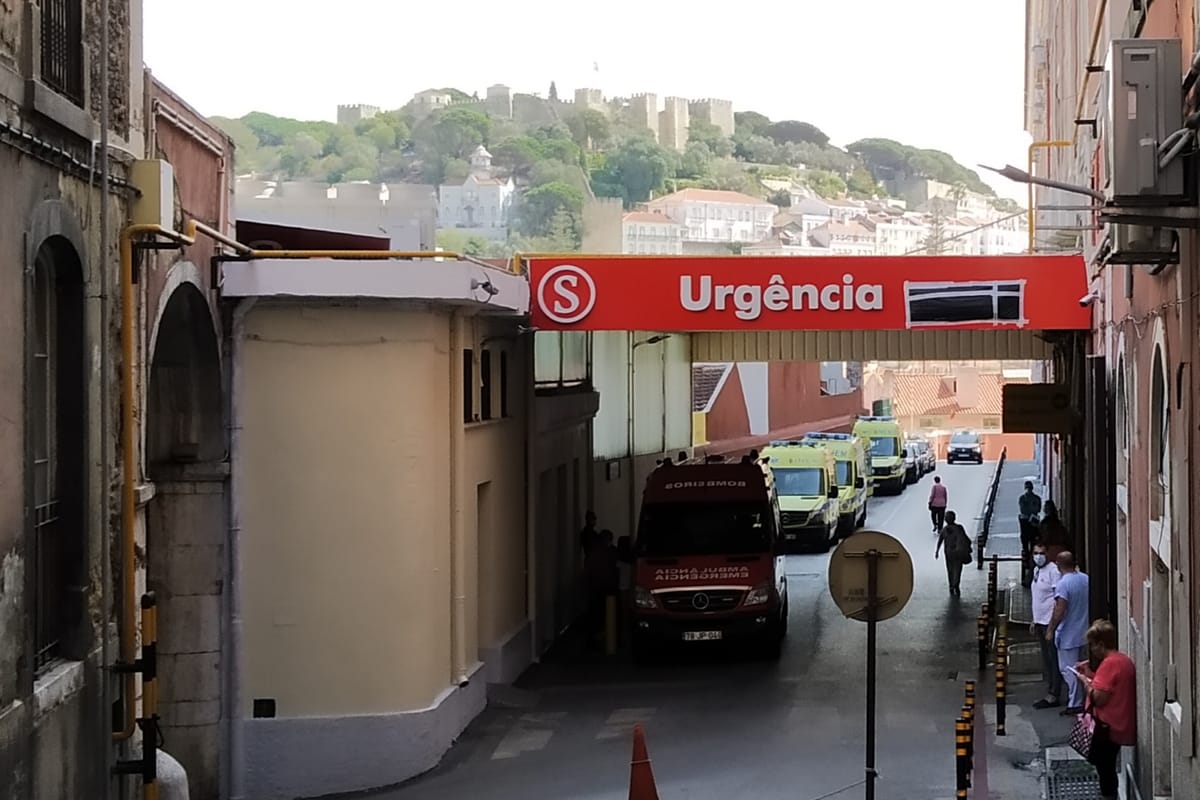
Portugal's health inspectorate has told at least two hospital groups to consider taking payment from non-resident foreigners at the door of the emergency department rather than on the way out, and to build a compulsory check-out point into the discharge route so patients cannot simply walk past the cashier. The recommendations, made over recent months to the Unidade Local de Saúde (ULS, Local Health Unit) do Algarve and the ULS de São José, were described by the Inspeção-Geral das Atividades em Saúde (IGAS, the Inspectorate-General of Health Activities) in a written answer to Observador published on Thursday evening.
Before anything else, a distinction worth nailing down, because it is the one that gets lost. None of this is about foreign residents. The people IGAS counted are pessoas estrangeiras não residentes em Portugal: foreign nationals who do not live here. If you hold a residence permit, a número de utente and a place on a health centre's list, you are inside the Serviço Nacional de Saúde (SNS, National Health Service) on the same terms as anyone else, and none of the measures below is aimed at you.
The survey that started it
The numbers behind the argument come from IGAS's own data collection, published on 29 November 2024 and corrected on 6 December after the ULS de Matosinhos sent revised figures. Between 15 October and 15 November 2024 the inspectorate put a four-question survey to the boards of all 39 Local Health Units, asking how many non-resident foreigners each had treated in its hospital emergency departments, how many of those were not covered by insurance, protocols, international conventions, cooperation agreements or the European Health Insurance Card, and how each unit went about billing and managing them.
The answers produced a four-year series. Non-residents treated in SNS hospital emergency departments: 46,155 in 2021, 89,480 in 2022, 102,252 in 2023 and 92,189 in the first nine months of 2024. The uncovered subset: 16,475, then 35,982, then 43,303, then 45,471. As a share, that is 35.7 percent, 40.2 percent, 42.3 percent and 49.3 percent.
Two caveats belong with those figures, and IGAS states both. The 2024 column stops on 30 September, so it is nine months against twelve and cannot be read as a fall from 2023. And the survey asked for people, not episodes; a high proportion of units answered with episode counts at the first attempt, and had to be sent back to recount. The inspectorate was explicit that the exercise was not an inspection at all. It was a scoping exercise into what it called, in the questionnaire's own words, the thing "it is customary to describe as health tourism", carried out under the organic law of IGAS, Decreto-Lei n.º 33/2012.
What IGAS is now asking hospitals to do
After the survey, IGAS audited the three units with the largest non-resident emergency workload individually: the ULS do Algarve, the ULS de São José and the ULS do Oeste. Two of those audits are finished. In the Algarve, IGAS told Observador, it found 1.2 million euros of care given to non-residents in 2023 and 2024 that was never collected.
The recommendations that followed fall into three groups. The first is the timing of payment. IGAS has asked the units to assess the possibility of charging the emergency fee on entry to the emergency department rather than at the end of the episode, in cases where the patient produces no proof of a third party legally or contractually responsible for the bill. The second is the exit: a revision of the discharge and payment circuit to include a mandatory check-out point that validates the patient's departure and reports it to the administrative desk.
The third is disclosure, and it is the one with the longest reach. IGAS reminded the units that they are already supposed to produce monthly reports on foreign non-resident activity, a duty it traces to a 2001 order signed by the then health minister António Correia de Campos, and said flatly that collecting that information regularly is not the inspectorate's job. It wants those monthly reports to carry the patient number or provisional identifier, nationality, sex and age, occupation where available, habitual residence, and the number, type and nature of the clinical acts performed with the charges they generated. It also wants the units' annual reports, which are public documents, to include a chapter on unpaid invoices linked to foreign patients, how old those invoices are and what has been done to recover them.
What a Portuguese emergency department actually costs
The prices themselves are not a matter of hospital discretion. They sit in Portaria n.º 274/2026/1 of 25 June, published in Diário da República n.º 121/2026, which approved the current regulations and price tables for institutions integrated in the SNS. Article 17 fixes the price of an emergency episode at 115 euros in a Serviço de Urgência Polivalente, 88 euros in a Serviço de Urgência Médico-Cirúrgica and 52 euros in a Serviço de Urgência Básica. An attendance at a Serviço de Atendimento Permanente or a Centro de Atendimento Clínico is 37 euros.
Those are floor prices. Diagnostic and therapeutic procedures listed in Annex III are added on top, as is transport. Three billing rules in the same article are worth knowing. If the emergency visit ends in an admission and the patient stays 24 hours or more, the emergency episode is not billed separately; the clock for the inpatient stay starts at the moment of arrival in the emergency department. Where a unit runs more than one type of emergency service and the patient is transferred between them, only the more differentiated episode can be billed. And a second emergency episode within 24 hours of discharge from the first, for the same medical cause, is billed only once, unless the first discharge was against medical advice.
IGAS had asked the Administração Central do Sistema de Saúde (ACSS, the Central Administration of the Health System) to review whether prices matched the real cost of care, particularly under heavy caseload. The inspectorate told Observador that the 2026 portaria is the answer to that recommendation. The movement it produced was modest: on Observador's comparison with the previous table, three euros on the polyvalent tariff, two on the medical-surgical and one on the basic.
Bilateral agreements, and a point about fairness that cuts the other way
The recommendations to ACSS are less about collection and more about plumbing. IGAS wants the agency to analyse which nationalities are turning up in which emergency departments, so that Portugal's bilateral health agreements can be matched to where the demand actually is, and to update the map of access flows and responsible paying entities in the official reception manual for foreign citizens so that it reflects the agreements currently in force. The gap is real: in the São José audit, the most represented region in obstetric emergency attendances was South Asia, covering countries such as India, Nepal, Pakistan and Bangladesh, with which Portugal has no protocol at all.
One further recommendation runs in the opposite direction to the rest, and is easy to miss in a story framed around unpaid bills. IGAS asked ACSS to reconsider how patients triaged green ("pouco urgente") and blue ("nada urgente") are redirected to primary care, so as to bring the rights of non-resident foreigners into line with those of residents and, in the inspectorate's words, to counter the discrimination that currently exists between the two. A non-resident sent away from an emergency department does not have a family doctor to be sent to.
Hospital administrators are unconvinced
The Associação Portuguesa de Administradores Hospitalares (APAH, the Portuguese Association of Hospital Administrators) told Observador the measures will not achieve much. Its president, Xavier Barreto, put the objection to the check-out point plainly: if patients at the exit say they cannot pay, as they usually do, what happens next? Are the police called, and to what end?
On disclosure he agreed, saying publication makes sense if only to establish the size of the problem and its effect on hospital accounts. His own preference is to push collection towards embassies, so that countries whose nationals generate repeated unpaid bills are brought into a conversation about it. He also warned about the corrosive effect of leaving the bills unpaid, describing a legitimate sense of injustice that the Portuguese pay and arrivals do not.
The political context is not new either. In February 2025 the health minister, Ana Paula Martins, told the parliamentary health committee that recovering the cost of care had been unviable for a relevant percentage of non-residents, naming the Oeste, the Algarve and the Hospital Fernando Fonseca, and said the government was studying management mechanisms to improve it. That hospital, whose new president put the foreign share of its patients at around 40 percent last week, is the same one now at the centre of the debate.
What this means for you
If you live in Portugal with a residence permit. Nothing here changes your position. You are a user of the SNS, you pay the same taxas moderadoras as a Portuguese citizen where they apply, and the emergency prices above are the inter-institutional tariff for people outside the system, not a bill you will be handed.
If you are visiting from another EU or EEA country or Switzerland. Carry the European Health Insurance Card. It is precisely the document that moves you out of the uncovered 49.3 percent, and it is free to request.
If you are visiting from anywhere else. Travel insurance is the only thing standing between you and the full tariff, plus procedures. A single polyvalent emergency visit with imaging and bloods will comfortably exceed the 115 euro headline.
If you are newly arrived and not yet registered. Get on a health centre's list as soon as your residence paperwork allows. Until you do, an emergency visit can be processed as a non-resident attendance, and the rules about when an urgência visit is free turn on being inside the system.
None of the recommendations has the force of law. IGAS recommends; the units and ACSS decide whether to act. Whether a check-out desk appears at the exit of the Algarve's emergency department is now a question for its board.