Forty Percent of the Patients at Amadora-Sintra Are Foreign Nationals, and the Hospital Has Eight Emergency Doctors Where It Needs Thirty
Sandra Cavaca took over one of Portugal's most pressured hospitals in February. Eleven doctors have left the fixed emergency team, 200,000 people in its area have no family doctor, and it holds 0.8 beds per thousand residents against a national 3.7.
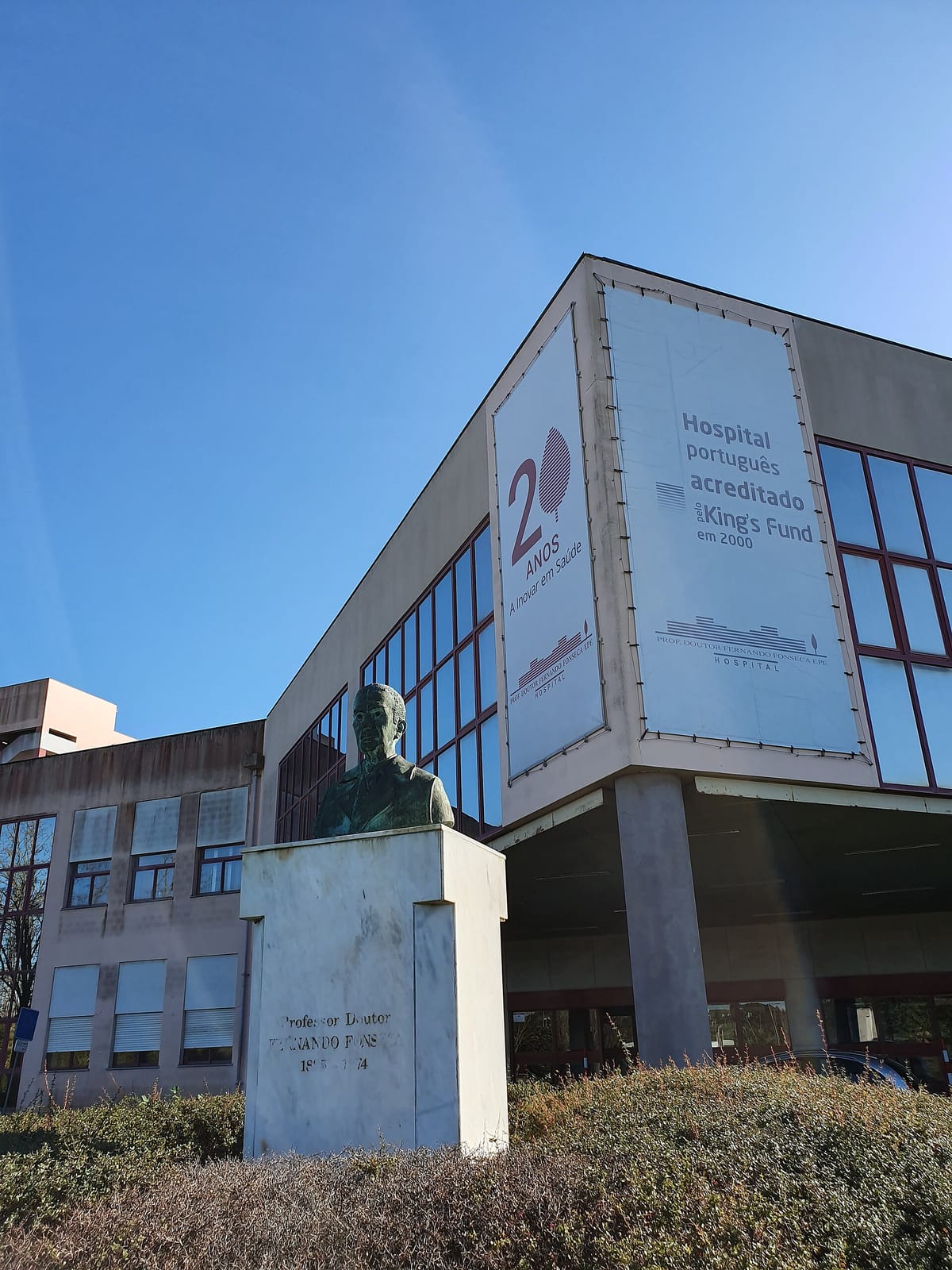
The hospital that serves Amadora and Sintra was built for a population of 300,000. It now answers to roughly twice that, about a third of the people on its books have no family doctor, and its new president puts the share of foreign nationals among its patients at around 40 percent, drawn from 150 nationalities. In an interview published on Sunday night, Sandra Cavaca described a service being held together by improvisation, and gave the numbers that explain why.
The most arresting of them is the smallest. The fixed emergency team at the Hospital Professor Doutor Fernando Fonseca, the unit that keeps the department running, has eight or nine doctors. To run the emergency department normally, Cavaca said, it would need about thirty. Eleven doctors left that team, more than half of it, and the hospital has not been able to replace them. The head of the emergency department left in April and has not been replaced either; the clinical director is covering the job personally, which she called "very heavy".
Cavaca took over the Unidade Local de Saúde (ULS, Local Health Unit) Amadora-Sintra in February 2026, the third board in two years. Asked whether waits of 23 and 24 hours to be seen by a doctor are acceptable, she said they are not. "None of us likes providing a service that does not meet the referral standard of the Manchester Protocol," she said. "The truth is that we face a serious shortage of professionals."
Why eleven doctors left
The departures were not about money. The previous board tried to change the shift pattern of the fixed team, which works 08:00 to 16:00, by creating intermediate shifts covering the late afternoon and night. The doctors opposed it, and the board pressed on. "There was no attempt to reach an agreement," Cavaca said. "Simply giving an order to be carried out is not going to work."
What is left is a department built on locums. Beyond the eight or nine on the fixed team, the cover comes from contracted service providers and from a mobile team of the hospital's own doctors doing rotating stints in the emergency room. Nights are thinner than days, because doctors working 24-hour shifts have to rest. The hospital is now monitoring productivity to see whether more patients can be cleared during the day, on the logic that the fewer people left waiting at nightfall, the less the night team has to absorb.
Recruiting a replacement head of department has failed twice. One candidate from Barreiro took two or three months to decide and then declined. A second, well known in the field, has conditions and has not accepted. Cavaca said the answer may end up being an internal appointment. She also wants a Centro de Responsabilidade Integrada, a management model that allows financial incentives for clinical staff, and says the design is finished but she wants to launch it with a new emergency chief in place. Even with incentives, she was blunt about the market: "even in terms of locum doctors, it is very difficult to get them to want to come and work here."
The plan is to stop people arriving
The measures Cavaca described are almost all upstream of the hospital door.
A Centro de Atendimento Clínico, modelled on the one at Sete Rios attached to Santa Maria, is to open in Amadora. The council has found the space and is refurbishing it. It would run 08:00 to 22:00 seven days a week for non-urgent cases, starting at 100 appointments a day, with the slots released by the ULS itself to the SNS 24 line and the "Ligue Antes, Salve Vidas" scheme. A caller triaged as not needing a hospital emergency gets a booked time at the centre within 24 hours. Cavaca said she wants it running during October.
The same logic is being applied inside the department. Once the information system was updated, the hospital began offering patients triaged blue or green an appointment that day or the next at the new centre or at a health centre, rather than a place in the queue. Since July there has also been a video consultation route for blue and green patients, staffed by external doctors under contract, with the hospital's own nurses taking blood pressure, monitoring symptoms and assisting the doctor remotely. Take-up has been modest. "People do not much like the video consultation," she said. Nobody is turned away: "We never block access."
Two hundred thousand people without a doctor
The reason the emergency department is a front door at all is that about 200,000 people in the ULS area have no family doctor. Cavaca named the health centres where the gap is concentrated: Agualva, Olival, Mira-Sintra, Monte Abraão, São João das Lampas and Algueirão Mem-Martins. They have nurses. They do not, in practice, have doctors, beyond the occasional non-specialist.
The response is six teleconsultation rooms staffed by general practice specialists. "We have an obligation to give them care," she said. On recruitment, the hospital attracted 17 family doctors this year against 60 vacancies, up from 9 the year before. Young doctors who visit, she said, do not like the buildings, and the ULS is asking councils for help refurbishing them. The regional picture is not better: Lisbon and the Tagus Valley added 49,000 people without a family doctor in a year.
0.8 beds per thousand against a national 3.7
Amadora-Sintra has 0.8 inpatient beds per 1,000 residents. Cavaca put the national average at 3.7. She wants about 100 more beds and says the ULS survives only by discharging fast and by contracting beds in other institutions. "We always live in a squeeze, we cannot admit people, we have trolleys in the corridors," she said. "If it were not for that, we would already have collapsed."
The strategic plan proposes a new inpatient building costing 41.42 million euros, and the ULS is looking for outside funds and philanthropy, because the Recovery and Resilience Plan money is gone. Her account of that is the sharpest passage in the interview. The ULS had 70 million euros of Recovery and Resilience Plan funding. When she arrived, 13 million had been spent. Execution was pushed to about 40 million, enough for a new pharmacy and imaging, but not enough time remained to tender and award the rest. The psychiatry building works are stopped. Fitting psychiatry inside the hospital cost orthopaedics 30 beds. "The funds we had, 70 million euros, would have been enough to build the new building," she said. "I am sorry I did not get here earlier."
The bed pressure is partly a social-care problem. When she arrived, 56 beds were occupied by people waiting for a care-home place; that is now 90, after clearing the earlier backlog. The ULS has 12 long-stay continuing-care beds, 30 convalescence beds and palliative beds, 147 in total. Nationally, the queue for a continuing-care bed reached 3,195 this summer.
Immigration, obstetrics and health tourism
Asked directly whether rising pressure is linked to migration, Cavaca did not hedge. "The pressure is great and immigration plays an important role," she said. Most births at the hospital are to foreign nationals. Patients come from 150 nationalities. Communication inside the hospital, she said, often happens through Google Translate, because many patients do not speak English either. "It is a lot of improvisation, but it works."
She then raised what she called health tourism, people travelling to Portugal specifically to get care. "It is difficult. People come and we cannot refuse assistance to anyone. There are many people who arrive at the airport and come here. They already have relatives in the area and they come." She noted that after 90 days a person can reach primary care, and said she doubted the phenomenon was confined to her unit. On obstetrics, asked whether people come deliberately to give birth in the public system, she said: "I have no doubt. They come."
Her framing of the problem was fiscal rather than exclusionary. "I know the Constitution says we have to provide care," she said. "But if we go to other countries, to Switzerland for example, or the United States, if you need care you have to pay for it. There are no emergency rooms where you do not pay. We provide the care, we are obliged to provide it, but then who do we bill? We know who we provided care to; the problem is then tracing it and knowing who is going to pay. Portugal has a different policy, and I am not saying it is wrong." The ULS is also weighing redirecting the population of some parishes to other units.
It is worth being precise about the legal position she is describing, because it is frequently misstated. Base 21 of the Lei de Bases da Saúde (Health Framework Law), Lei n.º 95/2019, makes beneficiaries of the SNS not only Portuguese citizens but also EU nationals, third-country nationals, stateless people, applicants for international protection and migrants "with or without their legal situation regularised", where they hold permanent residence or are in a situation of temporary stay or residence. The hospital is not exercising discretion when it treats them.
What else the interview disclosed
Surgical activity fell between the first half of 2025 and the first half of 2026. Cavaca attributed it to the drop in "additional production", the extra-hours surgical programme, after an ordinance changed the rules and surgical teams stopped. Additional surgery has restarted in ophthalmology and orthopaedics. Asked whether the doctors were right to protest, she said her own calculations showed they would earn the same or slightly more. Waiting lists are growing and she may send work to outside providers.
Orthopaedics and internal medicine are the specialties she named as most short-staffed. Nobody chose orthopaedics in the last competition.
On the Sintra hospital, which is underused, the constraint is nursing. Sixty inpatient beds are built and only ten are occupied. The plan is 12 palliative beds by October and 20 to 30 convalescence beds by the end of the year, with three doctors already identified, plus an internal medicine specialist on 24-hour cover for the basic emergency unit, which currently has only non-specialist doctors. The urology licensing that was missing when the hospital opened is only now being issued.
Cavaca also answered a question about reports that she runs the ULS from Mozambique. She goes three times a year for six or seven days, using her own annual leave, because her husband lives there, and said she always attends board meetings.
The wider context is that almost half a million people in Portugal live more than an hour from an emergency room, and that the problem at Amadora-Sintra is the opposite one: an emergency room that is far too close to far too many people, with eight doctors on the fixed team and winter coming.