Earthquakes Under Portugal's Highest Mountain Push Pico's Volcanic Alert to V1
CIVISA raised the Pico volcano's alert level to V1 on Thursday after a swarm of small earthquakes from 05:48 on the mountain's southern flank. The strongest, magnitude 2.4, was felt at intensity III/IV in São Caetano and Candelária. The alert signals closer monitoring, not an imminent eruption.
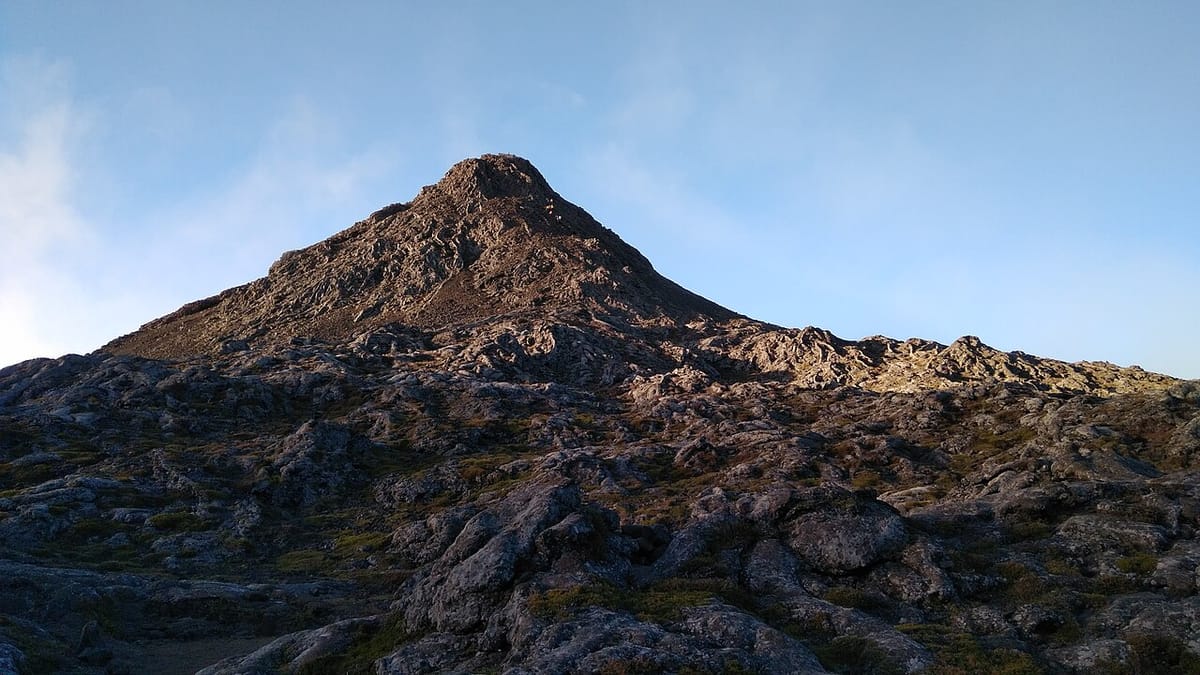
Portugal's highest mountain gave its monitors an early wake-up call on Thursday. From 05:48 local time (06:48 on the mainland), seismometers on Pico island in the Azores began registering a swarm of small earthquakes on the southern flank of the Pico volcano, and by the end of the morning CIVISA, the Azores Seismovolcanic Information and Surveillance Centre (Centro de Informação e Vigilância Sismovulcânica dos Açores), had raised the volcanic alert for the mountain to V1.
The tremors themselves were modest. All of the recorded events were of low magnitude, the strongest a 2.4 on the Richter scale at 05:50, with its epicentre roughly four kilometres north-east of São Caetano, a parish on the island's southern coast. Residents of São Caetano and neighbouring Candelária, both in the municipality of Madalena, felt the shaking at a maximum intensity of III/IV on the Modified Mercalli scale — the level at which hanging objects swing, crockery rattles and the vibration resembles a heavy lorry passing the house, but no damage is expected.
What changed on Thursday is the official reading of the volcano's state rather than any immediate danger. On CIVISA's eight-level alert ladder, which runs from V0 (a volcanic system at rest) to V7 (an ongoing eruption of colossal explosivity), V1 designates a system in a phase of “metastable equilibrium”: activity slightly above reference levels, of tectonic, hydrothermal or magmatic origin, which could intensify — or fade away — at any moment. The classification is a signal to watch more closely, not a warning that an eruption is coming. Unless the picture changes, the V1 alert will stay in place for eight days.
It is the third time this year the central Azores have sat at V1, but the first time the alert has applied to the Pico volcano itself. A swarm of submarine tremors at the Cachorro volcanic system in the Faial-Pico channel kept the strait between the two islands under a V1 alert through April, before CIVISA walked the channel back down to V0 at the start of May — only to restore V1 two weeks later when the submarine line between Madalena and Lagido stirred again. A 4.6-magnitude tectonic quake off São Jorge in May was felt across the entire central island group. The archipelago sits on the boundary of three tectonic plates, and this rhythm of unrest and stand-down is part of Azorean life.
Still, the mountain in question is no ordinary hill. The Pico stratovolcano rises 2,351 metres straight out of the Atlantic — the highest point in all of Portugal — and last erupted in the early eighteenth century, when lava flows reached the island's southern shore not far from the parishes that felt Thursday's tremors. Today the summit climb is one of the Azores' signature tourist experiences, at the height of a season in which extra summer flights are ferrying visitors from Lisbon directly to Pico. No restrictions on the mountain trail or on daily life had been announced as of Thursday evening; for now, the volcano is simply being watched more closely, and CIVISA will issue updates if the seismic pattern shifts.