Two Emergency Ambulances in Every Council That Has None: The Terms INEM's Technicians Take Into Wednesday's Ministry Meeting
STEPH's strike notice for 14 and 28 September asks INEM to keep all 56 emergency ambulances, drop the plan to turn life-support ambulances into cars, and open two emergency ambulances in every council without one by the end of 2027. Only five councils have two or more today.
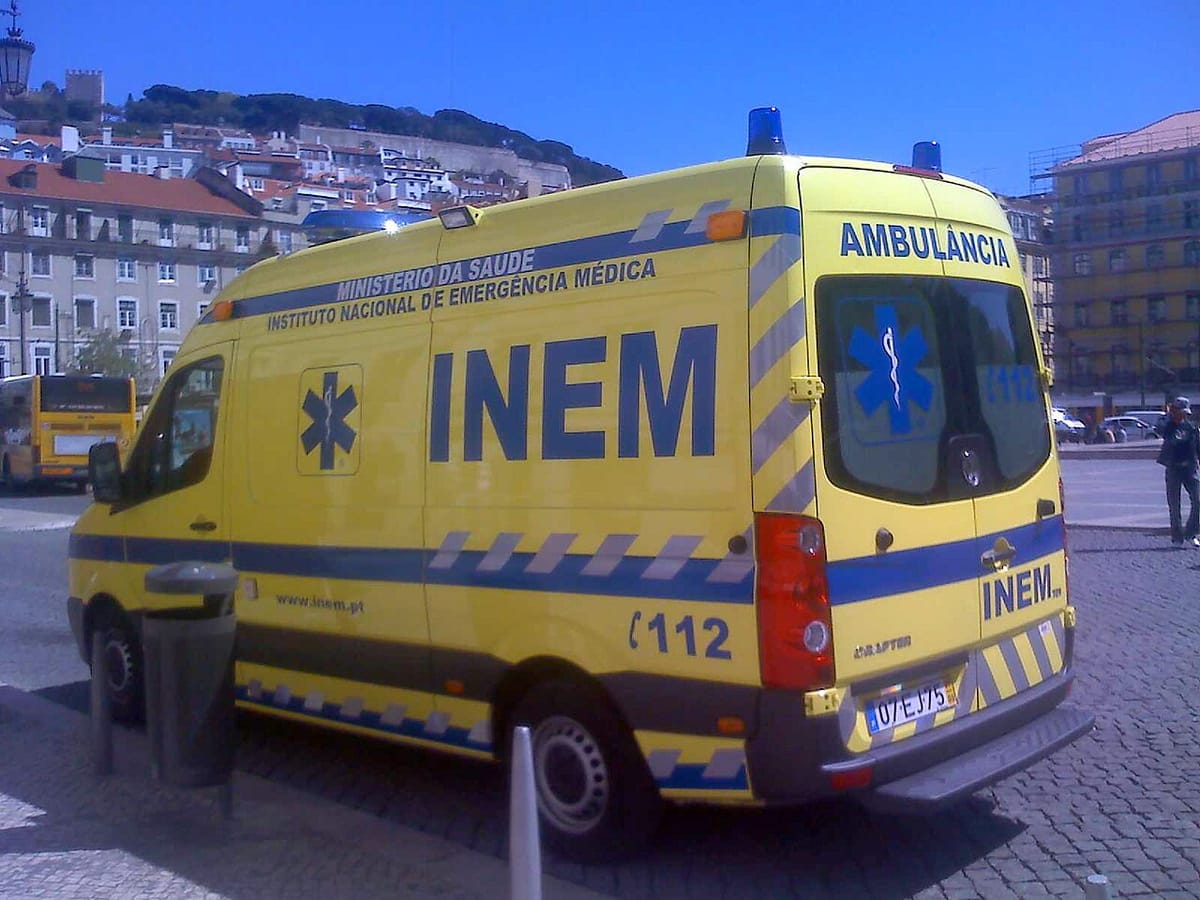
The union representing Portugal's pre-hospital emergency technicians sits down with the Health Ministry on Wednesday carrying a list of conditions, and at the top of it is a number: two emergency ambulances in every council that currently has none, open by the end of 2027.
The conditions come from the strike notice filed by the Sindicato dos Técnicos de Emergência Pré-Hospitalar (STEPH), which calls two stoppages, on 14 and 28 September. Lusa has seen the document. The meeting is set for 26 August at the Health Ministry, and the union has said it would pull back from the strike if the measures it objects to are changed.
What the technicians are asking for
Three demands carry most of the weight.
The first is that INEM abandon its plan to convert Suporte Imediato de Vida (SIV) ambulances into light vehicles. An SIV carries a technician and a nurse; turning it into a car removes the ability to transport the patient at all. The second is that all 56 Ambulâncias de Emergência Médica (AEM) currently in service stay in service. The third is the expansion: a government commitment to open, by the end of 2027, at least two emergency ambulances in every municipality that does not have one.
That last point rests on a figure worth pausing over. According to the union, only five councils in the country have two or more Ambulâncias de Emergência Médica. Most municipalities are covered by fire brigade vehicles rather than by INEM's own emergency ambulances.
Beneath the headline demands sits a set of operational requests. STEPH wants a despacho published to govern how SIV ambulances and partner vehicles (fire brigades and the Red Cross) work together: where a patient needs clinical accompaniment, the transport should be by SIV, with technician and nurse aboard; where no accompaniment is needed, the fire brigade ambulance should take the patient so the SIV stays free for the next call. The union also wants a rule that only two ambulances are dispatched when the vehicle arriving first is the less differentiated one, and a written commitment from INEM that call triage at the Centros de Orientação de Doentes Urgentes (CODU) will continue to be done entirely by pre-hospital emergency technicians.
What INEM is actually changing
The reorganisation that produced the dispute has two visible parts: transferring management of the Ambulâncias de Emergência Médica to the Unidades Locais de Saúde, and converting the existing SIV ambulances into light vehicles. Both were among the measures announced in July that INEM's unions called a dismantling, and which prompted the September strike call earlier this month.
INEM's position has not moved: the institute has repeatedly denied that its planned measures reduce the pre-hospital response. The technicians say the opposite, that they cannot go along with measures that could damage the quality and effectiveness of the emergency medical system.
The minimum services set for the two strike days include 80 percent of the workers rostered to the CODU on the date of the notice. For the field units, the union proposes keeping running those means that operate continuously, 24 hours a day, seven days a week.
What This Means for Expats
- Two dates to note: 14 and 28 September. Both are Mondays. Emergency dispatch keeps 80 percent staffing and round-the-clock units continue, so 112 works normally, but response on non-continuous means may be slower.
- The ambulance that reaches you is often not INEM's. In most Portuguese municipalities the vehicle sent to a medical emergency belongs to the local fire brigade. That is the structural fact behind this dispute, not a failure on the night.
- Nothing is decided yet. Wednesday's meeting is the point at which the strike either firms up or is called off. Watch the outcome rather than the notice.
- Call 112 regardless. Triage happens at the CODU, and the union's own demand is that it stays fully staffed by trained technicians. Do not self-triage or drive yourself to a hospital to avoid a strike day.