Three Unions Set 2 October as the Strike Date for Portugal's 350,000 General-Career Public Workers
The national public services federation, STAL and the Lisbon municipal workers' union have called a joint stoppage for Friday 2 October, plus an 11am demonstration in Lisbon, demanding pay talks open now rather than in 2027.
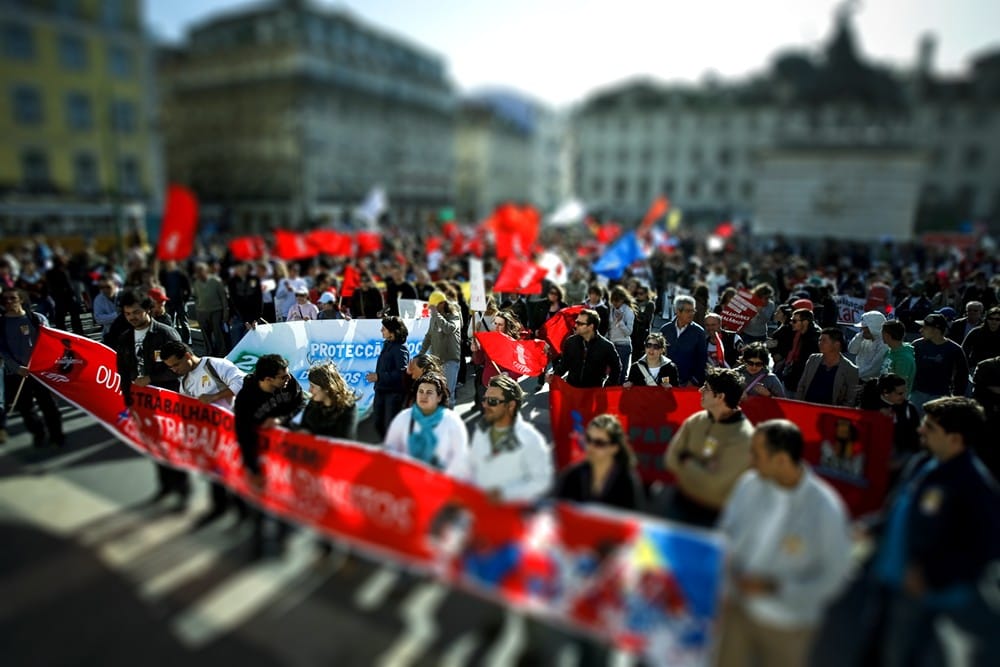
Three public administration unions affiliated to the CGTP have called a strike for Friday 2 October covering the general careers of the Portuguese public service, a group they put at roughly 350,000 workers. The date was announced on Tuesday at a press conference in Lisbon, alongside a demonstration in the capital on the same day at 11am.
The strike is called jointly by the Federação Nacional dos Sindicatos dos Trabalhadores em Funções Públicas e Sociais (National Federation of Public and Social Service Workers' Unions), by STAL, the Sindicato Nacional dos Trabalhadores da Administração Local e Regional, Empresas Públicas, Concessionárias e Afins (National Union of Local and Regional Administration, Public Enterprise and Concession Workers), and by the Sindicato dos Trabalhadores do Município de Lisboa (Lisbon Municipal Workers' Union).
Who is covered
"General careers" is the technical term that matters here. It covers the assistant, technical assistant and senior technician grades that make up the bulk of the administrative workforce, as distinct from the special careers held by teachers, nurses, police officers and inspectors. Joaquim Ribeiro, a leader of the national federation who spoke for all three organisations, described them as "the worst paid in the public administration."
The stoppage reaches across central government, both direct and indirect administration, and across local and regional administration: front-desk public services, municipal departments, refuse collection and school non-teaching staff. Ribeiro's forecast was blunt: "We are certain it will be a big public administration strike, with thousands of public services closed, thousands of schools closed, and disruption to refuse collection."
What the unions want
The three organisations are asking for three things:
- An immediate upgrading of general-career pay scales.
- Formal recognition of the specific characteristics of these professions, which shapes how careers are graded and progressed.
- Salary negotiations opening now, rather than waiting for the next negotiating round.
That third demand is the crux. The strike is framed as "an urgent alert to the Government" that, in Ribeiro's words, it "cannot wait until 2027" to begin. He accused the government of Luís Montenegro (PSD/CDS-PP) of having spent the past two years "always leaving general-career workers until last," and acknowledged that a stoppage on this scale "will create disruption for the population," while arguing that "workers are also striking so that the public service is better delivered."
The 2 October date is not accidental. Public sector pay talks for the 2027 State Budget are expected to open in October, and the other main union blocs are preparing their own demands for higher rises, a larger meal allowance and career revaluation. Calling a national stoppage in the opening days of that cycle sets the terms before the first meeting rather than after it.
What This Means for Expats
- Plan around 2 October: If you have an appointment at a Loja do Cidadão, a conservatória, a câmara municipal or a tax office that day, expect it to be at risk. Book before or after where you can.
- Deadlines do not move: A strike does not automatically extend an administrative deadline. If something is due at the start of October, file it early rather than assume an extension.
- Schools: Expected closures come from non-teaching staff rather than teachers. Canteens, cleaning and supervision are the pinch points, so a partial-day closure is as likely as a full one. Municipal refuse collection is also in scope, usually the most visible effect in dense city centres.
- If you work in the public sector: Striking is an individual right; participation is not compulsory and needs no advance declaration, though pay is deducted for the period of the stoppage.
This is now the second significant public sector stoppage on the autumn calendar, after INEM's emergency technicians confirmed strikes for 14 and 28 September. Both disputes turn on the same underlying argument about whether pay talks open in 2026 or are pushed into the 2027 budget. The government has not yet responded publicly to the 2 October call, and it has a month in which to decide whether opening negotiations early is cheaper than a shutdown.